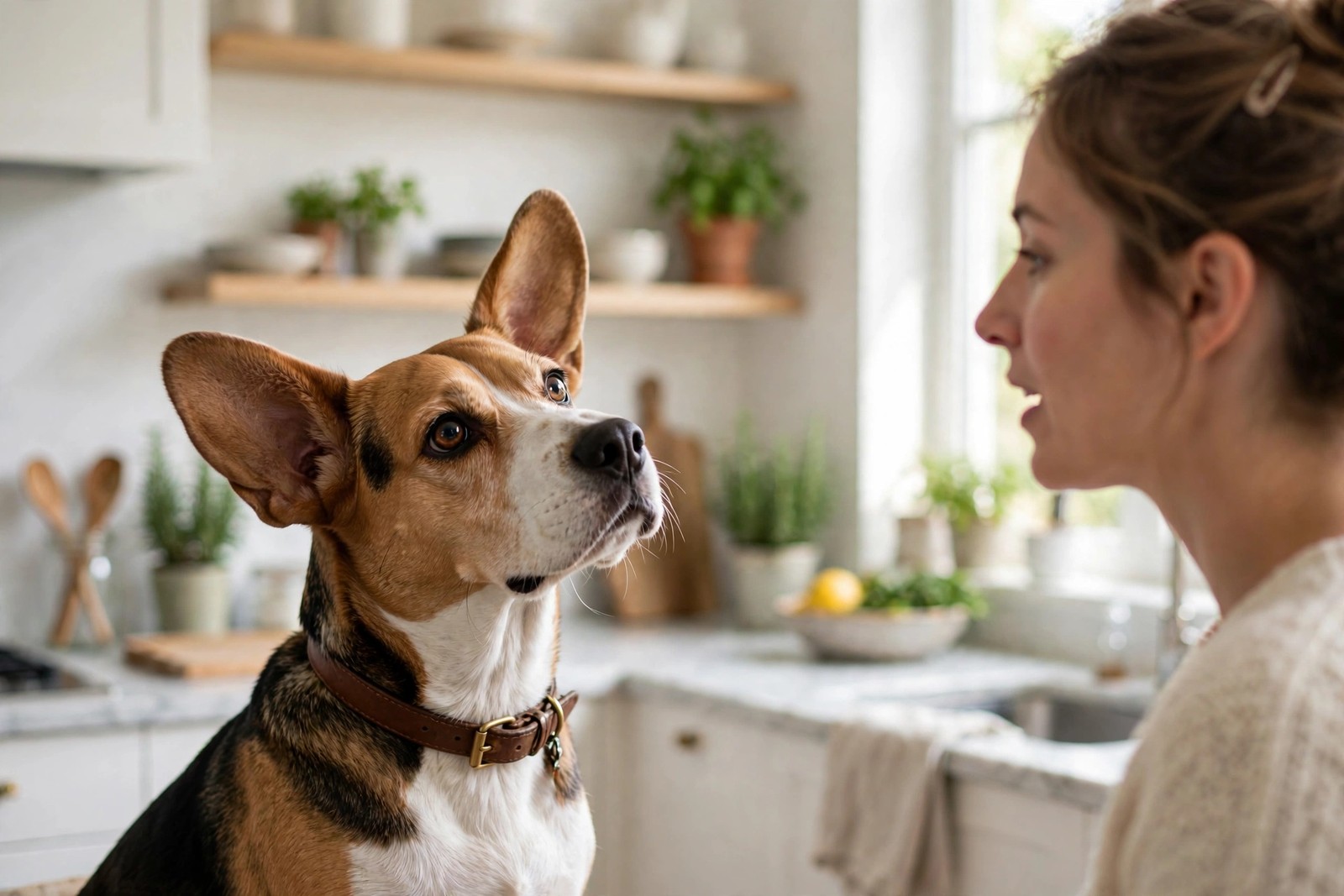
He tilts his head because he is listening hard, not because he understands grammar. Dogs typically learn words by shape, sound, tone, and what happened next. A word that has often been followed by food, a walk, or an interesting visitor becomes significant in any language, so 'dinner' spoken in another language still arrives in a dinner voice, at dinner time, near the kitchen. Tilting adjusts his ear flaps and helps him locate the sound, while perked ears show attention rather than obedience.
How a word earns a head tilt
Think of his vocabulary as a list of sounds with histories, not a dictionary of definitions. 'Dinner' in English, in another language, or even in a playful sing-song voice can carry the same history if the same things followed it: a bowl being lifted, a fridge door opening, footsteps toward the kitchen, and then food. Context does much of the work. The same sound spoken flatly in a different room, with no kitchen cues and no meal following, often earns a smaller reaction or none at all, which tells you he is reading the whole scene, not translating a single word.
Head tilting itself is practical listening. Dogs hear a wider range of sounds than people do, and a tilt changes the angle of the outer ear and helps the brain compare what each ear receives. That comparison helps him place a sound in space and pick a familiar voice out of background noise. Some dogs tilt more than others, and dogs with upright ears, floppy ears, or a broad head may tilt at slightly different angles, but the tilt is a listening adjustment, not a sign of confusion or a request for a translation.
Why non-commands can matter more than commands
Set cues are taught deliberately, with repetition and reward, yet everyday words often carry stronger histories because they were never drilled and were always followed by something real. 'Dinner', 'walk', 'park', and the name of a favourite person can therefore produce a sharper tilt and a brighter expression than a formal command the dog hears in training sessions. Tone adds another layer. A rising, warm tone that usually precedes something pleasant will perk his ears even when the words are unfamiliar, while a flat or sharp tone that usually precedes nothing interesting may leave him still.
That is also why a word in another language works. He is not recognising the language; he is recognising a familiar sound shape, a familiar voice, and a familiar moment. Change one cue at a time if you want to test what he actually knows, and watch his body rather than waiting for a word-perfect response.
Using his listening without confusing him
Keep his significant words consistent across the household. If one person says 'dinner', another says 'tea', and a third says a foreign word for the same meal, he will learn three cues for one event, which is workable but wasteful, and he may start tilting at partial sounds that resemble any of them. Choose one word per event for daily use, keep the tone friendly, and pair the word with the event itself rather than repeating it until he loses interest. Say it once, then let the bowl, the lead, or the door do the explaining.
A sudden change in listening deserves attention. If a dog who once tilted eagerly stops responding to familiar words, tilts only to one side, shakes his head, scratches at an ear, or shows a head tilt that stays fixed rather than coming and going with sounds, mention it to a vet, because ear discomfort or hearing change is a health question, not a training puzzle. KinsLe's Care Teams helps keep his cues and responses consistent, because the household words, tones, and daily routines for this dog can be written down once, shared with every family member, and updated whenever a cue changes.