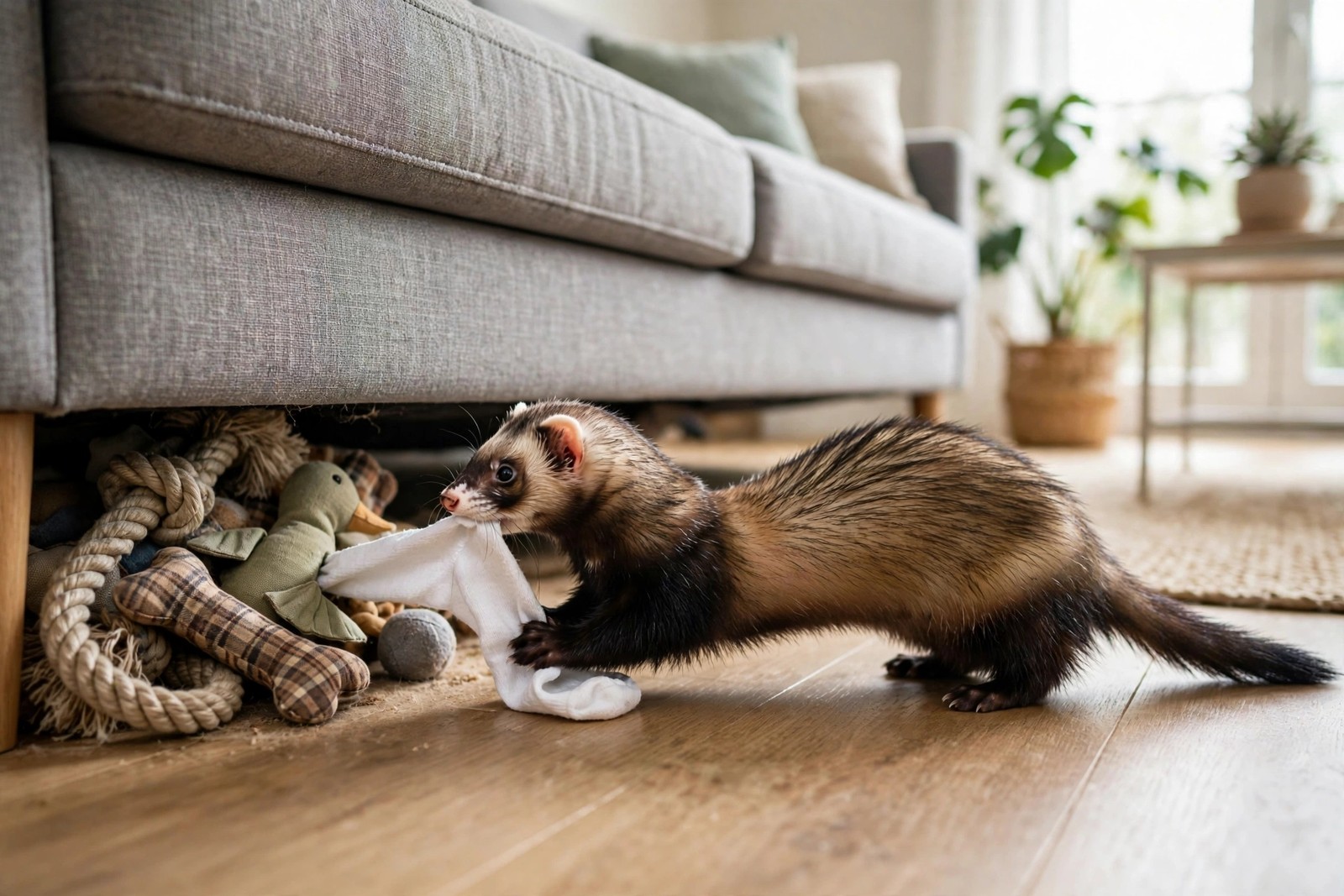
Your ferret is not stealing to annoy you. Your ferret is caching, a deep instinct from wild ancestors that tucked surplus food away in burrows and hollow logs to return to later. A pet ferret rarely needs to store food, so the same drive lands on objects instead. Carrying, dragging, and hiding things is satisfying work for a ferret, and a finished stash gets visited, rearranged, and defended with real pride.
Why Some Objects Get Chosen
A ferret picks for feel, sound, smell, and novelty. Soft personal items that carry your scent, such as socks, gloves, and folded laundry, are frequent targets. So are shiny or rattling things like keys and bottle caps, squeaky toys that respond when bitten, and smooth items that slide easily across the floor. Size matters too. A ferret favors anything that fits in the mouth or can be hauled backward while shuffling, and a new object often outranks a familiar toy simply because it is new. Once an item joins a stash, your ferret may move it between hiding places for days, testing which spot feels safest.
Favorite spots repeat for a reason. Ferrets like dark, tight, low places close to a wall or under cover: under a sofa, behind a dresser drawer, inside a closet corner, under a bed, or tucked behind stored boxes. Finding one stash usually means finding the main one, but most ferrets keep a smaller backup stash as well, often near the cage or play area.
Making the Habit Safe
You cannot train the instinct away, and scolding a ferret for finding a stash only teaches wariness around you. Work with the drive instead. Ferret-proof the favorite spots first: block gaps behind heavy furniture where a ferret could get trapped, check under recliners before sitting, and empty known stashes daily so you know what has been collected. Look closely at anything damaged during that check.
The safety line is about materials that break into swallowable pieces. Foam inserts, rubber erasers, soft plastic, and spongy toy parts can be chewed apart, and a swallowed piece can block the intestine, which is an emergency. Keep those materials out of any room where your ferret roams, choose stash toys made from sturdy fabric or hard, solid materials with no loose parts, and inspect them often. A ferret that may have swallowed foam or rubber, then stops eating, vomits, strains, or turns unusually quiet, needs a vet promptly rather than a wait-and-see night at home.
Offer a sanctioned alternative and the raids shrink. Give your ferret a digging and stash box filled with clean fabric strips, balls, and dedicated toys, and let carrying them away be the game. Rotate a few of those sanctioned stash toys each week so novelty returns without new household losses, and praise the drop when a forbidden item is traded for an approved one.
A Household List That Prevents Losses
Stashing causes the most friction when only one person knows the map. One family member finds keys under the couch, another keeps leaving foam packing in reach, and a child keeps offering a soft eraser as a toy. Write the system down once: the two or three main stash spots to check before blaming a loss, the backup spot, and the hazard list of foam, rubber, and soft plastic that never enters ferret rooms.
Put names to the jobs as well. Dana checks the main stash each evening and returns personal items to a closed drawer, Luis sweeps play rooms for packing material after deliveries, and everyone follows the same trade rule instead of chasing and grabbing. When the list lives where the whole household can see it, a visiting sitter can follow it too, and fewer treasures vanish for good.
That written map stays useful longest when KinsLe holds it alongside the ferret profile, since the Family Sharing access lets each household member review identical stash locations and hazard notes before free-roam time begins.