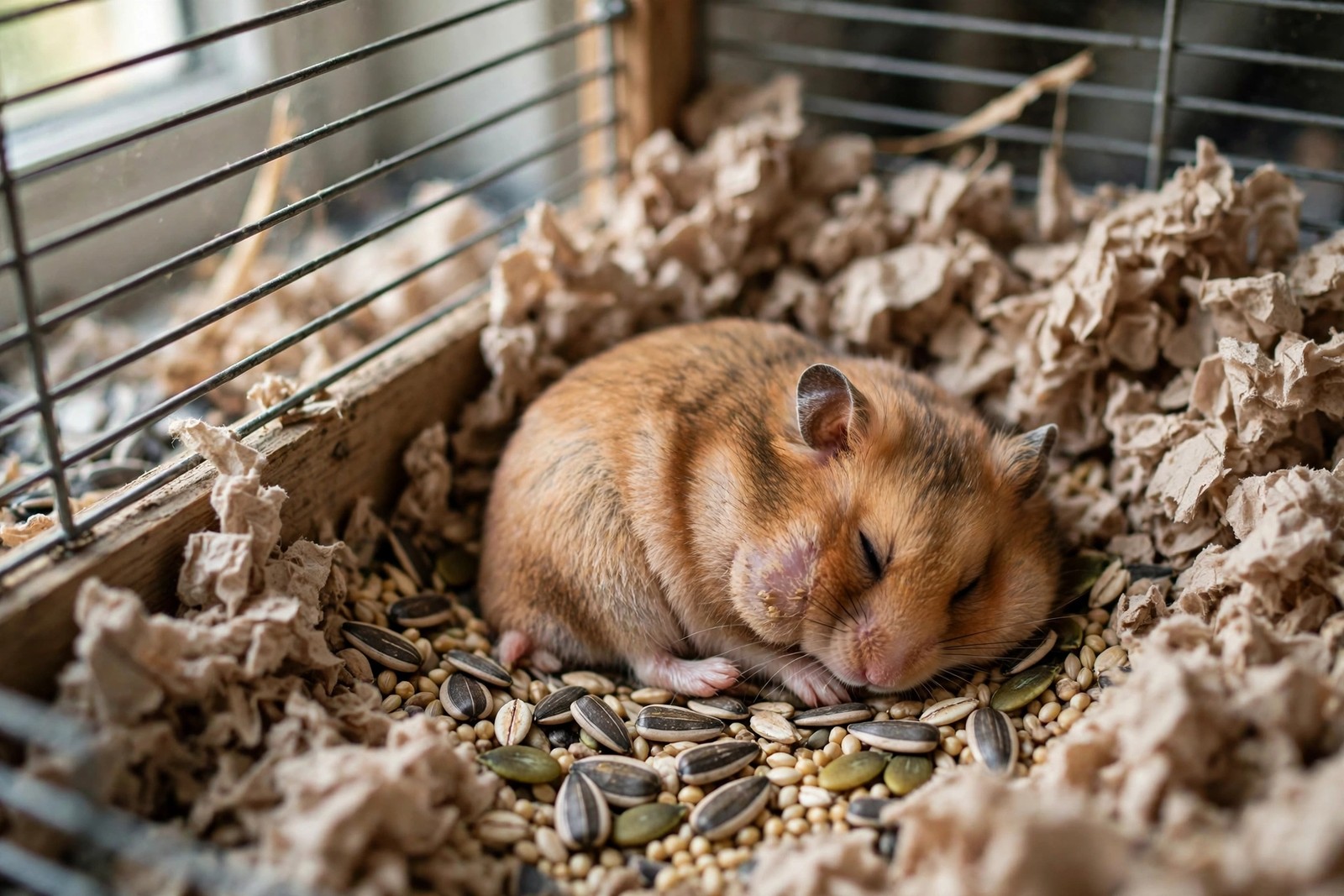
That nightly picture — a hamster curled asleep on top of a mound of seeds it carried to bed piece by piece — looks like a quirk, and it is actually the most ancient behavior in the cage. Wild hamsters are solitary foragers in dry country where food appears in patches and vanishes fast. The winning strategy is to gather far more than you can eat, carry it home in expandable cheek pouches, bury it in the nest chamber, and sleep on top of it. Your hamster is running that exact program, correctly, in a cage where dinner arrives on schedule.
Cheek Pouches and the Cache
The work starts at the food bowl. A hamster stuffs its pouches until its head looks twice its normal width, carries the load to the nest, and empties the pouches with a squeezing motion of its front paws. What looks like greed is transport: the hamster is not eating that food now, it is banking it. Over days the bank grows into the pile you find under the bedding, often mixed and sorted in a way only the hamster fully understands.
Caching is also why a hamster may seem to eat almost nothing from the bowl at feeding time and still thrive. Much of the day's intake happens later, in private, from the store.
Sleeping on the Pile Is Guard Duty
Sleeping directly on the hoard is the second half of the instinct. In the wild, a stored meal attracts mice, insects, and rival hamsters, and the owner's body is the lock on the door. A hamster asleep on its cache can feel movement in the pile, wakes instantly to interference, and loses nothing while it sleeps through the vulnerable hours.
This is also why a hamster can react with real alarm when a hand rearranges the nest. From the hamster's side, something large is reaching into the food reserve it depends on, in the one place it should be safest.
The Keeper Rules for the Hoard
Rule one: never raid the hoard in front of the hamster. Scooping out the pile while the hamster watches, or worse, while it is sitting on it, reads as theft of its survival store and can damage trust in your hands for a long time. If you must inspect the nest, do it while the hamster is out exercising or busy at the far end of the cage.
Rule two: during cleaning, quietly remove only perishable fresh food. Pieces of carrot, apple, or other fresh foods tucked into the hoard will spoil, mold, and foul the nest, so those come out discreetly as part of routine cleaning. Dry seeds, pellets, and grains keep well and stay — put the bedding and the dry store back as close to how you found them as you can, so the hamster returns to a nest that still feels like its own work.
Rule three: support the instinct instead of fighting it. Deep bedding lets the hamster burrow and cache properly; for a Syrian hamster, bedding depth of at least about 10 inches in at least one area gives room for real tunnels and a proper buried store. A hamster that can cache well is a calmer hamster, and scattering some food in the bedding to be gathered and pouched gives the foraging drive honest work.
Household Duties That Respect the Hoard
Write the hamster's care plan down with the household: one named person handles feeding and scatter-foraging, another handles cleaning on the agreed day — with the hoard rules written on the plan itself — and everyone agrees that children check with the cleaner before 'tidying' the nest as a surprise. The rule that protects the hoard only works if every pair of hands in the house knows it. Written down once, the plan protects the hoard on every cleaning day, and KinsLe makes those duties easy to hand over because Care Teams assigns them to named household members.