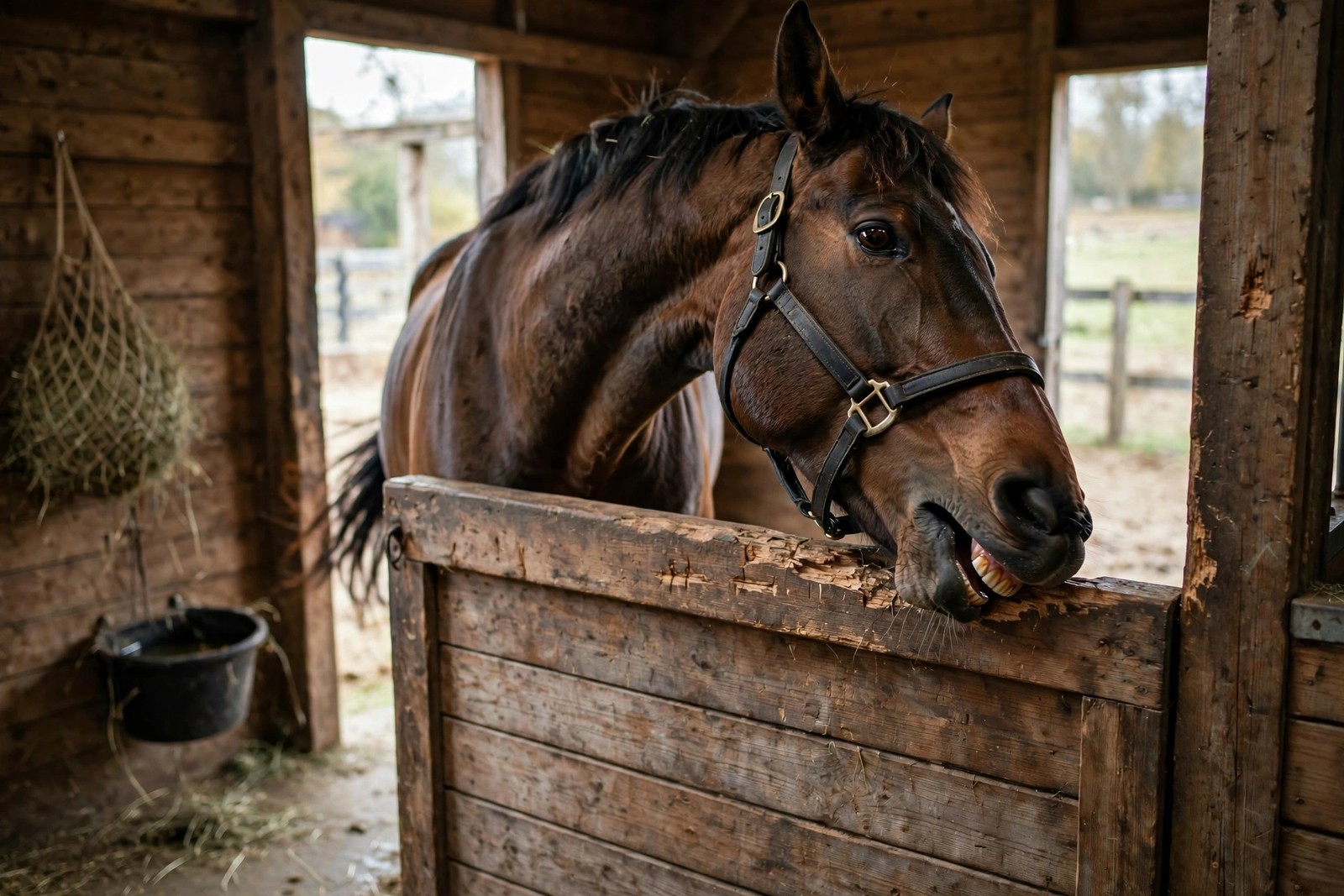
Crib-biting and weaving belong to a family of behaviours called stereotypies: repetitive, apparently purposeless actions that horses develop as a way of coping when their environment blocks strong natural drives. A crib-biting horse sets the upper teeth on a fixed surface, a door edge, rail, or post, arches and tenses the neck, and pulls back, often with an audible grunt as air moves into the throat. A weaving horse stands and sways, swinging head, neck, and shoulders from side to side and rocking weight between the front feet, commonly over the stable door at the busiest times of day.
The Stable Life Behind the Behaviour
Neither behaviour is naughtiness, and neither is a horse copying a neighbour for fun, though horses on the same yard often share them because they share the management that produces them. The common background is long hours in a stable set against a horse built to move and graze for most of the day. Limited forage is central: a horse's stomach produces acid continuously and expects a near-constant flow of chewed forage, so hours with an empty hay net mean both hunger frustration and an uncomfortable stomach. Concentrate-heavy feeding with long gaps, little turnout, isolation from companions a horse can see and touch, and early or abrupt weaning all raise the risk. Vets frequently find stomach discomfort in the background of crib-biting in particular, which is one reason the behaviour often peaks just after meals.
Once established, a stereotypy can become a habit that persists even after management improves, much like a person still pacing after the stressful situation has passed. That persistence is not a reason to give up on the management changes; the horse's overall frustration load still falls, and the behaviour usually reduces in frequency even when it never disappears entirely.
Real Costs Worth Knowing
Crib-biting wears the front teeth unevenly, which can eventually affect grazing, and committed cribbers may struggle to hold condition. Weaving works the front legs, joints, and hooves asymmetrically for hours a day, wears stable bedding and flooring into ruts, and burns energy a horse in work can ill afford to waste. Both behaviours also read as a welfare signal about the routine, which is why buyers and yards take them seriously.
Management That Actually Helps
Start with the causes, in this order. Maximise turnout, ideally with companions, and bring forage close to continuous: hay available through most of the stabled hours, split into several nets or slowed with a small-hole net so it lasts. Feed concentrates little and often if they are needed at all, and never leave a horse facing a long empty stretch before a meal. Give stable life some texture: a view of other horses, contact over a grille or partition, varied forage positions, and a predictable routine, since weaving often spikes around feeding and turnout times when anticipation runs high.
Have a veterinarian examine a horse who cribs or weaves, to check teeth, weight, and whether stomach discomfort should be investigated, and to advise before anyone reaches for a cribbing collar or anti-weave fittings. Physical prevention without fixing the cause simply removes the coping behaviour and leaves the frustration. Punishing the horse is worse than useless for the same reason.
Holding the New Routine Together
Stereotypy management succeeds on consistency: turnout that happens daily, nets that never sit empty for hours, and feeding times that do not drift. On a shared yard that is a team effort, not one person's memory. KinsLe's Care Teams lets the yard assign turnout, hay-net, and feeding duties for your horse to named helpers with timestamps on completion, so the forage-first routine that keeps cribbing and weaving down survives busy weekends and holidays.