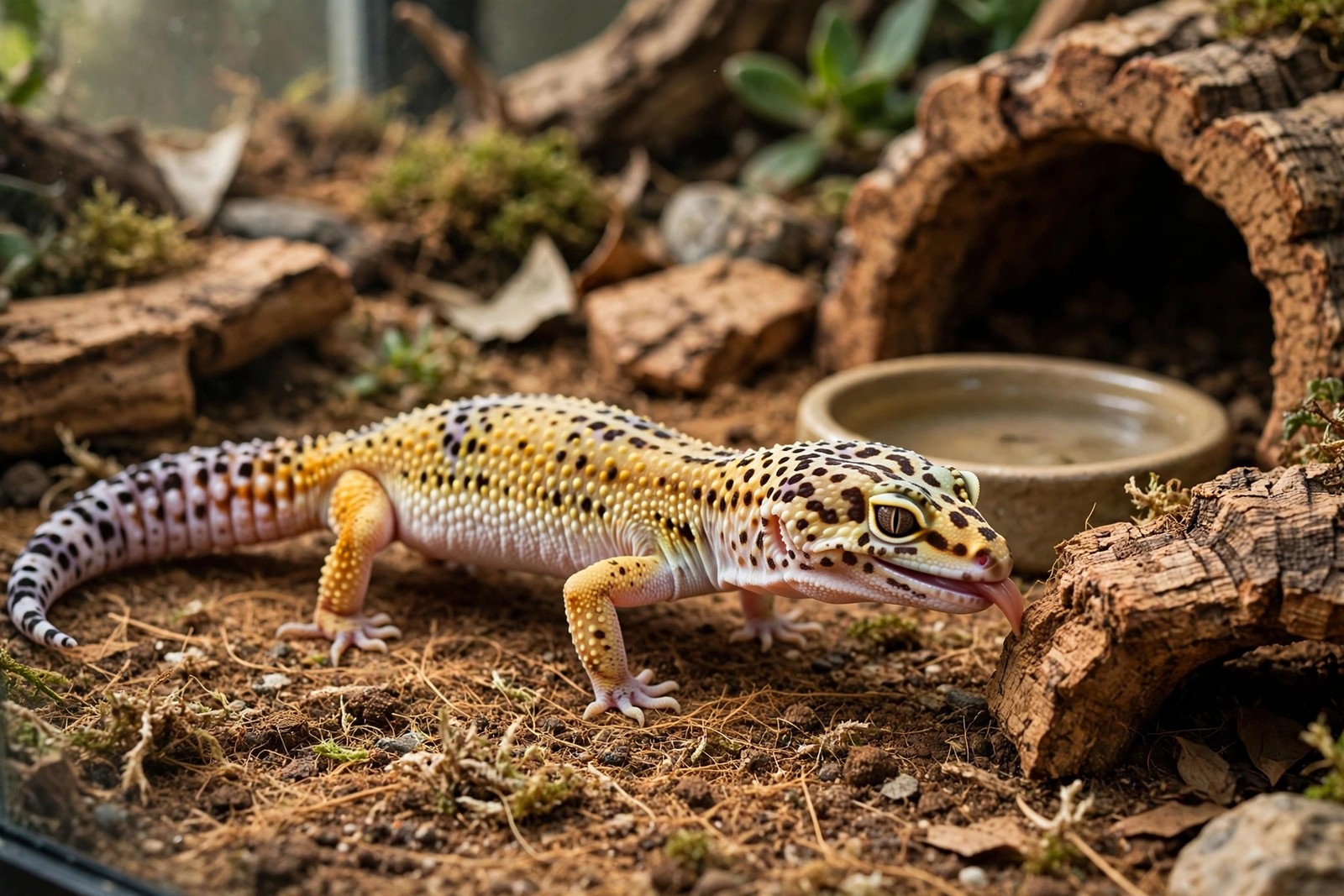
Watch a leopard gecko explore and you will see the tongue working constantly — flicking over the floor, the hide entrance, a piece of bark, your fingers. This is not random, and it is not a sign your gecko is hungry for the furniture. Licking is a leopard gecko's main investigative tool, the way the animal gathers detailed information about a world it experiences largely through scent and taste.
Chemosensory sampling: a tongue that reads
A leopard gecko's tongue picks up microscopic scent particles from whatever it touches and carries them to a specialised scent organ in the roof of the mouth, often called the Jacobson's organ. The brain reads those particles as a detailed chemical picture: what has walked here, whether this surface is familiar, whether food passed this way, whether another gecko is near. Poor eyesight for fine detail makes this system essential, so a healthy, curious gecko in a changing environment licks a great deal — it is the equivalent of a dog sniffing every lamppost on a new street.
When licking increases, and why that is normal
Expect a licking festival after anything changes. A cleaned vivarium smells wrong until it has been re-mapped, new decor is chemically unknown territory, a different person's hand carries an unfamiliar scent, and a gecko placed on a table for handling will lick its way across the surface before settling. Geckos also lick their own eyes and snouts to keep them clean and moist, and licking around the mouth after eating is ordinary tidying. A gecko that licks calmly while moving slowly, exploring with relaxed posture and eating well, is a gecko doing exactly what it should.
Licking that deserves a second look
Context turns licking into a symptom. Repeatedly licking the substrate, especially loose substrate, alongside a falling appetite or a swollen-looking belly raises the worry of swallowed material, which needs a reptile vet rather than home treatment. Persistent licking at one spot on the body can point to stuck shed, a sore, or irritation worth examining under good light. A gecko that licks frantically while glass climbing, refuses food for an extended stretch, loses weight along the tail, or becomes lethargic should be booked in; bring notes on temperatures, humidity, recent feeds, and the last shed, because husbandry details are central to any reptile consultation.
Handling and husbandry that support exploring
Wash and dry your hands before handling so your gecko meets your scent rather than soap, lotions, or the smell of another pet, and let the gecko lick and walk onto your hand at its own pace instead of being scooped from above. Keep the warm and cool sides of the vivarium stable, provide clean water, and change one thing at a time in the setup, so an exploring gecko is mapping small changes rather than a whole new world every week. Note feeds, refusals, sheds, and weight, because trends matter more than single days.
Licking you: what your gecko learns from your hand
Hand-licking deserves its own mention, because owners often worry it means the gecko wants to bite. In practice, a gecko that approaches slowly, licks your fingers repeatedly, and then climbs on voluntarily has identified you as familiar and safe — the licking was the background check. A gecko that licks once and retreats rapidly has read something it dislikes, which may be a scent of hand cream, another animal, or food residue; washing and drying your hands and offering them again usually changes the verdict. Biting, by contrast, is fast and unannounced, and is often a feeding-response mistake by a gecko that has learned to expect food from fingers, which tong feeding prevents.
That logging is easiest when it does not depend on one person's notebook. KinsLe's Care Teams lets everyone who feeds or handles your gecko record tasks and observations with timestamps against one profile, so a week of unusual licking can be checked instantly against clean-outs, new decor, and feeding changes.