
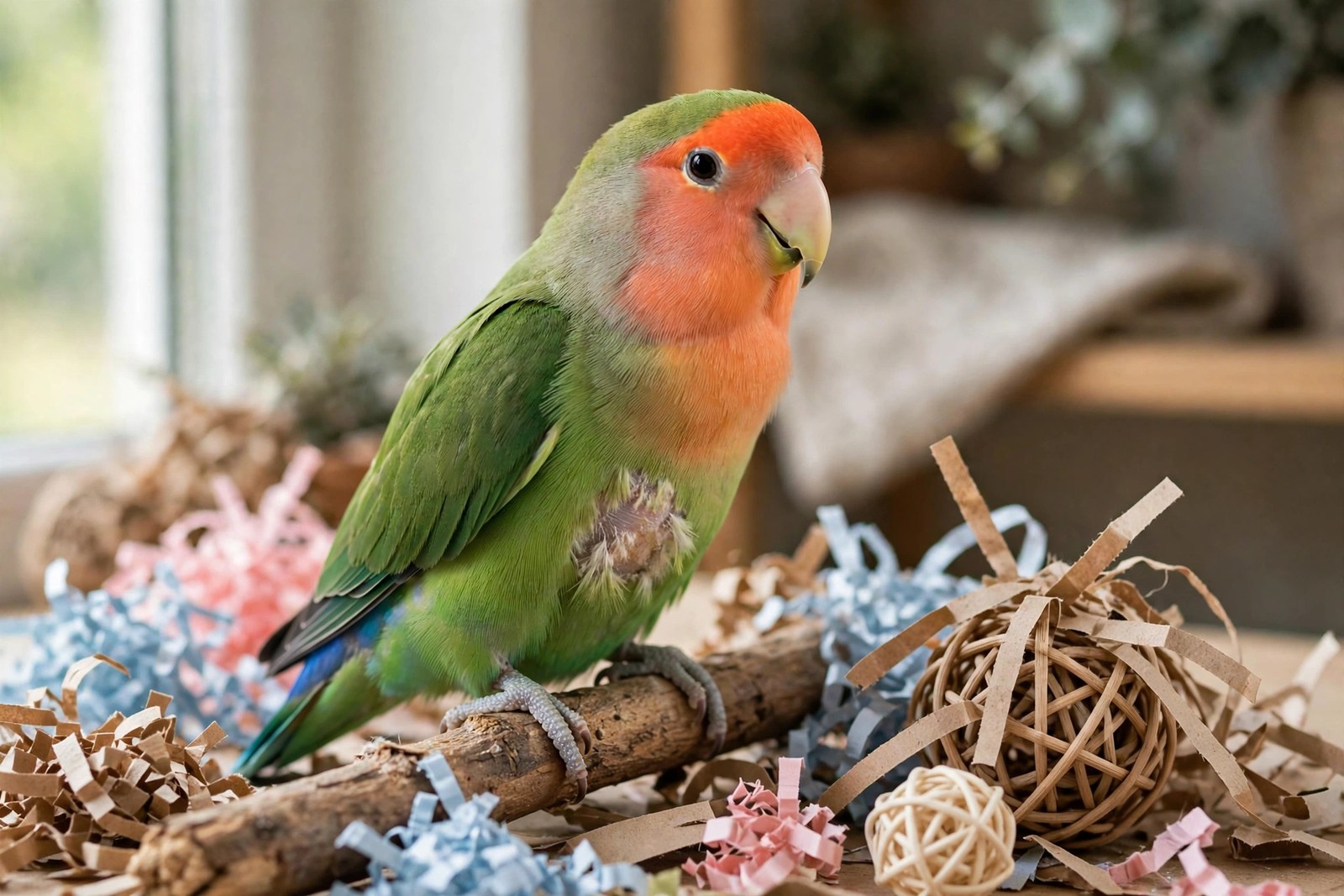
Feather plucking in a lovebird can have many causes — boredom, stress, skin irritation, or an underlying health issue — so treat it as a signal to investigate, not a habit to scold away or wait out. Start with an avian vet check to rule out medical causes, then look honestly at sleep, enrichment, and daily interaction, because lovebirds are social, busy birds whose needs are easy to underestimate.
Plucking, Chewing, and Molting Are Different Things
First, be precise about what you are seeing. A molting lovebird loses feathers evenly and grows pin feathers, while otherwise behaving normally. A plucking bird pulls feathers out herself, often from the chest, legs, or under the wings — the places her beak can reach — sometimes leaving downy feathers or bare patches while the head, which she cannot reach, stays fully feathered. Some birds chew or snip feathers rather than pulling them, leaving frayed, broken plumage.
That reach pattern is a useful clue for the vet, and so is timing. Note when it started, whether it is seasonal, and what changed around then: a house move, a new work schedule, a cage mate lost or added, less time out of the cage. Photos taken weekly in the same light show progression far better than memory does.
Start With the Vet, Not the Spray
It is tempting to reach for an anti-pluck spray or a collar bought online, but those treat the symptom and can add stress or risk if the real cause is medical. An avian vet can check skin and feather condition, ask about diet, and consider irritation, infection, parasites in some species, or internal issues that no amount of new toys would fix. Only an examination can sort that out — this guidance cannot diagnose your lovebird.
Be ready to discuss the full picture: exact diet, hours of sleep, cage size and position, time out each day, and how much direct interaction your lovebird gets. Lovebirds kept singly need substantial daily social time from their person; a bonded pair needs monitoring too, because occasionally one bird over-preens the other.
The Lifestyle Audit That Often Helps
While medical causes are being checked, improve the basics that most commonly sit behind behavioral plucking:
- Sleep: ten to twelve hours in a dark, quiet space, every night
- Foraging: hide pieces of favorite food in paper cups, woven toys, or a foraging box so meals take effort
- Rotation: swap toys weekly and include shreddable materials like cork, balsa, and yucca
- Bathing: offer a shallow dish or misting, which many lovebirds love and which supports feather care
- Presence: keep the cage where household life happens, without constant noise or handling
Change one or two things at a time and give them weeks, not days. Feather regrowth is slow, and a bird who has plucked for months may keep the habit loop going even as life improves — another reason the vet stays involved.
You Do Not Have To Solve It Alone
Plucking worries owners deeply, partly because progress is slow and setbacks are normal. In KinsLe's Circle of Love, you can connect with other bird lovers who have worked through the same worry and share what helped — remembering that the Circle of Love is the wider KinsLe community that also powers Lost Pet Alerts, which are free in every profile and alert nearby members. Hearing "our cockatiel did that for a season, here's what our vet checked" does not replace professional advice, but it steadies you for the process. Ask in the Circle of Love on KinsLe what finally helped other owners through months of slow regrowth, and borrow their routines for foraging, bathing, and keeping sleep undisturbed.