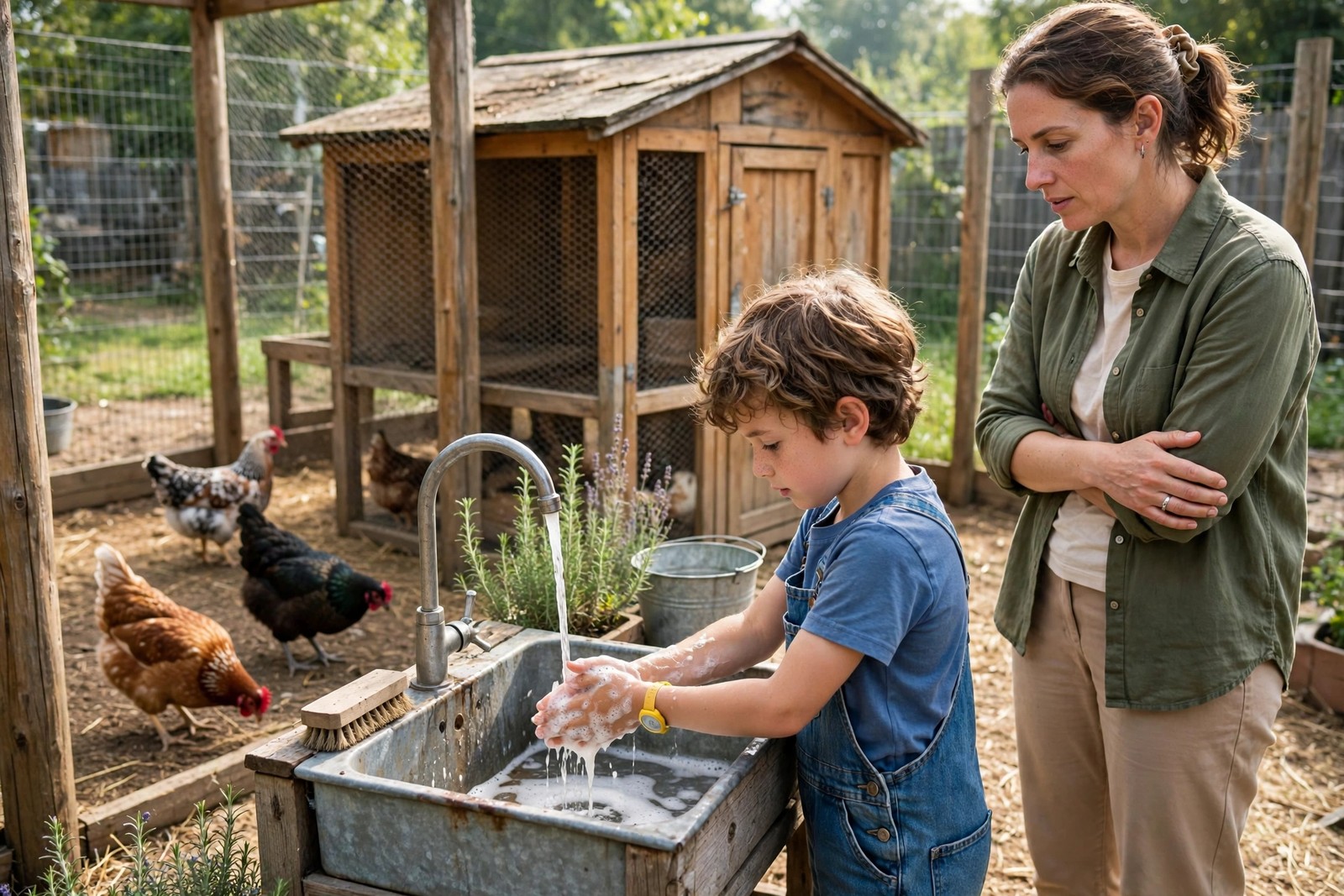
Children should wash their hands after handling poultry because birds that look perfectly healthy can carry Salmonella, Campylobacter and E. coli without showing any illness themselves. The bacteria live in the birds' droppings and spread onto feathers, feet, eggs, bedding and coop surfaces, so a child who strokes a hen, collects an egg or cleans a feeder picks them up on the skin. The infection route is the child's own hand: to the mouth, to a snack, to a rubbed eye. Handwashing with soap breaks that route at the one point fully under your control.
The germs involved and why children are at higher risk
Salmonella is closely linked with poultry, and it causes diarrhoea, fever and stomach cramps that are unpleasant for anyone and can become serious in young children, whose immune systems are still developing and who lose fluids faster. Campylobacter, another bacterium commonly carried by poultry, produces a similar illness, and certain E. coli strains add a further risk. Children under five are a higher-risk group and are heavily exposed: they handle birds at face height, they cuddle chicks against their cheeks, they put fingers in mouths without thinking, and they eat snacks the moment they leave the coop. Kissing chicks and ducklings, however charming it looks in a photograph, puts droppings-borne bacteria directly at the mouth and should be a firm household no. Adults are not exempt from the rule, but supervising the child's wash matters more than performing your own.
How to wash so it actually works
Wash with soap and running water for about twenty seconds, long enough to sing a short song twice, and cover palms, backs of hands, between fingers and under nails, because the grime from a coop collects exactly in those places. Do it immediately after handling birds, eggs, bedding or coop equipment, and before eating, drinking or touching the face. Supervise younger children at the sink rather than sending them, since a quick splash under the tap removes almost nothing. Hand sanitiser is a backup for the middle of a field or a show, not a substitute at home: it works poorly on visibly dirty hands, and coop hands are usually dirty. Keep a dedicated towel by the sink used for coop handwashing, wash it often, and make the routine automatic by placing the rule at child height in the order it happens: birds away, hands washed, then snack.
Habits around the coop that reduce the load
Handwashing carries less work when fewer germs reach the house. Keep a pair of coop-only boots or shoes at the door so droppings are not tracked across kitchen floors, and leave handling clothes, especially the ones a chick has been cuddled in, out of food areas. Poultry should not come indoors into kitchens or living spaces, and their feeders and drinkers should never be washed in the kitchen sink; use an outdoor tap and a bucket kept for the birds. Eggs should be collected with the handwashing rule applied straight afterwards, and cracked or heavily soiled eggs are better discarded than washed and eaten. At shows and petting farms the same routine applies, and it is worth carrying sanitiser for the gap before you reach a sink, then washing properly at the first opportunity. If a child develops diarrhoea, fever or cramps after poultry contact, see your doctor and mention the birds, because that detail helps the doctor judge the cause.
Making the rule stick for every visitor
The routine fails when it applies to your own children but not to visiting cousins, grandparents or the neighbour's toddler, all of whom will handle the friendliest hen. State the rule as part of the visit rather than as an afterthought, keep soap and a towel where small hands can reach them, and praise the wash when it happens so it reads as the finishing step of holding a bird, not as a punishment afterwards. KinsLe's Family Sharing lets you record the wash-after-handling rule on the flock's shared profile alongside feeding and egg-collection details, so every helper and visitor works to the same standard.