
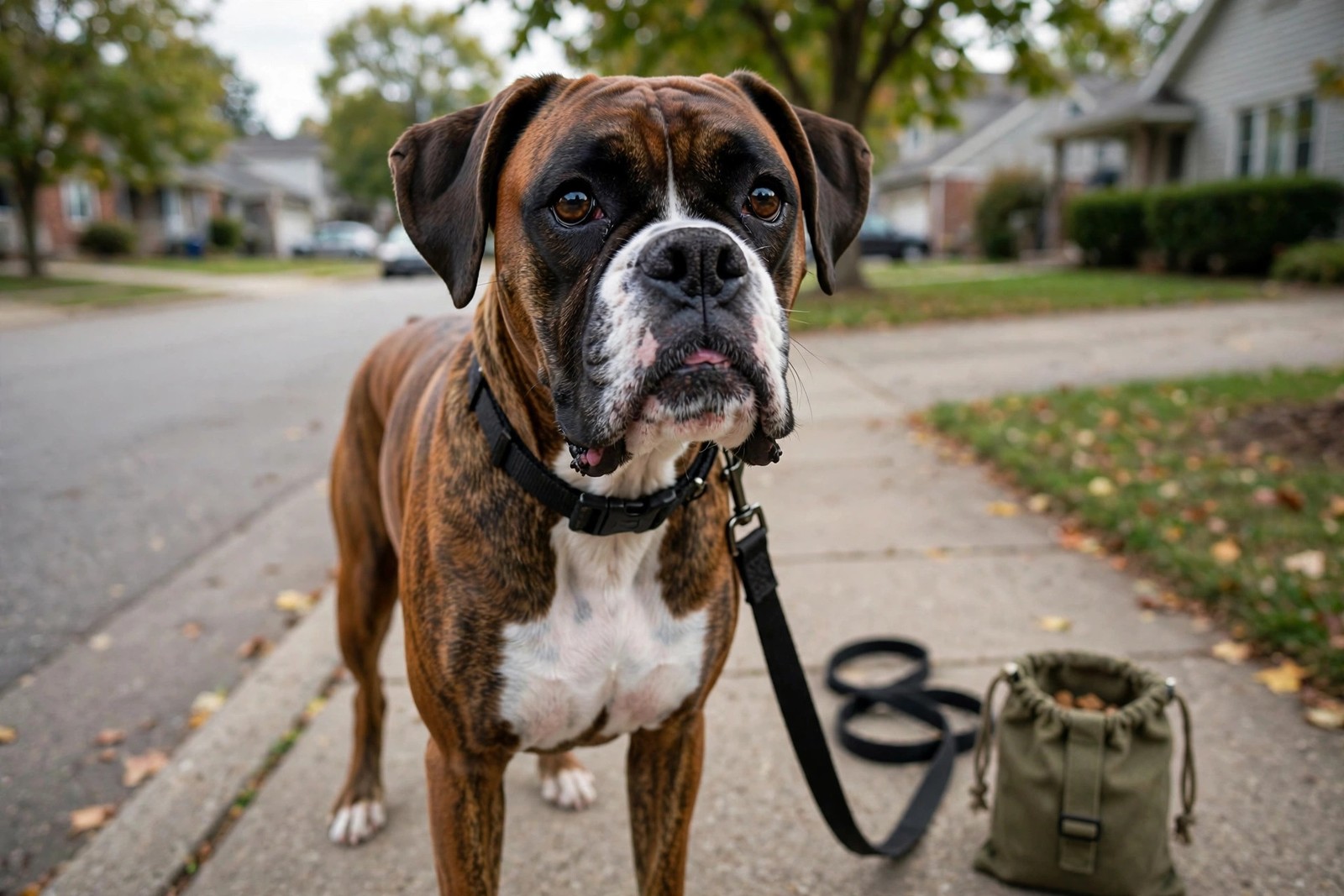
Yes — and with feeling. Few breeds commit to family children the way a Boxer does. This is a dog that typically shadows its children from room to room, joins every game, tolerates a remarkable amount of childish nonsense, and retains a clownish playfulness well into middle age. The breed's caution with children is rarely about temperament at all. It is about momentum.
The Physics Problem
An adult Boxer weighs roughly 25 to 32 kilograms of muscle, plays by bouncing on its front paws — the boxing move the breed is named for — and greets the world at full enthusiasm. Adolescent Boxers, from about six months to two or even three years, are famously slow to mature and at their most exuberant exactly when their strength peaks. A flying welcome can put a toddler on the floor, a playful paw can scratch, and a dog doing joyful laps of the garden will not brake for a small child in its path.
None of this is aggression, and all of it is manageable — but it means babies and toddlers need physical management, not just supervision from the sofa: baby gates, the dog on a lead for greetings until calm is reliable, and a strict four-paws-on-the-floor rule rewarded every single time.
Training That Makes the Match
Start these from the first week, not the first incident:
- Calm greetings: the Boxer earns attention only when all four feet are down; jumping up is ignored, never pushed off, which the dog reads as a game
- A solid settle on a mat, so the dog has a trained job during children's parties and excited moments
- Mouth manners: redirect puppy mouthing onto toys consistently — Boxers stay mouthy in play longer than many breeds
- Exercise before exposure: an hour or more of exercise and play for an adult, taken before the children come home from school, transforms indoor behaviour
Children, for their part, learn not to ride, climb on or hug a Boxer around the neck, and never to take toys or food from its mouth — leave that to adults and trade-up games.
The Payoff
In return you get a dog whose patience with its own children is genuinely notable, who plays for as long as they do, and whose protective instinct usually expresses itself as watchful presence rather than trouble. Boxers are also heat-sensitive because of their short faces, so summer play with children should be in the cooler hours, with shade and water — a vet can advise if breathing ever seems laboured.
Families keep the exuberance manageable by keeping the dog properly worked, and KinsLe's Care Teams makes that a shared system: walks, training practice and play sessions for your Boxer assigned across the family with completions logged, so no day's exercise quietly disappears into a busy household schedule.