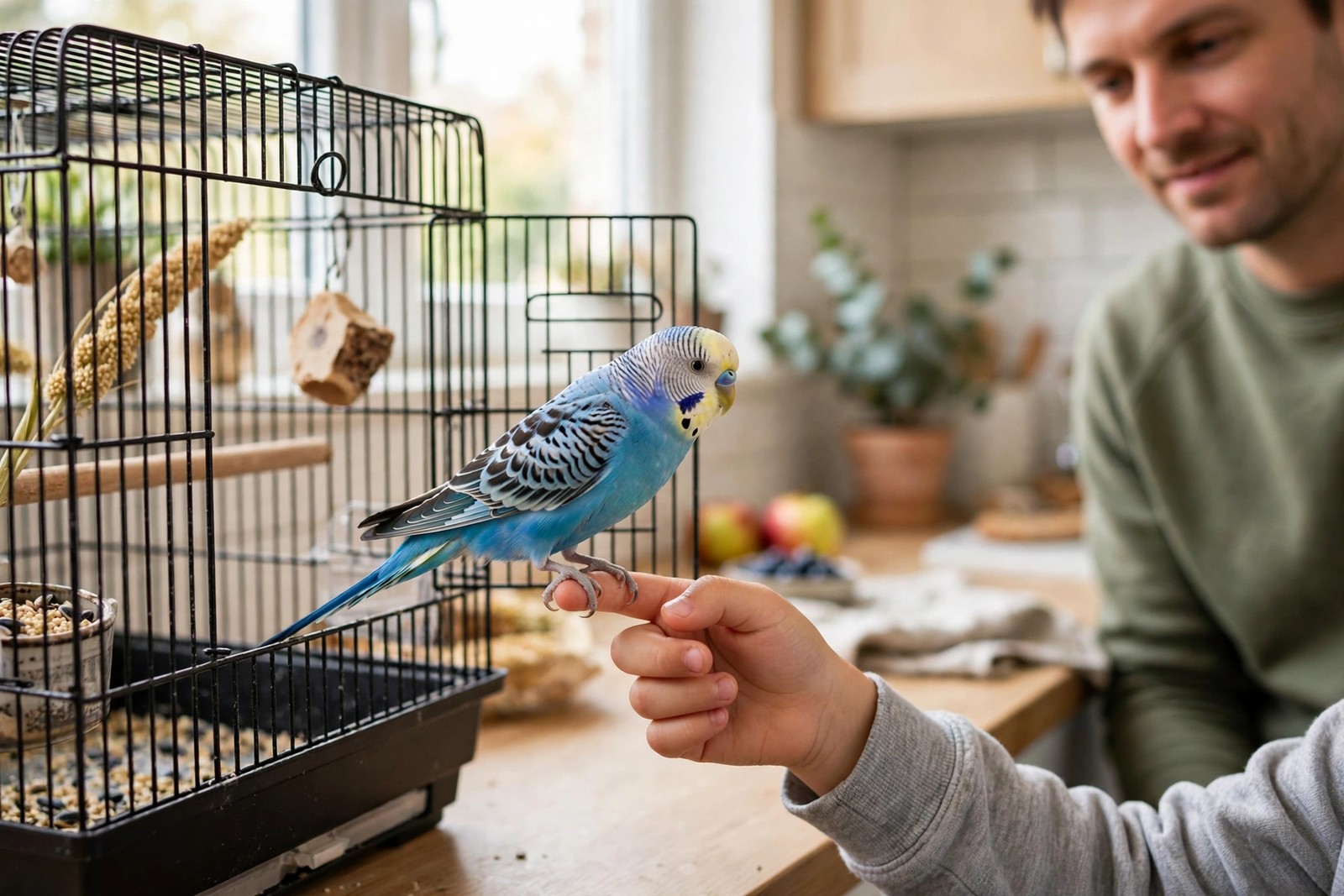
Yes — for the right child, with an adult genuinely in charge. Budgies are cheerful, intelligent and social little parrots, often recommended as a first bird, and they can give a child years of companionship. But the conditions in that answer are real ones, because a budgie's body is built very differently from a cat's or dog's, and the mismatch between childish enthusiasm and avian fragility is where these pets get hurt.
Why Fragility Sets the Terms
A budgie weighs around 30 to 40 grams — less than a small apple — with hollow bones and a chest that must move freely for the bird to breathe. A well-meant hug can suffocate or crush one; being grabbed from above triggers a prey animal's panic; a fall from shoulder height onto a hard floor can break a leg or wing. A frightened budgie also bites — a sharp, pinching nip that is unlikely to do serious damage but will teach a child to fear the bird if it happens repeatedly.
For those reasons, toddlers and preschoolers should enjoy a budgie by watching, talking to it and offering treats through the bars, not by holding it. Handling belongs to children who have shown they can move slowly and follow instructions — often around seven or eight, judged by the individual child rather than the birthday.
What a Child Can Genuinely Do
Plenty — and this is where budgies shine as children's pets:
- Daily jobs: fresh water, measured seed or pellets, a sprig of suitable greens, done each morning as the child's own responsibility
- Training: budgies learn step-up onto a finger, recall over short distances and simple target training in five-minute sessions, and taming a budgie to the hand is a real achievement a child can own
- Company and speech: children who chat and read to their budgie have the most social birds, and some budgies learn to mimic words and whistles clearly
- Supervised out-of-cage time: typically an hour or more a day in a bird-proofed room — windows and mirrors covered or marked, doors closed, ceiling fans off, no cats or dogs present
The Adult's Side of the Bargain
An adult must own the unglamorous parts: cage cleaning, recognising illness (a fluffed, quiet budgie sitting on the cage floor needs an avian vet promptly), providing a cage large enough for flight, and ensuring the bird is never a passing phase. Budgies commonly live seven to ten years or more, so this is a long commitment entered on the child's behalf.
With slow hands, real supervision and daily jobs that are truly theirs, children and budgies are a genuinely good pairing — and KinsLe's Care Teams keeps the supervision structured by assigning your budgie's feeding, cage checks and out-of-cage sessions to named family members, so 'an adult was watching' is a rostered fact, not an assumption.