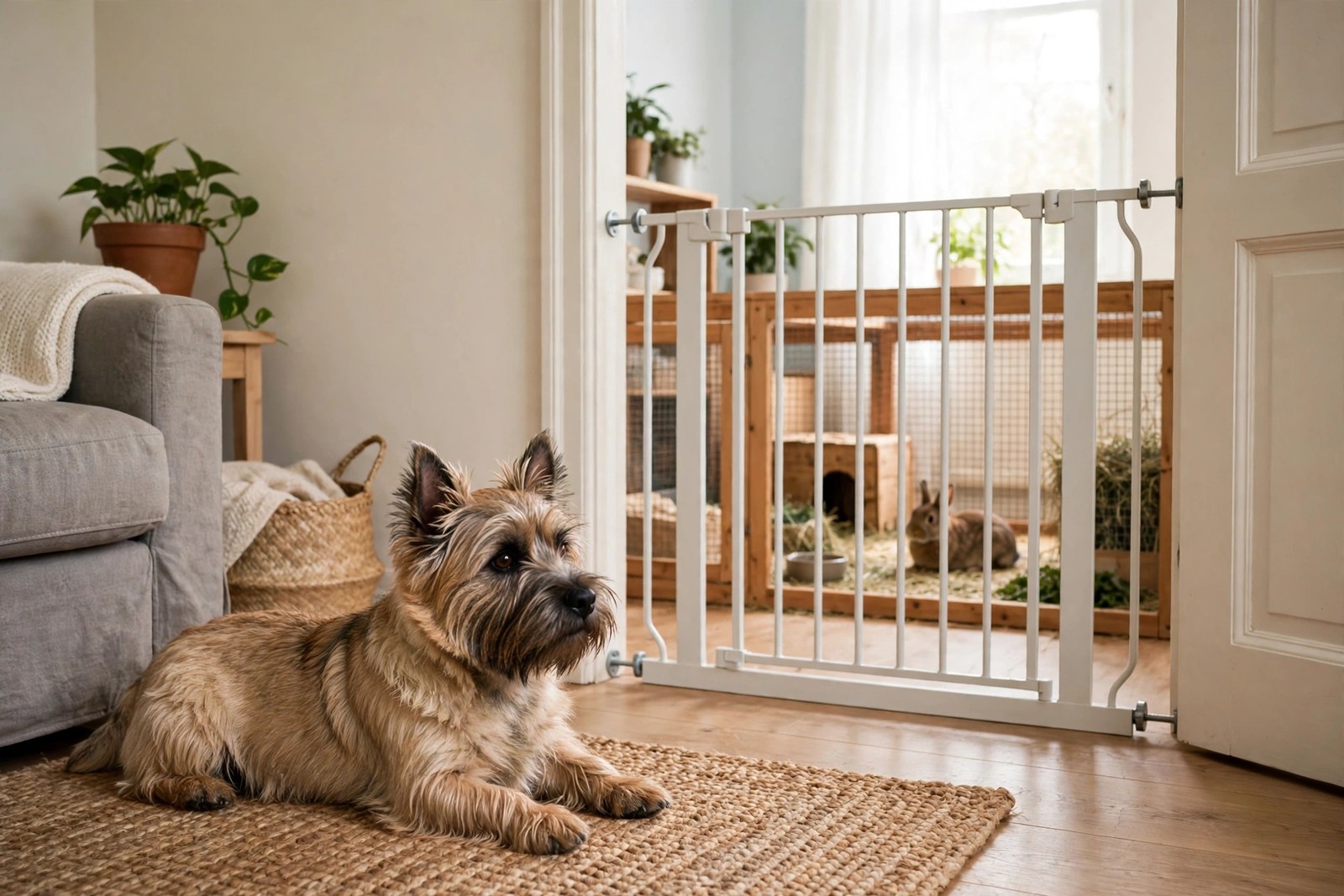
Some breed questions have a soft answer and some have a hard one, and this is a hard one. A Cairn Terrier was bred to go to ground and kill quarry the size and shape of a rabbit, working fast, close, and independently of any handler's second thoughts. Rabbits and guinea pigs are not small friends to that wiring; they are the exact animals it was built for. Households do keep Cairns and small pets under one roof, but they do it with separation systems, never with trust.
Why Introductions Do Not Settle This
It is tempting to believe that a careful introduction, a puppy raised beside the hutch, or a calm dog who ignores the guinea pigs through the bars has solved the problem. It has not. Prey drive is triggered by movement: a small animal that freezes may be ignored for months, and the same animal bolting across a run can switch a terrier into chase in a heartbeat. The risk is a risk, not a certainty: many Cairns live out their lives without an incident, but the incident, if it comes, is over in seconds and cannot be undone.
No amount of introduction training removes the instinct. Training can build steadiness, a reliable leave-it around distractions, and a dog who is calmer in the same house. It cannot rewire what the breed was made to do, and a household plan that depends on the training holding at the worst moment is a plan built on the weakest brick.
What Safe Coexistence Actually Looks Like
Small pets live in secure housing a terrier cannot reach, tip, or dig into: a solid, latched enclosure, ideally in a room or area the dog does not enter, so the small animals are not living under a predator's stare either. Stress matters on both sides of the wire; a rabbit who is watched and lunged at daily is not coexisting, whatever the dog intends. Exercise and handling of the small pets happen with the dog shut out of the space, every time, with doors treated as part of the equipment.
Everyone in the household follows the same rule, including visitors and children, because the system fails at its most casual moment, not its most careful one. The dog, for its part, needs its drive given legal work elsewhere: digging in its own spot, chasing toys, and training that uses its focus, so the terrier is not spending its days frustrated at a barrier.
The Contrast Worth Noting
Cats and other dogs raised in the same household are a different case. A Cairn raised with a confident household cat, or living with another dog, is dealing with animals who are part of its social world, and many such arrangements run peacefully for years with ordinary supervision sense. The line this breed draws is at small, fleeing prey animals, and respecting that line is what lets the other relationships stay relaxed.
A Rule That Must Outlive the Current Household
Strict separation only protects the small pets if it survives handovers: a house sitter for a weekend, a family member the dog stays with, or a future owner if the dog is ever rehomed. A rule that lives only in the current owner's head has an expiry date, and prey drive does not.
Writing it into the dog's permanent record is the honest safeguard, and in KinsLe the Transferrable Profiles notes hand that separation rule, the housing details, and the dog's history with small animals to whoever cares for the dog next, in plain writing they cannot miss.