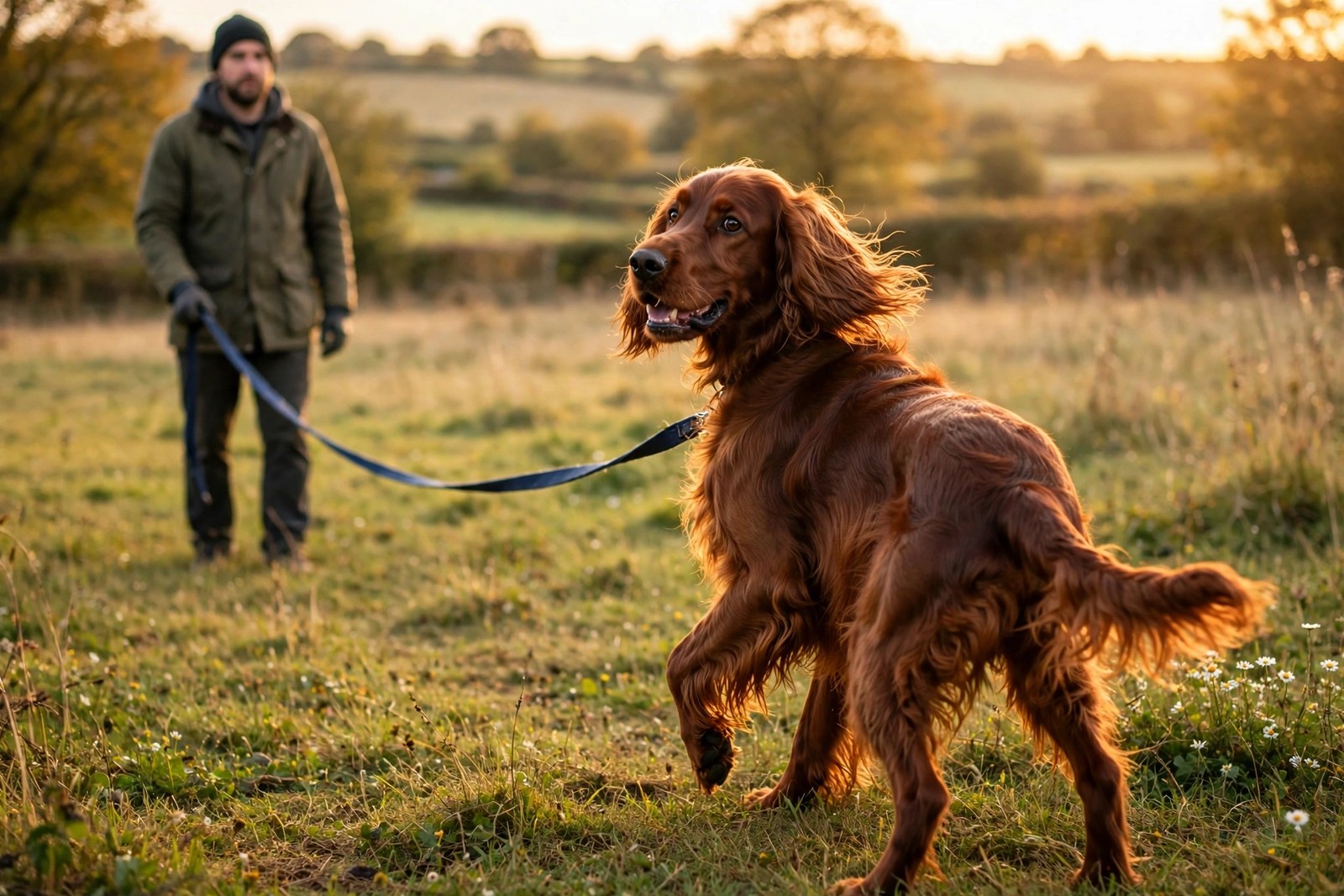
Yes, mostly. The Irish Setter is a bird dog bred to range, notice movement, and love people, and that combination matures slowly. Many owners describe a dog who is physically grown long before the brain catches up: elegant and adult-looking at a year, yet still leaping up at visitors, pulling toward every pigeon, and losing a known cue the moment a more interesting smell arrives. Expect the scatty phase to run well into the second and often the third year, with gradual improvement rather than a sudden switch.
What Adolescence Actually Looks Like
The hard months usually bring selective hearing outdoors, mouthing that returns after you thought it was finished, counter surfing powered by a tall reach, and bursts of evening silliness indoors. Setters are not being defiant in the human sense. They are highly stimulated by movement and scent, and their reward for noticing the world was built into the breed long before pet life asked them to ignore it. A teenage Setter who recalls perfectly in the garden and not at all across a field of gulls is showing a training gap, not a character flaw, and the answer is an easier setting and more repetitions, not louder corrections.
Training That Fits This Breed
Keep sessions to a few minutes and make them feel like games. Reward every voluntary check-in on walks, because a dog who glances back at you is building the habit recall depends on. Use a long line in open spaces so the Setter can range and sniff without rehearsing the lesson that running away works. Practise recall in stages: quiet garden, empty field on the line, then the same field with a friend and a calm dog at a distance, and only drop the line when the dog turns away from distractions reliably at each stage.
Teach a settle on a mat, a leave-it for food and wildlife, and a polite greeting routine where all four feet stay down before anyone strokes that red coat. Scatter feeding and sniffing games tire this breed in a way a pavement plod does not. Most adolescent Setters need a generous daily mix of exercise, free sniffing, and training, broken up with real rest, because an overtired young gundog can look even wilder than an under-exercised one.
Living With the Long Fuse
Plan for the coat and ears as part of training life. The long feathering on the legs, chest, and tail picks up mud and burrs after every wet run, so a quick brush-out is easier as a calm daily habit than as a wrestling match once a week. The long, low-set ears trap moisture, so lift and look at them during grooming and ask a vet about any smell, redness, or repeated head shaking rather than guessing at a cause.
Choose this breed with eyes open. If you want a dog who is sensible at a year, walks calmly off lead early, and fits training around a busy week, a Setter will frustrate you. If you enjoy an affectionate clown, can laugh through months of cheerful chaos, and will protect recall training for as long as it takes, the adult who emerges is famously sweet-natured and worth the wait. KinsLe's Care Teams keeps that long project shared fairly, with the Setter's runs, recall practice, feeding, and grooming assigned to named helpers and time-stamped when finished, so progress does not depend on one person's memory.