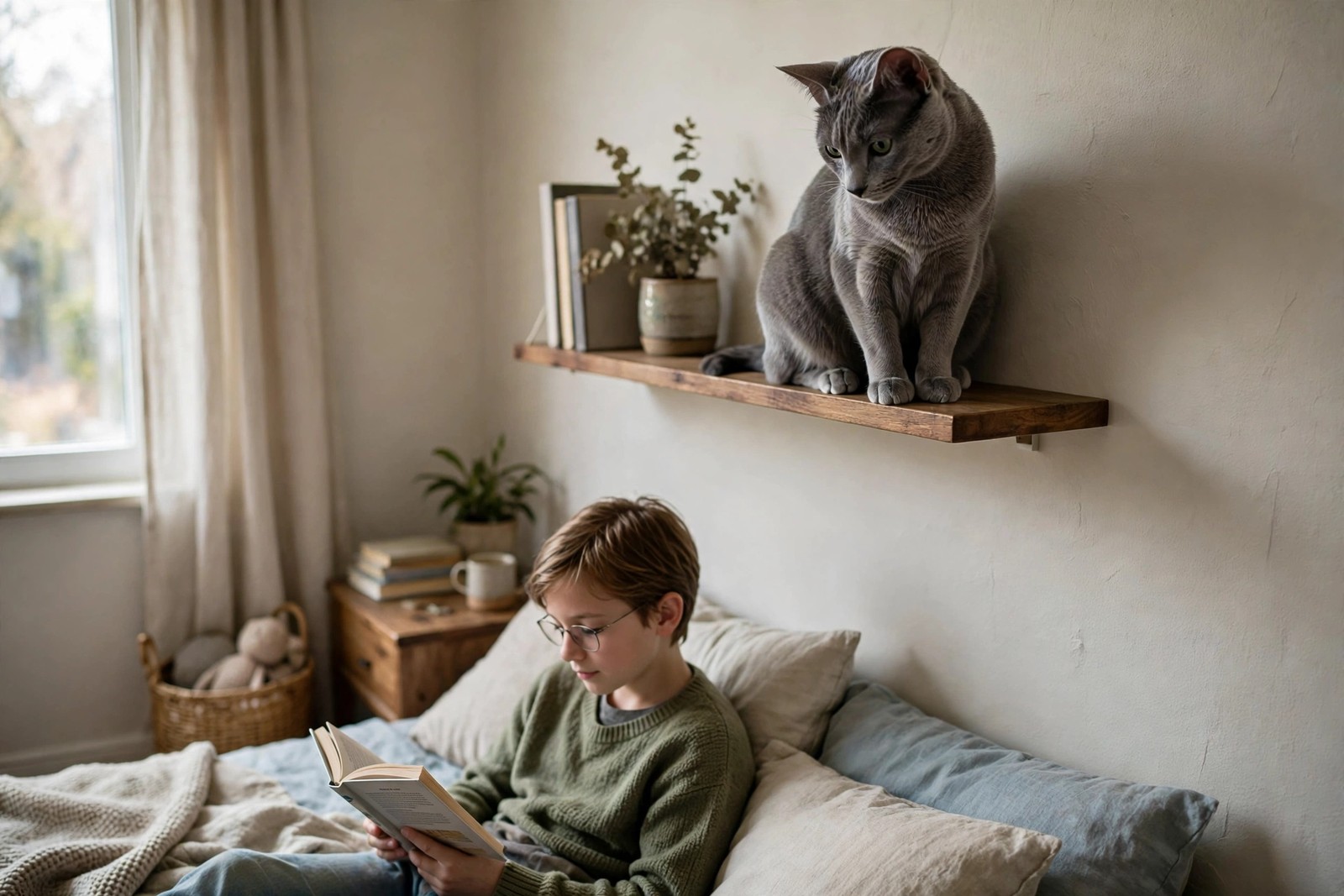
It depends entirely on the children. A Russian Blue is a gentle, intelligent, deeply loyal cat — with the people it has chosen, in the home it knows, on the routine it trusts. It is also one of the more reserved breeds: wary of strangers, unsettled by noise and change, and slow to offer trust. Put those facts together and the answer writes itself: calm older children, often an excellent match; a loud household of toddlers, usually a miserable one for the cat.
The Temperament Behind the Answer
Russian Blues bond intensely, often selecting one or two favourite humans and following them with quiet devotion. They remember routines precisely — feeding times, the order of the morning, where each person sits — and they rely on that predictability. Sudden noise, grabbed-at handling, chased games, and a constant stream of visiting strangers all cut directly against what makes this breed feel safe.
A stressed Russian Blue rarely makes a scene. It disappears: under beds, on top of wardrobes, into the one room children rarely enter. Families sometimes report the cat is 'no trouble at all' while the cat is in fact living a small, avoidant life. That outcome is the thing to decide against honestly before you buy, not discover afterwards.
The Children Who Suit a Russian Blue
A child of roughly eight and up, who can move calmly, read a clear no, and wait to be approached, can build something special with this breed. Russian Blues often enjoy structured play — a wand toy worked with skill, a treat puzzle, a predictable evening game at the same time each day. That rhythm appeals to them. The child who feeds the cat at set times and becomes part of the trusted routine is often rewarded with the chosen-person bond owners of the breed treasure: head bumps, quiet company, and a cat waiting at the door for them specifically.
Coaching matters. Teach children to crouch sideways, offer a hand to sniff, and let the cat close the distance. No picking up until the cat clearly tolerates it — many Russian Blues prefer laps they choose themselves over being held. Never corner the cat to force a stroke, and treat hiding as a decision to be respected, not a problem to be fixed by fetching the cat out.
Setting Up for Success
Give the cat high, child-free territory from day one: a tall perch, a shelf route out of busy rooms, and one quiet room with litter, water, and bed where children do not follow. Keep the household's patterns steady during the settling weeks, introduce visiting children gradually and briefly, and let the cat observe family life from safety before being expected to join it.
Choose the individual carefully, too. A confidently raised kitten who has heard normal household sounds, or an adult known to relax with a calm older child, is a very different prospect from a nervy rescue in a chaotic home.
With the right child, this is not a compromise pairing but a genuinely close one — it just cannot be rushed or forced. KinsLe Family Sharing helps protect that trust by putting your Russian Blue's feeding times, retreat rules, and handling boundaries in a shared profile, so everyone in the family keeps the routines this breed depends on.