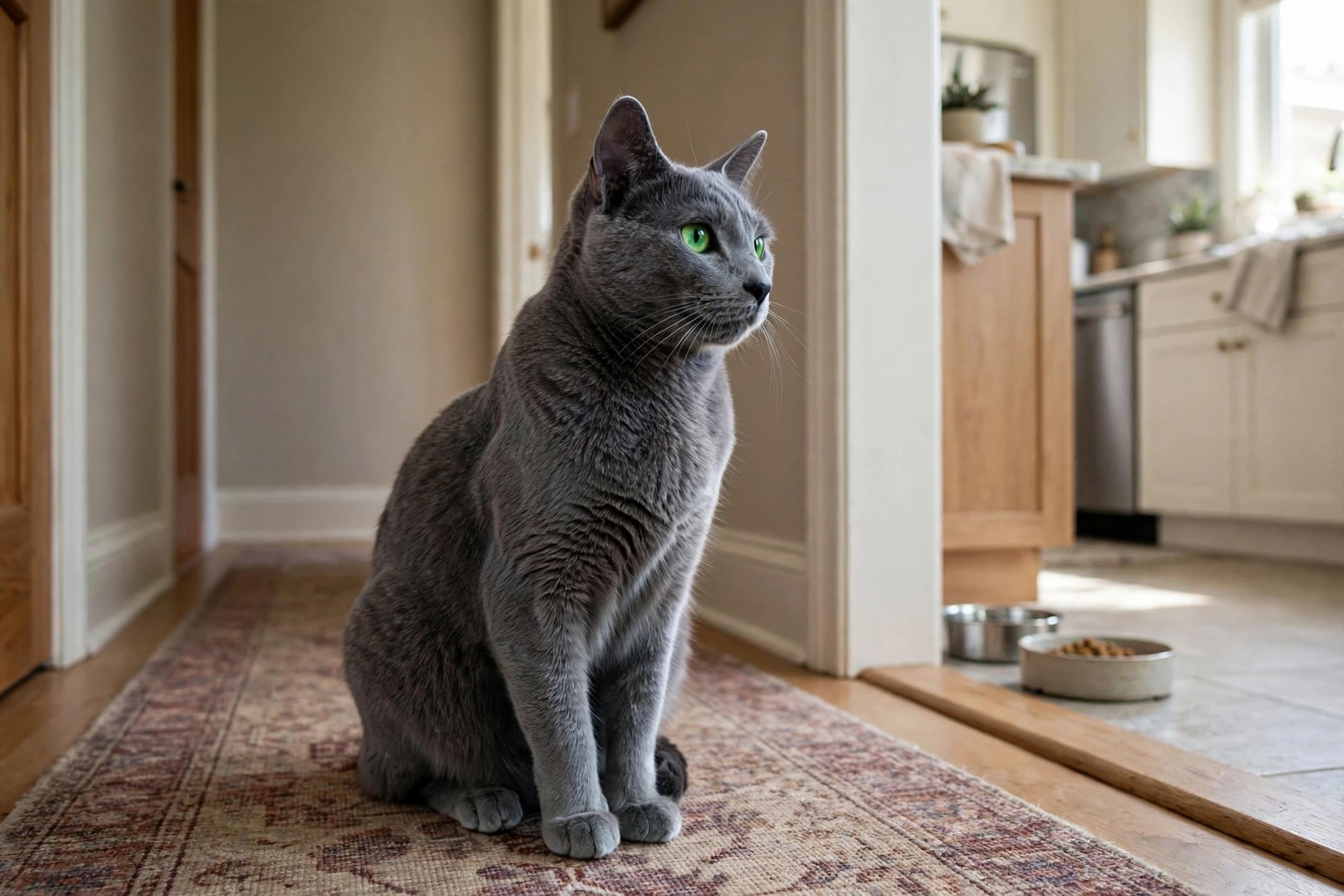
No. The Russian Blue is a reserved, self-possessed breed, and its voice matches: soft, infrequent, and deployed with discrimination. This is not a cat who narrates, greets the household at large, or calls for company. With its chosen people, a Russian Blue may hold occasional quiet exchanges. With visitors, many say nothing at all and are simply elsewhere until the house is theirs again. Talkative is among the least accurate labels available for this breed.
A Soft Meow, Saved for Specific People and Moments
The Russian Blue's typical vocalisation is a short, gentle mew, sometimes almost a murmur, and its occasions are consistent enough that owners can list them: the approach of a scheduled meal, a greeting to the favored person after an absence, a comment when a routine changes unexpectedly. This breed is famously attached to predictability, and much of its communication is really about the schedule. The cat who appears silently at the feeding place at the usual minute is making its point without sound. Some Russian Blues will answer their person with a soft mew when spoken to, a small courtesy within the bond, but even devoted owners describe a cat of few words rather than a conversationalist.
Subtle Signals From a Reserved Cat
Russian Blues communicate through timing, expression, and controlled affection. Their striking green eyes and almost smiling mouth make small expressions readable once you know the individual cat: the slow approach and head raise for a scratch from a trusted hand, the decision to share a room at a dignified distance, the playfulness, surprisingly kittenish and clownish with family, that strangers never see. Affection from a Russian Blue is earned and then genuinely given, often concentrated on one or two people. Because the signals are this understated, a new owner's first weeks can feel one-sided; the breed is assessing, and its quiet is caution, not coldness.
Vocal Changes in a Cat of Few Words
In a breed this quiet, new noise is a meaningful event. A Russian Blue who begins meowing persistently may be protesting a disrupted routine, a litter-box problem, a new animal, or a changed household, and restoring predictability fixes a surprising share of cases. Repeated crying with appetite, weight, or drinking changes, or night calling in an older cat, should go to a vet, since the senior conditions that make cats vocal, including thyroid disease and raised blood pressure, present exactly this way. The other direction matters too: a Russian Blue who withdraws further, skipping even its scheduled appearances, may be stressed or unwell, and in a cat whose normal is already aloof, that deeper retreat is easy to miss until it has gone on too long.
The Home This Quiet Breed Wants
Russian Blues suit calm, orderly households with set routines and people who appreciate a cat that chooses its moments. They are a sound pick for noise-sensitive living, and their fastidiousness extends to expecting a clean litter box and meals on time, delivered without fuss. What they ask in exchange for their silence is stability: the same feeding times, the same resting places respected, introductions to anything new made gradually, and affection offered at the cat's pace rather than pursued.
Recording those feeding times, the cat's few usual sounds, and its preferences in KinsLe's Care Teams, where duties for each pet are assigned and marked complete, keeps the routine unbroken when someone else feeds your Russian Blue, and an unbroken routine is the closest thing this breed has to a love language.