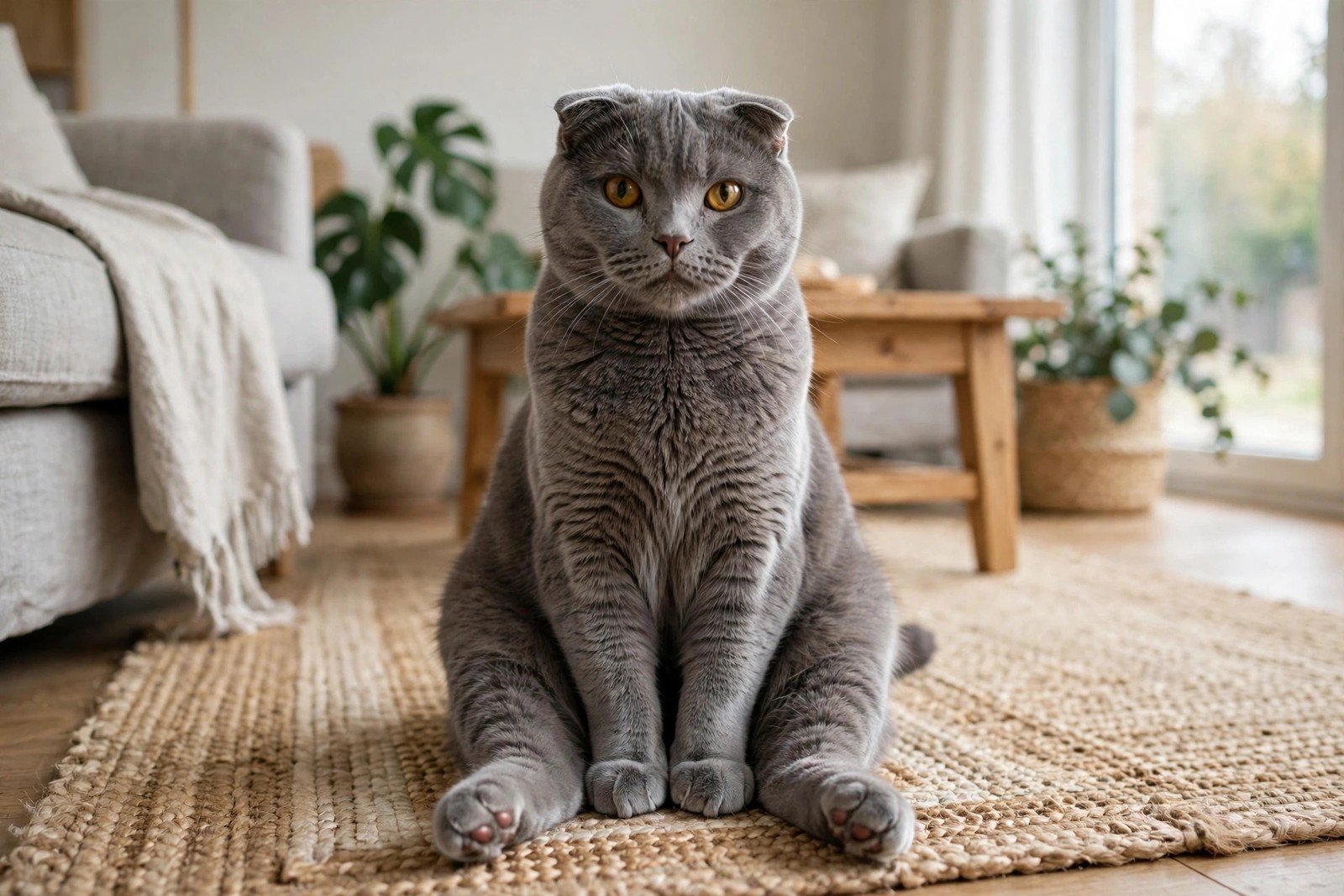
No. Scottish Folds are soft-spoken cats whose charm is largely visual and silent. The folded ears and round, wide-eyed face belong to a breed that vocalises rarely and quietly, often going long stretches without a single meow. Where other cats announce themselves, a Fold tends to materialise beside you, adopt one of its celebrated poses, and wait to be noticed. Anyone choosing the breed hoping for a chatty companion has been misinformed; anyone hoping for a peaceful one has chosen well.
The Fold's Small Voice and Stranger Sounds
On the occasions a Scottish Fold does speak, the voice is typically a small, soft mew or a brief, quiet chirp, and some individuals produce little sounds that owners describe as unlike other cats: faint squeaks, soft puffing noises, and muted murmurs during play or at the sight of birds. Volume is never the breed's register. Repeated or loud meowing is out of character, and a Fold who vocalises mainly around mealtimes is usually working a learned routine, one polite sound that history has shown produces food, rather than expressing a talkative nature. It is worth knowing that a Fold's ear position, one of the usual feline mood signals, is fixed by the fold itself, so owners must read the rest of the cat: body tension, tail, pupils, and posture.
The Famous Silent Poses
Scottish Folds are internet-famous for positions that function as communication in place of a voice. The Buddha sit, upright on the haunches with hind legs stretched forward and paws on the belly, is a relaxed Fold at rest and often a bid for attention. Standing briefly upright on the hind legs, meerkat-style, is the breed surveying something interesting or checking where a sound came from. Sleeping flat on the back with legs extended, and the sploot with hind legs behind, signal a cat who feels entirely safe. A Fold who follows you and deploys one of these poses in front of you is socialising in its native dialect, and responding with attention at exactly that moment is how the conversation happens in this breed.
Silence That Deserves a Second Look
A quiet breed still needs its changes noticed, and with Scottish Folds there is a breed-specific reason to be attentive. The same gene that folds the ears affects cartilage throughout the body, and Folds can develop a painful joint condition that typically shows as reluctance to jump, climb, play, or be handled, a stiff or shortened tail, and a cat who moves less and withdraws more, not one who complains aloud. A Fold who stops posing, playing, or standing up to look, or who begins crying when picked up or moving, needs a vet assessment rather than reassurance that the breed is just quiet. Any new persistent vocalising, in either direction of change from the individual's normal, deserves the same prompt check as in any cat.
Living With a Quiet, Pose-Loving Cat
Scottish Folds suit calm indoor homes and owners who enjoy a nearby, undemanding companion. Give the breed low, accessible perches and steps rather than demanding climbing routes, gentle daily play in short sessions that respects stiff joints, and company without constant handling. They are generally tolerant and companionable, and their near-silence makes them easy in flats and shared homes. The work of owning one is observational: this cat will not tell you loudly when something is wrong, so you commit to watching movement, appetite, and participation as your early-warning system.
Noting your Fold's usual poses, activity level, and rare sounds in its KinsLe Pet Pass profile gives a vet or carer the baseline that matters for this breed, because in a Scottish Fold the first sign of trouble is usually a pose that disappears, not a sound that appears.