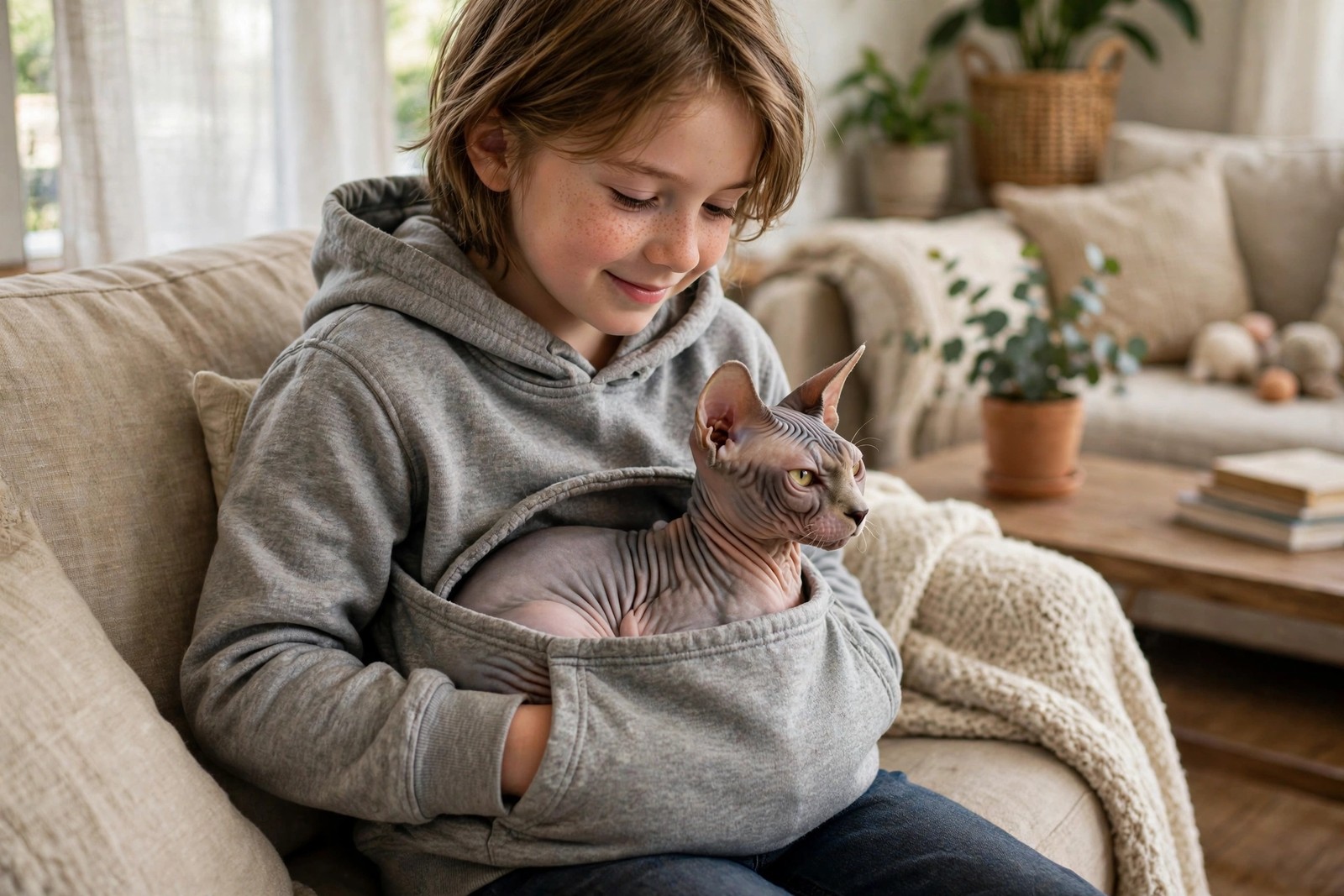
Often, yes — enthusiastically. The Sphynx is one of the most people-hungry breeds in the cat world: affectionate, playful, mischievous, and determined to be wherever the warmth and attention are. Many behave almost like dogs, greeting visitors, following children from room to room, and burrowing into laps, hoodies, and beds at every opportunity. For a child who wants a cat that actively chooses their company, a Sphynx can be a joy.
The breed's one real vulnerability is worn on the outside, and it shapes every rule for children.
Skin Without Fur Changes the Rules
A Sphynx has, at most, a fine down over bare skin, and that skin does everything fur normally handles. It scratches and grazes far more easily in rough play. It shows every small mark. It can be irritated by grabbing hands, scratchy clothing, and being dragged across carpets in a game. So the handling rules for children are stricter than for a coated cat: stroke gently with flat hands, never grab or squeeze, no wrestling games, no picking up for young children at all, and seated, fully supported holding only for older children the cat already trusts.
Nails matter from both directions. Keep the cat's claws trimmed so enthusiastic kneading and play does not rake a child's arms, and keep children's nails short and clean for the cat's sake. Any break in a Sphynx's skin deserves a prompt clean and a watchful eye, because there is no coat keeping everyday dirt away from it. If a scratch looks inflamed or the cat seems unwell, check with your vet.
Sun is the other skin issue in family life. A Sphynx joining children in a sunny garden can burn surprisingly fast, and window sunbathing has limits too. Keep outdoor time out of the plan — this is an indoor breed — and be thoughtful about long stretches in direct sun through glass.
Heat-Seeking and Constant Company
Children quickly learn the Sphynx's defining habit: it is always looking for the warmest seat in the house, which is usually a person. Expect the cat under blankets, inside jumpers, and on top of whichever child is sitting still. That is charming, and it needs one safety rule — everyone checks before sitting down on a lumpy blanket, and small children are taught never to roll onto or pile cushions on top of a hidden cat.
The clinginess runs deep. A Sphynx left alone for long stretches can become miserable and demanding, so families where children come home to an afternoon with the cat are a far better fit than homes empty from seven to seven. Children can share real care jobs: the breed needs regular skin care because oils build up without fur to absorb them, typically including periodic bathing and ear cleaning — adult-led jobs, but a gentle older child can hold the towel and learn how much looking-after their warm little shadow actually needs.
Making the Match
Meet the individual cat, start handling practice with adults modelling it first, and keep early sessions short, warm, and treat-filled. Teach children that a Sphynx asking for fuss is not the same as a Sphynx who can be scooped up mid-nap — even the friendliest cat deserves to be asked.
Handled gently, a Sphynx and respectful children are usually a loud, funny, affectionate success: a cat who wants to be in the game, on the lap, and under the shared blanket. KinsLe Family Sharing helps keep that skin safe by putting your Sphynx's handling rules, bathing routine, and warmth needs in a shared profile every family member can follow.