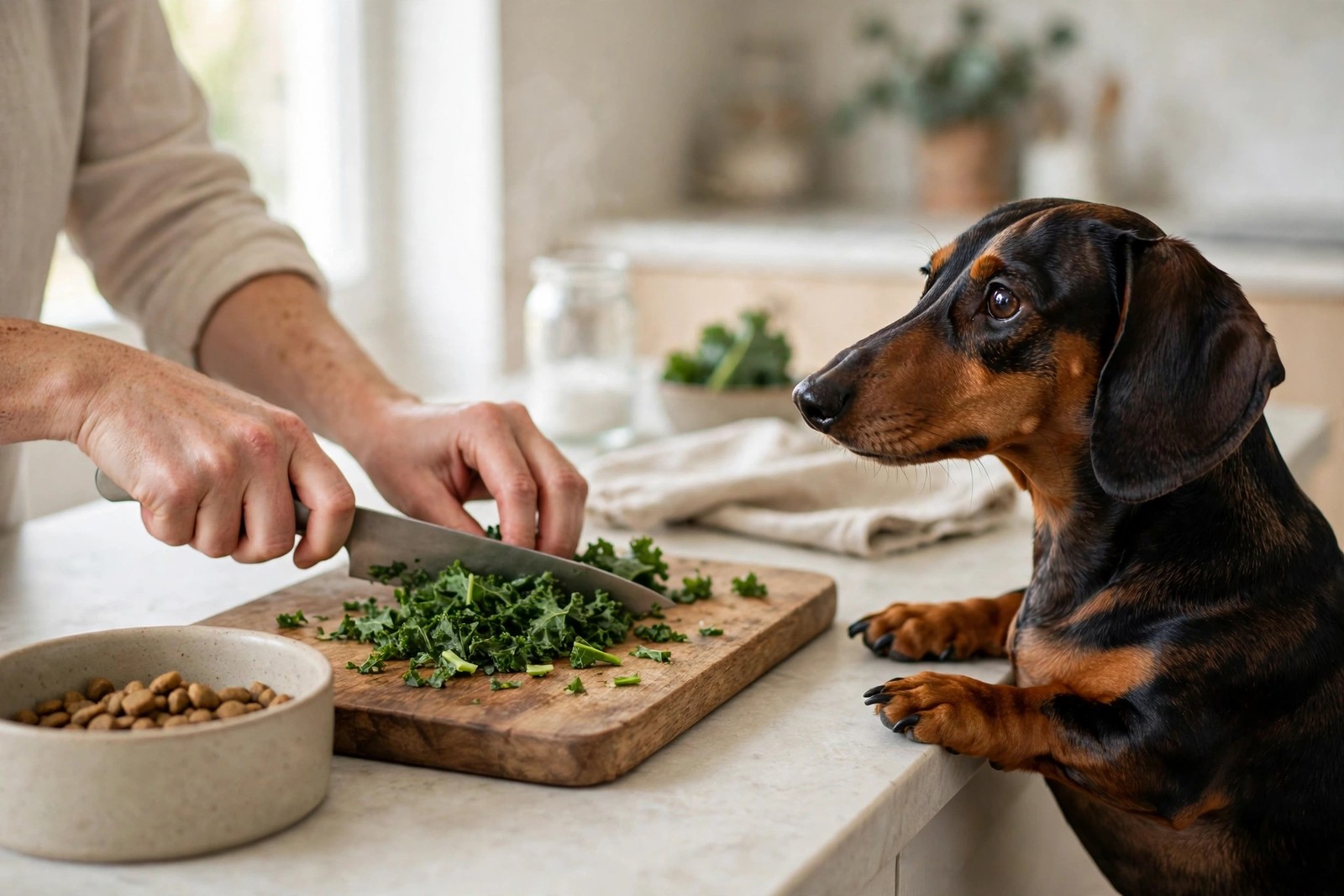
Kale is safe for most healthy dogs in small amounts, but 'small' is doing real work in that sentence. Kale should be a garnish — a spoonful of cooked, chopped leaf stirred through regular food — not a daily green base, a smoothie ingredient by the cupful, or a bowl of raw leaves handed over as a chew.
Why the preparation matters
Raw kale is tough and fibrous, with thick stems that a dog can tear into awkward pieces or gulp in chunks, making it a choking and stomach-upset candidate before nutrition enters the discussion. Lightly steaming or briefly cooking softens the leaf, and chopping it fine afterwards mixes it through food so a dog eats it gradually rather than bolting a wad of green. Wash leaves well, strip out the heaviest central ribs, and skip any kale prepared for the table — kale chips carry oil and salt, creamed kale carries dairy and seasoning, and garlic kale carries garlic, which dogs should not eat. Green smoothie leftovers and kale powder supplements are poor shortcuts for the same reason portion control matters here: a blended drink concentrates several handfuls of leaf into a few gulps, and a powder's strength varies in ways a spoonful of chopped leaf never does, so neither gives you the tidy garnish-scale serving this food calls for.
The oxalate and thyroid cautions
Kale contains calcium oxalates. For a dog with any history of bladder stones, kidney trouble, or a veterinarian's instruction to watch oxalate intake, kale should simply stay off the menu — this is the item's one firm exception, and guessing is not worth it when so many other vegetables exist. Kale, like other cabbage-family greens, also contains compounds that can interfere with thyroid function when eaten in very large quantities over time. At garnish scale for a healthy dog this is not a practical concern, but it is a solid reason not to let an enthusiastic owner turn kale into a daily supplement, and dogs already managing thyroid conditions deserve a quick veterinary check before green powders or juices join the routine.
Portions and reactions
Start with a teaspoon for a small dog or a tablespoon for a large one, mixed in, and watch for gas or loose stool — cabbage-family greens ferment enthusiastically in some dogs, and kale farts are a legitimate reason to retire the experiment. If stools stay normal and your dog enjoys it, a few servings a week at that scale is a reasonable ceiling. Puppies do not need kale at all; their complete puppy food already covers the nutrients owners hope greens will add.
Keep the exception visible in KinsLe's Pet Passport, where your dog's health records travel as one packet — a noted history of bladder stones tells any family member or sitter at a glance that kale, however healthy it looks, is not for this dog.