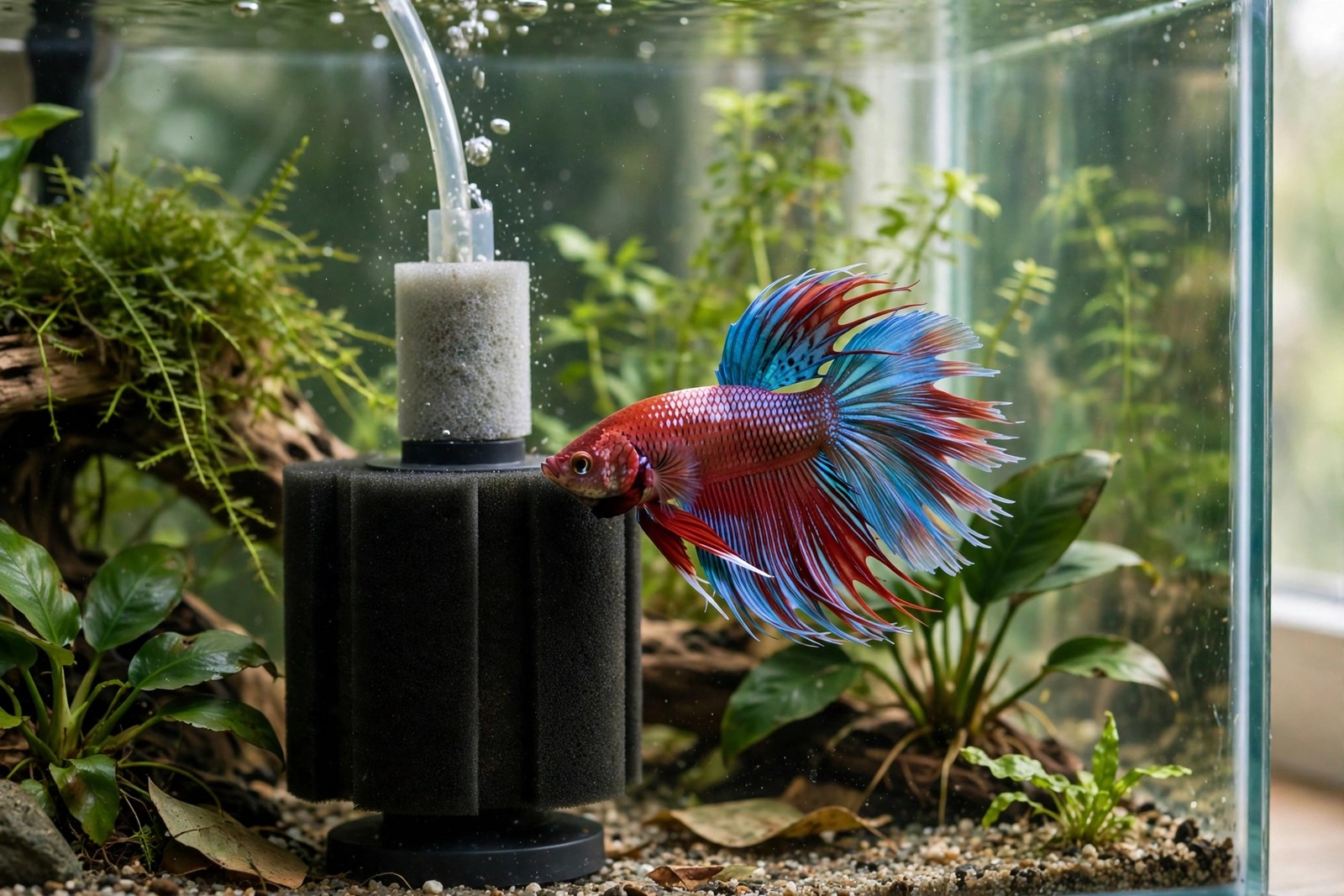
Yes — a betta in a typical home tank should have a filter, and the reason is chemistry rather than tidiness. Fish waste, decaying food, and plant matter release ammonia, which burns gills and skin even at low levels. In an established filter, colonies of helpful bacteria settle on the sponges and media and process that ammonia first into nitrite, which is also toxic, and then into nitrate, which is far safer and is kept down by your partial water changes. That living colony, often called the cycle, is the real life-support system; the box and impeller are just its housing.
Why the Flow Has to Stay Gentle
Wild bettas live in slow, shallow, heavily planted water, and the long-finned fish sold for home tanks are even weaker swimmers than their wild relatives. A strong filter outflow can pin a betta against the glass, shred the effort out of every crossing of the tank, and leave it hiding behind decorations or clamping its fins from exhaustion. Look for adjustable-flow filters or sponge filters driven by a small air pump, baffle a stronger outflow with a piece of coarse sponge, and watch the fish rather than the packaging: a betta that can hover calmly, rest on a leaf near the surface, and reach its food without fighting a current is a betta whose flow is right. Surface access matters too, because bettas breathe air at the surface as well as through their gills.
The Unfiltered Alternative, Honestly Priced
A betta can survive without a filter in a generously sized, warm, planted container, but the workload moves onto you. Without a bacterial colony doing continuous cleanup, safety depends on large water changes every few days, siphoning waste from the bottom each time, and never letting a missed weekend slide, because ammonia climbs steadily between changes. Small unfiltered bowls are the worst version of this bargain: tiny water volume means waste concentrates fast and temperature swings with the room. Most owners who start unfiltered and later add a gentle filter are surprised by how much steadier the fish's appetite, colour, and activity become.
Habits That Keep the Colony Alive
The bacteria you depend on are easy to kill by kindness. Rinse filter sponges in a bucket of water you have just removed from the tank, never under a hot tap, and stagger any media replacement so most of the colony survives. Keep up modest weekly partial changes even with a filter, since filtration does not remove nitrate, and test the water when a betta goes off its food or sits on the bottom, because ammonia is invisible. If your filter stops for more than a short outage, treat the tank as fragile for a few days and test before assuming all is well.
Good betta water is mostly a rhythm: feeding measured, waste removed, filter humming quietly in the background. KinsLe Care Teams supports that rhythm by letting you hand the weekly water test, the partial change, and the monthly sponge rinse to specific people in the household, each marked complete with a time stamp, so the invisible jobs that protect your betta never rest on one person's memory.