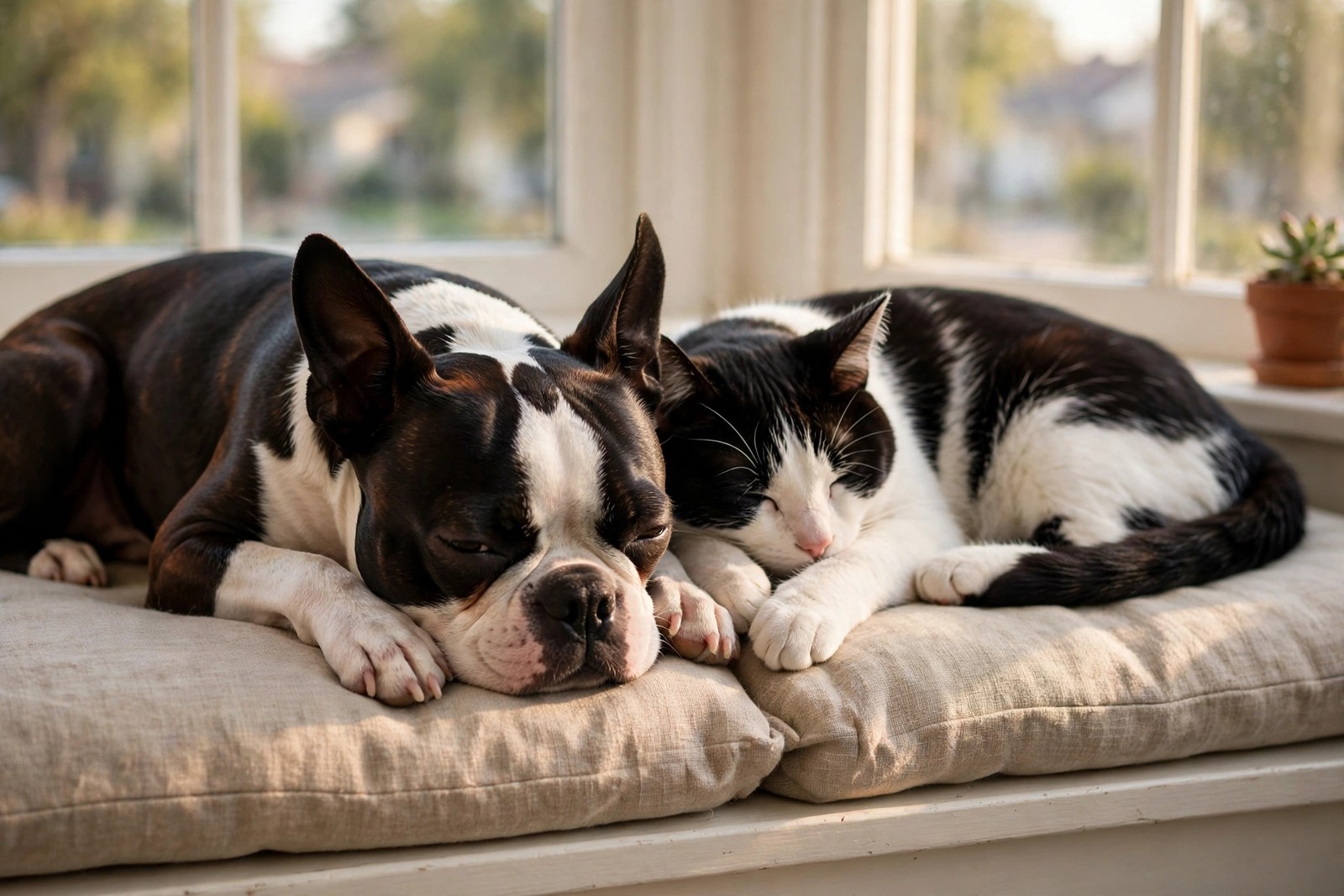
Boston Terriers are one of the more straightforward dogs to settle with a cat. Bred as companions rather than hunters, Bostons generally have little interest in chasing small animals for its own sake, and their size, typically in the same range as a large cat, means the relationship can be genuinely equal: neither animal is physically overwhelming, and cats often find a Boston easier to read than a big, looming breed. What needs managing is the Boston's play style and the breed's breathing, not any deep instinct to hunt.
Where Boston Enthusiasm Meets Cat Manners
A Boston plays the way the breed does everything: with bouncing, spinning, pawing and wrestling, all delivered face to face. A reserved or elderly cat can find it overwhelming, and a cat who feels cornered will swat at exactly the level of a Boston's large, prominent eyes. A scratched eye is painful and needs a vet the same day, so early supervision is about protecting the dog as much as the cat.
Excitement also costs a Boston more than it costs longer-muzzled breeds. The short muzzle that gives the breed its expression makes breathing less efficient, so a dog who winds himself up chasing and wrestling will snort, overheat and tire faster than the cat does, especially in warm weather. Play sessions in the early weeks should be short, in a cool room, and ended by you while both animals are still enjoying themselves, not when the dog is panting hard and too aroused to listen.
Introductions, Boston Style
Start with a few days of scent swapping so the cat learns this particular dog's smell alongside feeding and rest, then meet through a gate with the Boston on a leash. Bostons are usually quick to offer friendly signals, loose wiggles, play bows and rolling over, and you can reward every moment your dog chooses a toy or a look at you over fixating on the cat. Let the cat decide how close to come; a confident cat will often approach the gate within a few sessions.
In the same room, keep a light house line on the dog at first, and structure the time: a little play, then a pause where you call the dog to you, reward him and let arousal fall, then play again if the cat still chooses to stay. That pause-and-resume pattern teaches him that stopping is part of the game.
Rules for Play, Food and Rest
Interrupt wrestling every half minute or so at first, and end it for the day if either animal stops taking breaks naturally, if the cat's ears flatten and her tail lashes, or if the dog's play turns grabby around the cat's neck and legs. Feed the two apart and lift the cat's food to a surface the dog cannot reach, because a Boston who would never bother the cat may still wolf down her dinner; use a raised feeding spot or a room the dog does not enter. Keep the litter tray dog-free too, behind a gate or strap the cat can pass and the dog cannot.
Give the cat permanent high places and at least one dog-free room, and supervise a Boston puppy closely: his bouncing is relentless, and an older cat should never be left to discipline a puppy alone.
When the Pairing Settles
Expect the pattern to be friendship with boundaries. Many Bostons and cats play daily, sleep touching and follow each other around, while still valuing separate feeding and a retreat the dog respects. If, after a few weeks of gradual work, your Boston still cannot disengage from the cat, barks at her through the gate or grabs during play despite pauses, slow down and get help from a qualified behaviour professional.
Because play supervision, separate feeding and short, cool sessions involve whoever is home at the time, write the plan down and share it. KinsLe's Care Teams lets you assign those supervised play sessions, feeding jobs and settling practice across the household, with every completed task marked complete with a timestamp.