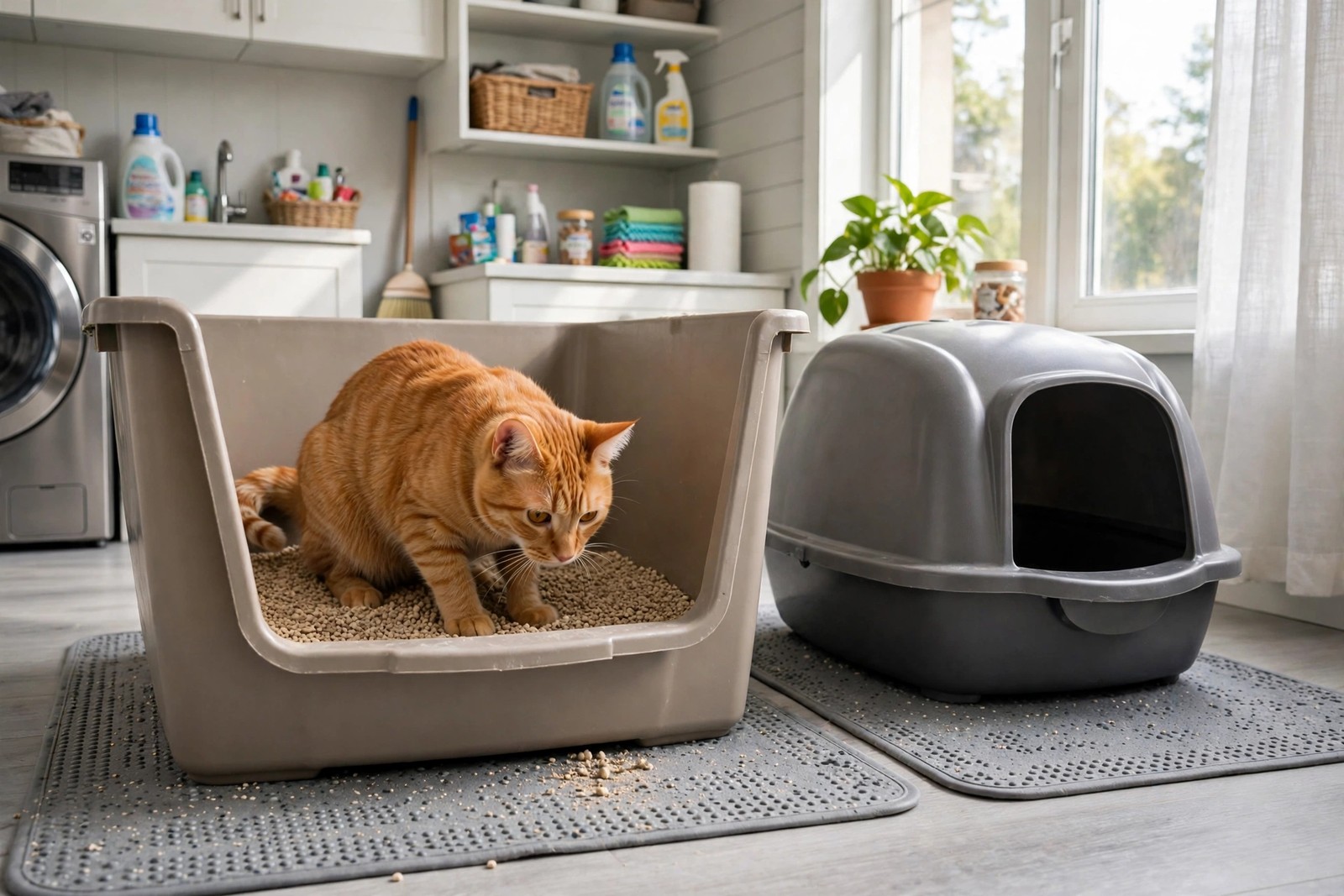
Most cats, given a free choice between two equally clean trays, choose the open one. That preference is not fussiness — it follows directly from how a cat experiences toileting: as a moment of vulnerability, managed by sight, smell, and escape options. A covered tray, or hooded box, is designed around human priorities. Understanding that gap explains a large share of 'mystery' litter problems.
Why open trays suit the cat
A cat in an open tray can see the room, track other pets and people approaching, and leave in any direction. In the wild and in a multi-cat hallway alike, being ambushed mid-toilet is a real fear, and a hood with a single doorway removes every escape route except past the ambusher. Swing doors on covered trays add a further barrier that kittens, arthritic seniors, and nervous cats may push through once and refuse ever after.
Smell is the second issue. A hood does not remove odour; it concentrates it inside the box, at exactly the height of the cat's nose, while the room outside smells fresher to you. Ammonia builds between scoops, and a cat with a sense of smell far keener than ours may choose the bath mat over a tray that smells clean to its owner. Hoods also hide the tray's state from you, so scooping quietly slips from daily to 'when it looks bad' — by which time the cat has been enduring it for days. Large cats add a space problem: many covered trays are too low and short for a big cat to turn, posture, and dig without brushing the roof.
When a covered tray seems to work
Some individual cats use a hooded tray happily for years, particularly in a quiet single-cat home where it is scooped daily and the cat is confident. Owners choose hoods to contain litter kicked by enthusiastic diggers, to keep dogs out, and to tuck the tray into a living space discreetly. Those are legitimate household needs — but solve them without taxing the cat where you can: a large open tray with high sides, a litter mat, a screen or cabinet with a roomy, always-open entry, and a baby gate against dogs often deliver the tidiness without the trapped air and single exit.
If you already use a hood, remove any swing door, scoop at least daily, wash the hood itself regularly since it holds odour, and offer one additional open tray in another spot. Watch the verdict honestly: hovering at the entrance, perching with two paws out, rushing out and shaking, or toileting beside the box are a cat voting against the hood.
Size, number, and the preference test
Whichever style you settle on, the tray should be about one and a half times your cat's length, filled with a few centimetres of litter, unscented for most cats, and provided at one per cat plus one spare, in separate locations. The fairest test is simple: put a large open tray beside the covered one for two weeks, keep both equally clean, and count which your cat uses. Most owners do not need to be told the result twice.
An open tray only stays inviting if it is scooped relentlessly, and KinsLe's Care Teams turn that into a shared, visible routine — scooping and weekly litter changes can be assigned across the household and marked complete with a timestamp, so the cat never faces a dirty tray because everyone assumed someone else had done it.