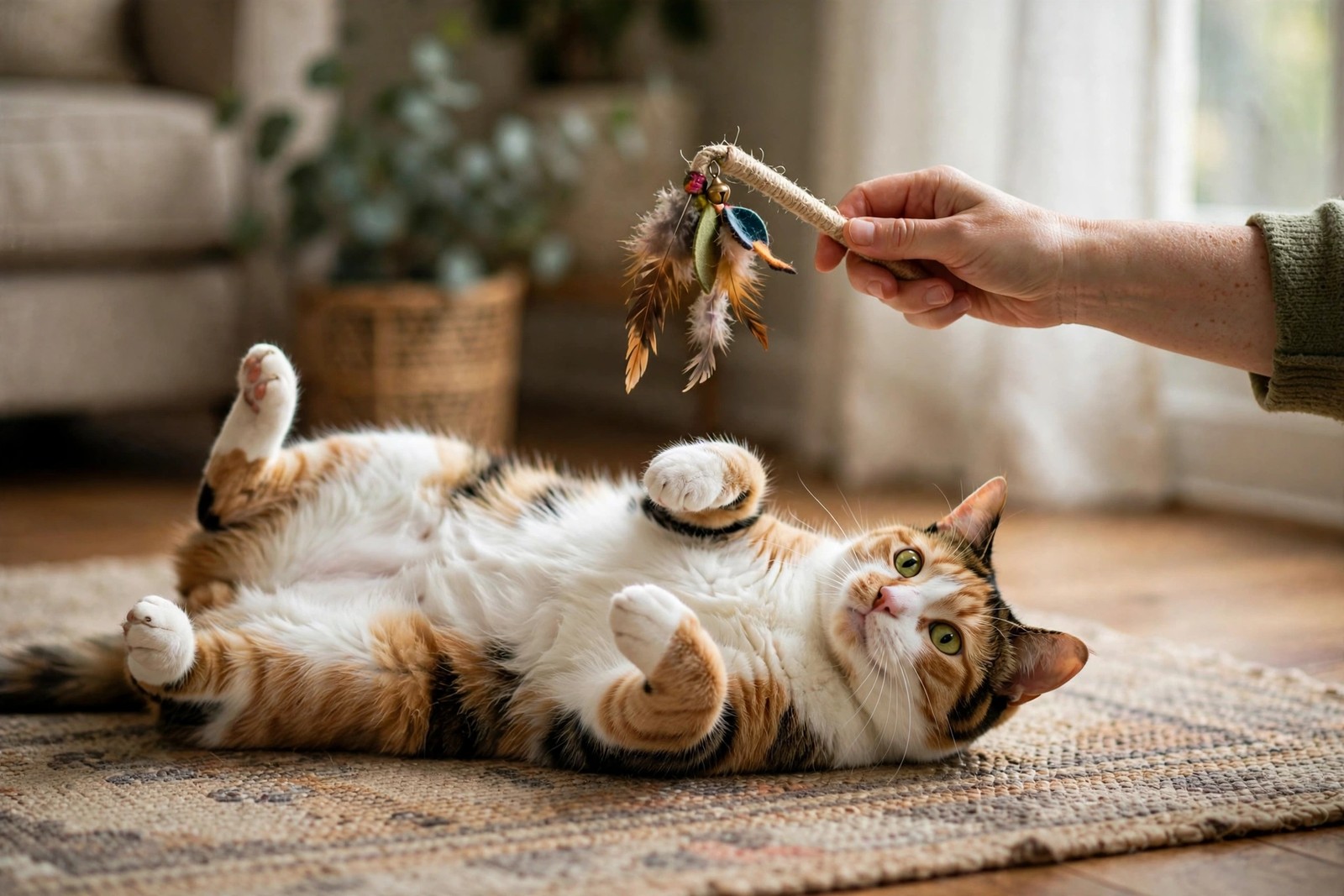
She flops at your feet, rolls onto her back with all four paws in the air, looks at you upside down, and then seizes your wrist the moment you reach for that exposed belly. It feels like a trap she set on purpose. It is actually two honest signals delivered back to back, and the misunderstanding sits in the gap between them: what the roll means in cat language, and what a hand on the belly means.
The Roll Is a Greeting, Not a Request
Cats roll as a social display. Kittens roll near their mother, friendly adults roll near cats they trust, and your cat rolling at your feet, often with a chirp, a stretch, and a slow blink, is saying she is relaxed, pleased to see you, and in a mood for company. Showing the belly is itself the message, because the belly is the body part a cat protects most carefully in any serious conflict. She can afford to display it precisely because she trusts you. A dog rolling over usually is asking for a belly rub; a cat rolling over is showing you a compliment and expecting you to admire it from a respectful distance.
Why Touching It Fires the Reflex
The belly guards her vital organs, its skin is sensitive, and contact there flips many cats from relaxed to defensive in a second. The classic response, forelegs and teeth gripping your hand while the hind paws rake, is the same hold a cat uses on prey or on an opponent's underside in a fight. Overstimulation adds fuel: even cats that tolerate a few belly strokes reach a threshold where sensation tips into irritation, announced, if you are watching, by a tail that starts to flick, skin that twitches along the flank, ears rotating back, and pupils widening. The bite that follows is rarely hard enough to break skin when it is a warning, but it is a real sentence in cat, and it means stop.
Your reaction shapes the next episode. Pulling away fast turns your hand into fleeing prey and can earn a firmer grip, so freeze, let her realise the hand has gone still and boring, and withdraw slowly when her paws loosen. Never scold or tap her nose for it; she answered a touch she had not agreed to, and punishment only teaches her that the greeting itself is risky.
Answer the Greeting the Way She Meant It
Respond where cats actually invite contact. A scratch under the chin, a rub along the cheek, or a stroke over the top of the head matches the greeting and keeps your hand in welcome territory. If the roll has an energetic edge, paws flexing and eyes bright, she may be inviting play instead, so trade your hand for a wand toy or a kicker toy she can grab, bite, and rake with full commitment. That swap is also the long-term fix for kittens and young cats: every belly trap that ends in a toy teaches them hands are never the prize, while hands that keep wrestling back teach exactly the wrong lesson.
A minority of cats genuinely enjoy belly contact, and they tell you by leaning into it, staying loose, and soliciting more without any tail or ear warnings. Even with those cats, work in short bouts and stop first.
Guests and sitters cannot be expected to know your cat's rules, and the flop-and-bite routine is aimed at new hands most of all. Write it into her care instructions in plain words, shown belly means greeting, not touching, and KinsLe's Care Pass lets you send that instruction to a sitter as a time-limited pass covering her care, so the person feeding her while you travel gets the warning before the roll, not after the bite.