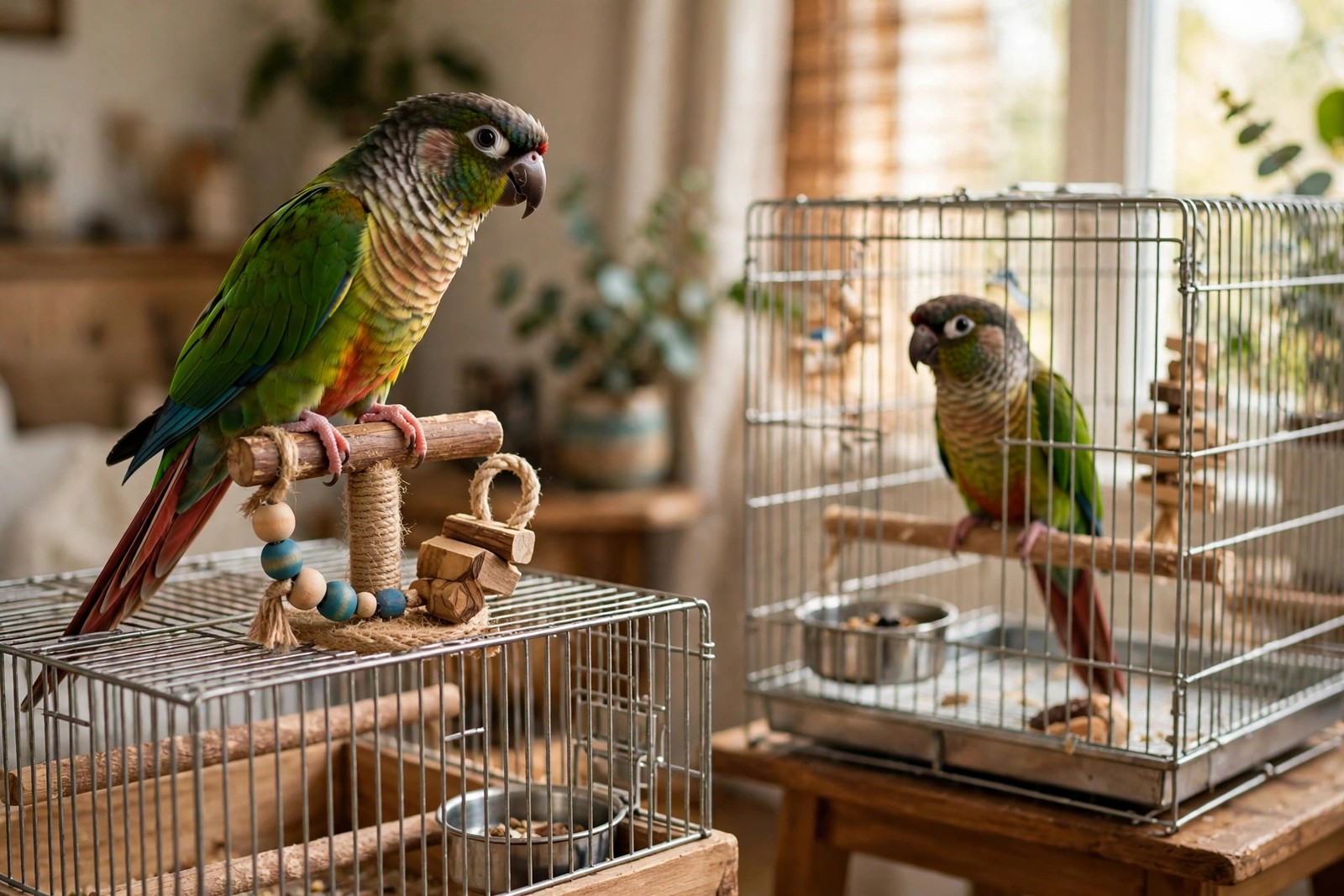
A conure does not need a bird companion in the way it needs food and sleep. What it needs, non-negotiably, is a flock — and in most homes, you are the flock. Conures are intensely social parrots who in the wild stay in near-constant contact with their group, calling back and forth, feeding together, and sleeping in contact. A single conure whose person works from home, trains with it, shares safe mealtimes nearby, and gives it several hours out of the cage daily can be a content, well-adjusted bird. The question only becomes urgent when the human flock is absent for most of the bird's waking day.
Reading a Lonely Conure
Loneliness in a conure rarely looks quiet. Contact calling that escalates into long screaming bouts when you leave the room, feather barbering or plucking, frantic cage pacing, and a bird who glues itself to you the second you return all suggest the social budget is not being met. Rule out the simpler causes first: a conure also screams for a dawn-and-dusk chorus, which is normal, and plucking can have medical roots, so an avian vet visit belongs in the picture before any big decision. If the pattern is clearly tied to your absence, more structured company — not just more toys — is the gap to close.
The Real Trade-Offs of a Second Bird
A second conure, or sometimes another similar-sized parrot, can transform a lonely bird's life: mutual preening, companionable chatter, and a flock mate who is present at 3 p.m. when you are not. The costs are equally real. Two birds may bond so closely that both become less interested in human handling, which is fine if your goal is their happiness and a shock if you wanted a hands-on pet. Noise roughly doubles, and so do food, cage space, and vet bills. There is no guarantee the two will like each other, so a second bird must be a bird you are willing to keep separately, in its own full setup, for life.
If You Add One, Add It Slowly
New birds should be quarantined in a separate room for several weeks with their own dishes and careful handwashing between birds, because apparently healthy parrots can carry contagious disease. After quarantine, place cages within sight, let the birds call and watch each other, then try short supervised time on neutral ground such as a play stand away from both cages, with treats for calm behaviour and a quick, unpanicked separation at the first hard bite or chase. Shared cage living comes last, only after repeated peaceful sessions, and the cage must be big enough for one bird to retreat fully from the other.
Whether you stay a one-bird flock or become two, the daily social programme is what your conure actually experiences. KinsLe Care Teams lets the people in your home split that programme — morning out-of-cage time, foraging toys stuffed fresh, evening training, cage cleaning — with each job assigned and time-stamped, so a busy week never quietly becomes a lonely week for the bird.