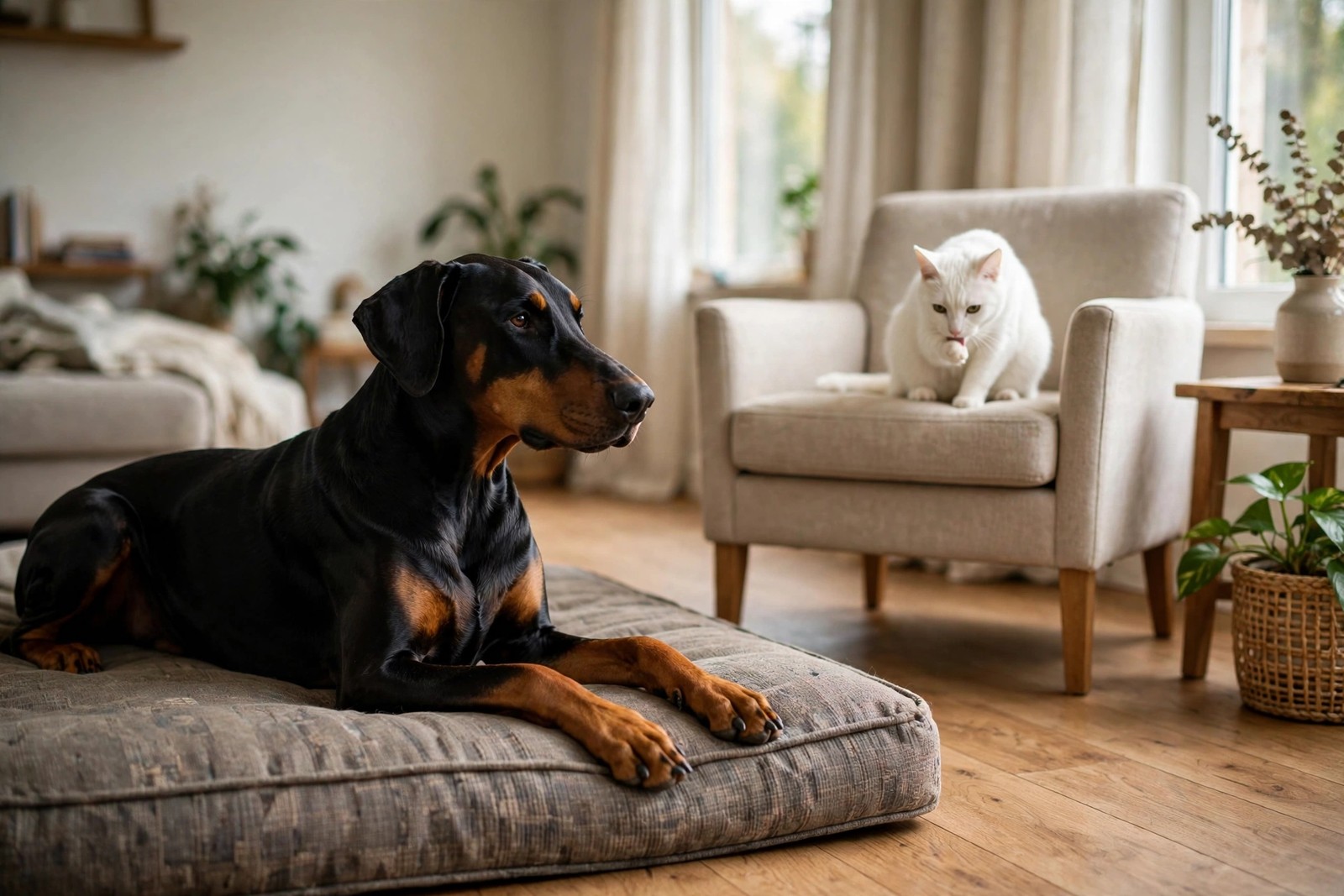
Dobermans have a public image as guard dogs, but owners know the private version: a sensitive, intensely loyal dog who wants to be touching his person and who usually extends that attachment to the other animals in the household. Many Dobermans live gently with cats, sharing beds and following the cat around with soft curiosity. That outcome is built, not assumed, because the breed combines real prey drive with serious size and strength, and a cat's safety depends on introductions and management that respect both.
Indoor Cat, Outdoor Animal: The Split That Matters
A Doberman typically distinguishes clearly between the household cat, who smells of home and belongs to his group, and a strange cat bolting across a garden, who reads as prey. Owners are often surprised by how gentle the same dog is indoors who would chase outdoors in a heartbeat. Plan for both versions of your dog. Indoors, build the relationship slowly and reward calm. Outdoors, keep the dog on a lead or behind secure fencing in cat-visited areas, and train recall honestly on a long line, accepting that a full-speed chase is not a moment to test whether recall has worked.
Inside the house, size is the everyday risk. A Doberman greets by leaning his whole weight against people he loves, plays with large paw movements, and can knock a cat flying simply by turning quickly in a hallway. Teach a settle on a mat, and keep early meetings in a room with space for the cat to keep real distance.
Introductions for a Strong, Fast-Learning Dog
Dobermans are highly trainable and read human reactions quickly, which makes staged introductions productive: many learn the pattern within a few sessions, discovering what behaviour earns rewards near the cat. Begin with scent swapping, then gate meetings with the dog on a leash, at a distance where he can look at the cat, look back at you and take treats. A soft body, ears in their natural position and easy glances away are green lights. A locked stare, closed mouth, weight creeping forward and silence are the opposite, and they mean more distance and more sessions at the barrier, not a firmer voice.
Move into the same room with a trailing line, and structure the time around settling: the dog on his mat, the cat free, rewards for the dog choosing to stay put while she moves. Let the cat approach if she wishes; never lead the dog up to her for a closer sniff. An adult rescue with an unknown history deserves extra stages and extra time before any off-leash trust is given.
Living Together Without Complacency
Feed the animals apart, keep the cat's food and litter tray in a dog-free zone, and give the cat high routes and a room of her own. Keep the pair separated when the house is empty until you have a long, uneventful history together, and re-check that history during adolescence, when young Dobermans test boundaries and their play gets rougher before it settles.
Children should be taught a calm approach around the pair: no chasing games, no cornering either animal, and an adult present while the relationship is young.
Judging the Outcome
Success looks undramatic: a dog who glances at the cat and returns to his mat, a cat who walks the floor in the open, shared naps and no silent fixation. If your Doberman fixates in a way you cannot interrupt, chases with intensity indoors, or guards food, beds or people against the cat, pause the process and work with a qualified behaviour professional; sudden changes in tolerance also merit a vet visit, because pain can sit behind new irritability in a large, stoic breed.
Because supervision, separate feeding and mat practice fall to different people at different hours, writing the plan down is what keeps a strong dog's rules from drifting. KinsLe's Care Teams lets you assign gate sessions, settling practice and feeding jobs across the household, with every completed task marked complete with a timestamp.