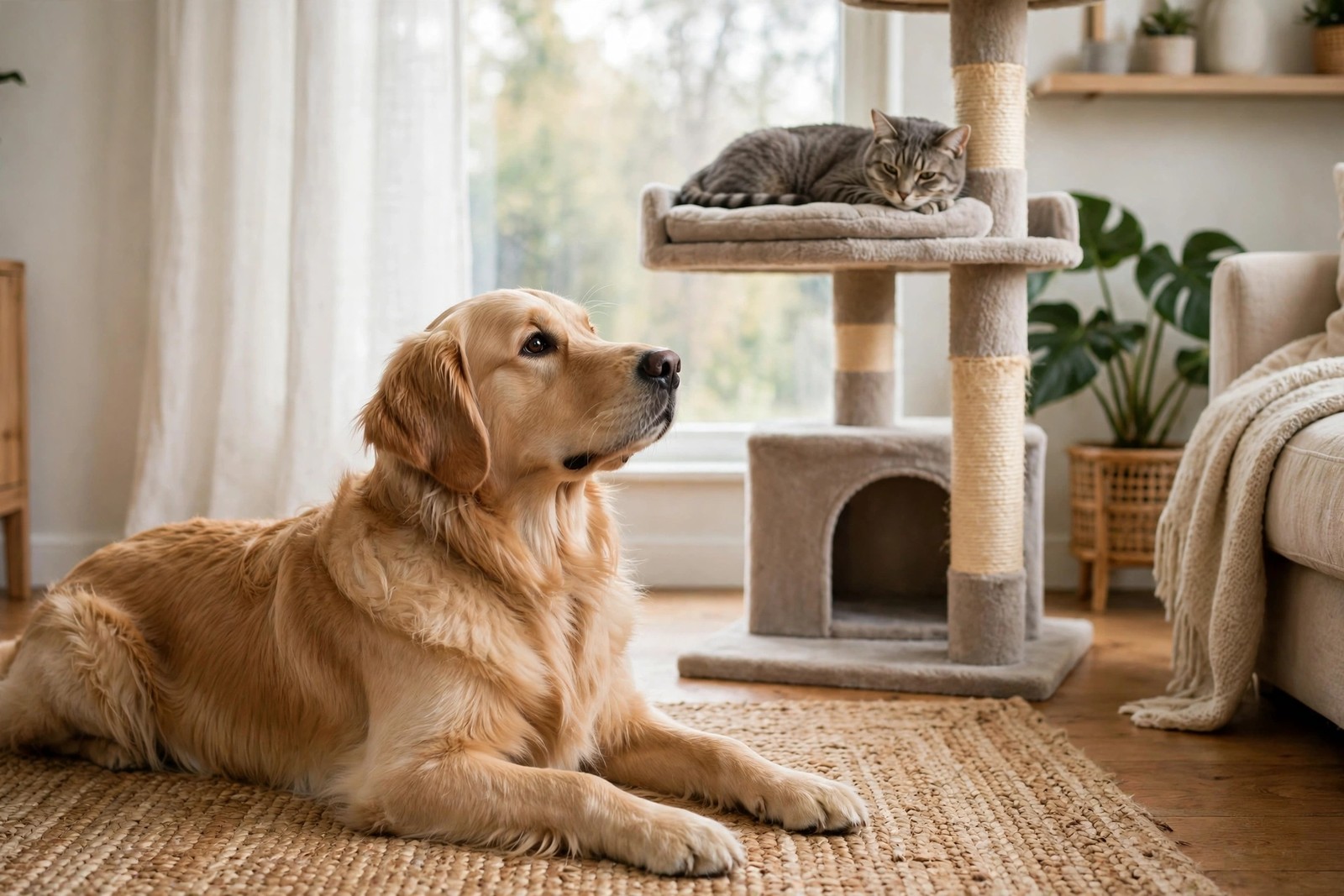
Golden Retrievers usually live peacefully with cats, and the breed gives you a genuine head start. Goldens were developed to work calmly beside people and other animals, carrying game gently instead of chasing it down, so most carry a low prey drive and a notably steady, friendly nature. A Golden is far more likely to greet a cat with a wagging, hopeful interest than with the fixed stare that signals trouble in a high-drive breed. That starting point matters, but it is only a starting point. The individual dog, the individual cat, and above all the way the first weeks are handled decide whether the pair settles into easy companionship or into a tense truce.
Let the Cat Set the Pace
Read the cat, not the dog, when you judge how introductions are going. A Golden will often look relaxed long before the cat feels safe, and pushing ahead on the dog's timeline is the most common mistake. A cat who chooses to stay in the room, eats normally, grooms, and moves around with a level tail and soft ears is coping well. A cat who stops eating, hides for long stretches, flattens her ears, growls from her refuge, or starts toileting outside the litter box is telling you the pace is too fast. Slow down a stage rather than coaxing her out. The cat's confidence, rebuilt at her own speed, is what turns tolerance into genuine ease.
Stage the Introductions
Work through the stages in order, and stay at each one until both animals are bored by it. Begin with scent alone: swap bedding between the dog and the cat, let each investigate the other's smell with no animal present, and feed both near the closed door between them so the new scent predicts good things. Move next to sight behind a barrier, such as a baby gate or a door held slightly ajar and secured, where they can see each other, be rewarded for calm glances, and walk away freely. Only then start short supervised meetings in the same room, with the dog on a loose leash at first, sessions kept brief and ended while everyone is still relaxed. Give the cat escape routes in every room and high places she can reach that the dog cannot — a tall cat tree, a cleared shelf, a gate she can slip through and he cannot. Never leave the pair unsupervised until the calm pattern has held over weeks, not days.
Build One Household Response
Consistency is what makes the stages stick. Everyone in the home should run introductions the same way: the same barrier routine, the same calm rewards for looking away from the cat, the same rule that the dog is called off and redirected the moment he fixates, bounces, or tries to start a chase game. Write the observations down as you go — which stage you are on, how the cat ate and moved that day, how quickly the dog settled. Notes written the same evening catch a slide backward far earlier than memory does. That shared routine is exactly the household plan the Care Teams feature in KinsLe is built to hold: named people take named duties, from morning scent swaps to evening barrier sessions, and the cat's reactions are recorded where the whole household can see them. A Golden puppy raised this way usually grows into a dog the cat treats as furniture with a heartbeat, and an adult Golden new to cats can learn the same lesson when the stages are honored. Written down once and followed by everyone, the introduction schedule lives in KinsLe, where the Care Teams plan names who handles each stage and what calm looks like before the next one begins.