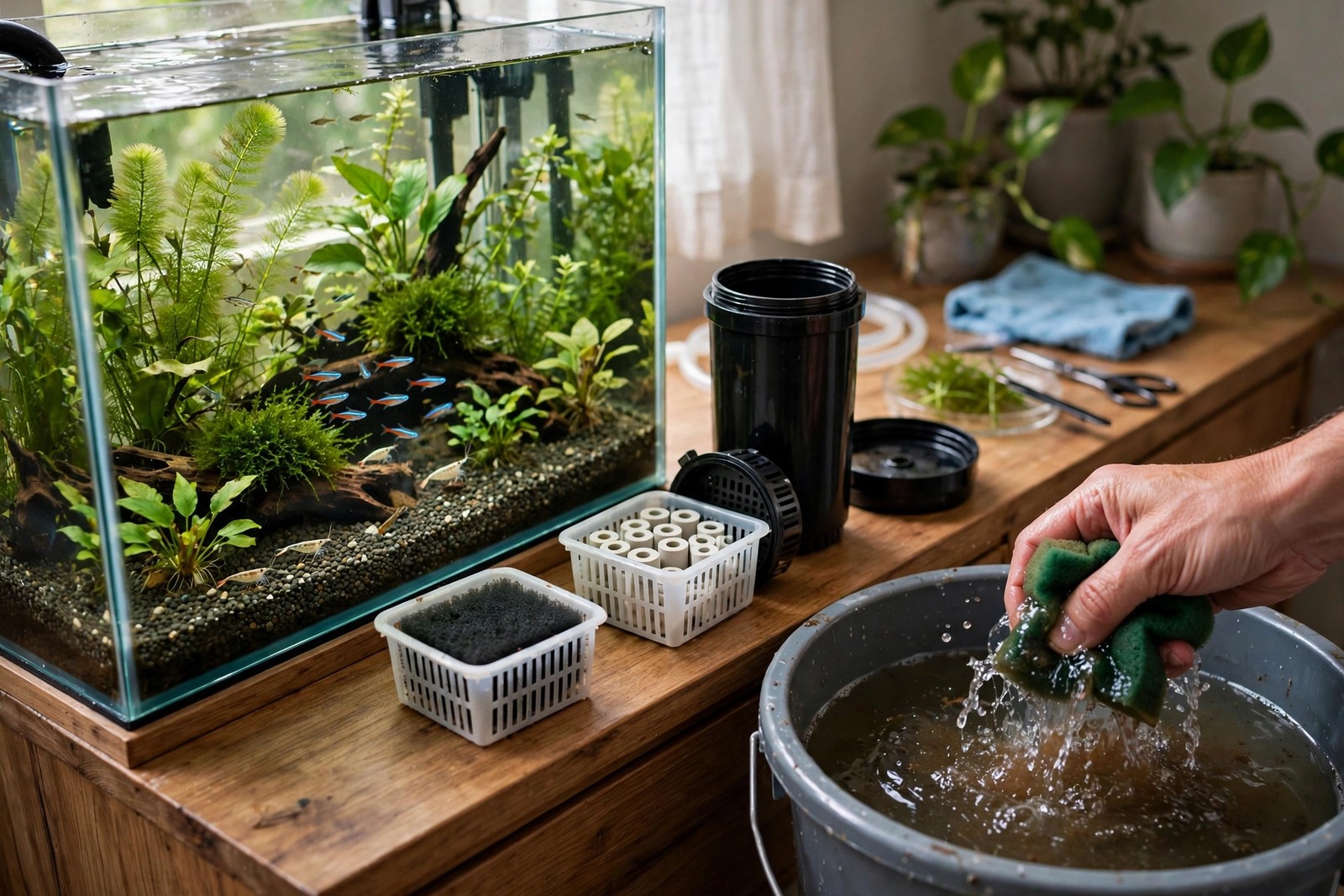
No. This is one of the most reassuring facts in fishkeeping, and it is widely misunderstood. Cycling is not a treatment you apply to a tank on a schedule; it is the one-time establishment of a living bacterial colony. Once that colony exists, it maintains itself indefinitely, working every hour of every day, provided its living conditions are not destroyed. An established tank never needs cycling again just because time has passed.
What 'Established' Actually Means
The nitrogen cycle runs on two groups of beneficial bacteria. The first converts ammonia — produced by fish waste, uneaten food, and decaying plants — into nitrite. The second converts nitrite into nitrate, which is far less harmful and is removed by your regular partial water changes and absorbed in part by live plants. Ammonia and nitrite are both dangerous to fish even at low levels; nitrate is manageable at the modest levels a maintained tank holds.
Crucially, these bacteria do not live mainly in the water. They live on surfaces, and overwhelmingly they live in your filter media, with smaller populations in the substrate and on decor. That single fact explains everything about protecting the cycle: the filter media is the cycle. Change the water and the cycle barely notices. Throw away the media and you have thrown away the colony, however mature the tank.
The Events That Force a Re-Cycle
A full re-cycle or a partial 'mini-cycle' — a temporary ammonia or nitrite spike while the colony rebuilds — follows only from specific accidents or decisions:
- Replacing all filter media at once with brand-new media, instead of staggering changes or rinsing and reusing it.
- Rinsing media under untreated tap water, whose chlorine or chloramine kills bacteria, or washing it with any soap or detergent.
- Letting media dry out, during a long power cut with the filter off, a house move, or a filter left unplugged after cleaning.
- A tank crash: a large die-off, heavy overfeeding rotting in the tank, or a medication that is not safe for filter bacteria, overwhelming or killing the colony.
- A sudden large increase in stock, which is not a destroyed cycle but an outgrown one — the colony needs days to expand to the new waste load, and ammonia can spike meanwhile.
Protecting the Colony You Already Have
A few habits make a re-cycle almost impossible in a running tank. Rinse filter media gently in a bucket of water you have just removed from the tank during a water change — never under the tap — and only when flow has visibly slowed. If media must eventually be replaced, run old and new together for several weeks, or replace only part at a time. During a power cut, keep media submerged in tank water and get the filter running again as soon as power returns; bacteria tolerate hours wet and still far better than a short time dried out. When moving home, transport media in a sealed container of tank water like the fish themselves — because, biologically, it is livestock too.
For a brand-new second tank, that media is also a shortcut: seeding the new filter with some established media can shorten its cycling greatly, though the new tank still needs testing before fish are added.
Testing After Any Disturbance
After any event on the list above — a filter change, a long outage, a move, a death in the tank — test ammonia and nitrite daily for several days. Zero readings on both, with some nitrate present, mean the cycle survived. Any ammonia or nitrite reading means partial water changes to dilute it and close watching until readings return to zero.
Routine testing in a stable tank can relax to a weekly or fortnightly habit, tied to your water-change day. Keeping those tests from slipping is a shared-household problem as much as a fishkeeping one, and KinsLe Care Teams solves it by letting you assign your tank's water tests, water changes, and filter-media checks to named helpers, each completed task timestamped so the cycle's guardians never have to guess what was done.