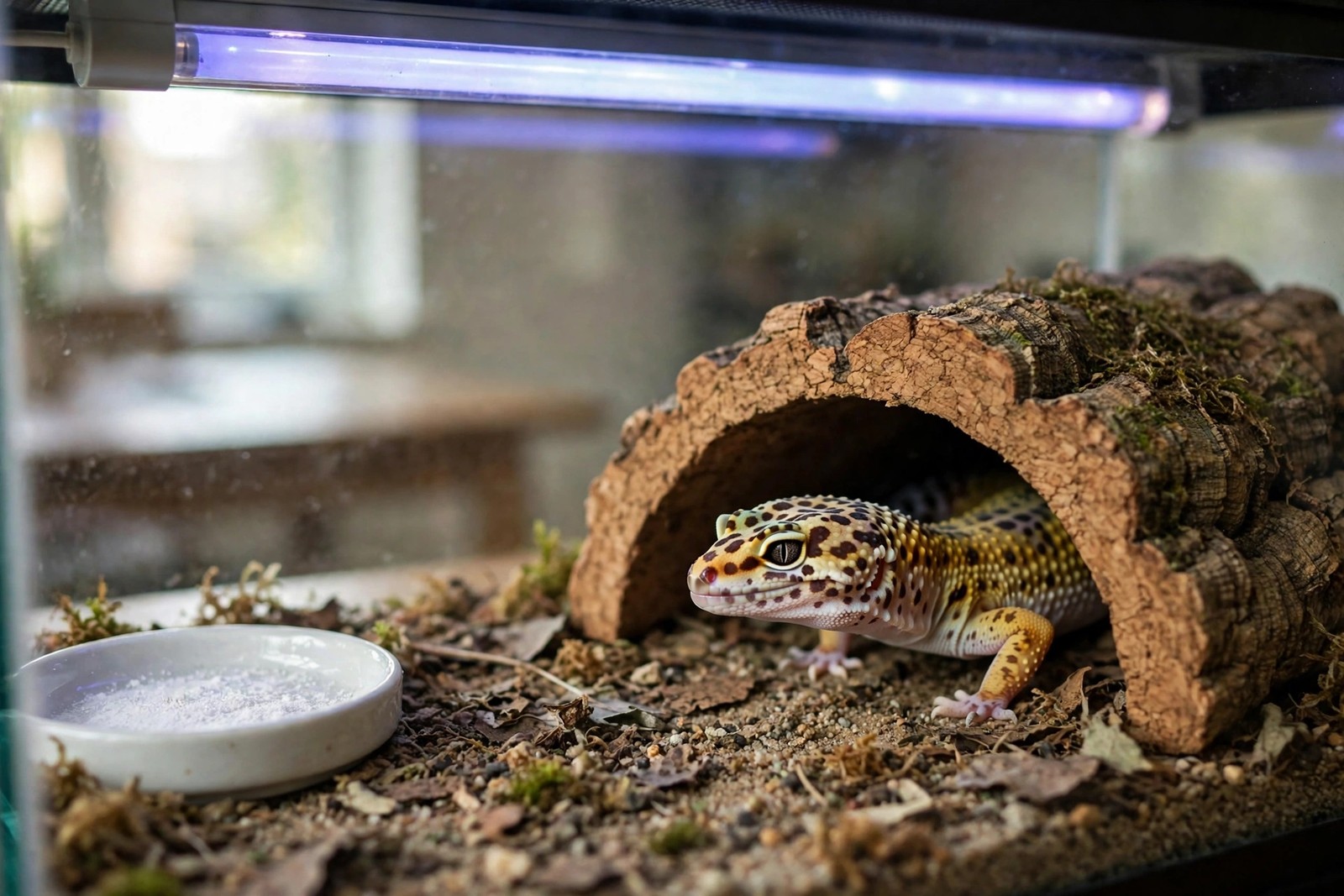
For years the standard advice was that leopard geckos, being active at dusk, needed no ultraviolet light at all, provided their insects were dusted with vitamin D3. That advice has shifted. Wild leopard geckos in the rocky grasslands of southern Asia are out at dawn and dusk, and keepers and reptile vets now recognise that they expose themselves to low levels of UVB at those times and use it. The current position: UVB is not the only route to vitamin D3, but providing gentle UVB is the more natural, more forgiving option, and it is what most experienced keepers now recommend.
What UVB Actually Does for a Gecko
UVB light lets the gecko's skin produce vitamin D3, and D3 is what allows the gut to absorb calcium from food. Calcium drives bone strength, muscle function, and, in females, eggshell formation. When D3 runs short — whether because there is no UVB and the supplement routine slips, or because plain calcium without D3 is being used — the body pulls calcium from the bones instead. Over months that produces metabolic bone disease: a soft or rubbery jaw, bowed legs, tremors, and a gecko who stops hunting. Those signs mean a prompt visit to a reptile vet, not home experimenting.
Setting Up Low-Level UVB Safely
The keyword is choice. Fit a low-output UVB tube across the warm end of the enclosure only, so the cool end stays unlit and the gecko can move in and out of the light as it would between rocks at dusk. Provide solid hides on both the lit and unlit sides, plus pieces of cork bark or similar cover in between, so the gecko can expose just part of its body while feeling hidden — behaviour keepers call cryptic basking. Albino and other pale morphs have more light-sensitive skin and eyes, so for them keep the output at the gentle end and the shaded cover generous. Follow the lamp maker's distance guidance for its tube, because output falls off quickly with distance and a mesh lid filters out a share of the light.
The Tube Looks Fine Long After It Stops Helping
A UVB tube keeps glowing visibly for far longer than it keeps producing useful UVB, so the replacement date — not the light — is what you manage. Most tubes are due for replacement roughly every six to twelve months depending on type, and the honest way to handle it is to write the fitting date on the tube itself with a marker and replace it on schedule. You replace a spent tube; you do not wait for it to fail. Keep dusting feeder insects with calcium as well — UVB and supplements are partners, not rivals — and keep a shallow dish of plain calcium available in the enclosure, which many geckos lick directly.
If You Keep a Gecko Without UVB
Some long-kept geckos do well without it, but the margin for error moves entirely onto the supplement routine: feeder insects dusted with a D3-containing supplement at most feeds, every week, for the gecko's whole life, with no gaps when a sitter takes over or a tub runs out. That fragility is the practical argument for UVB — the lamp quietly covers the days the dusting goes wrong. Whichever route you choose, watch the gecko: a keen hunter with firm limbs, a plump tail, and clean, complete sheds is telling you the system works, while appetite loss, wobbly walking, or a soft-feeling jaw is a vet conversation.
UVB succeeds or fails on dates and small repeated tasks, which is exactly where shared households drop the ball. KinsLe's Care Teams lets you assign the tube replacement, the dusting at each feed, and the weekly water-dish wash to named people with the dates attached, so your leopard gecko's light and calcium never depend on one person's memory.