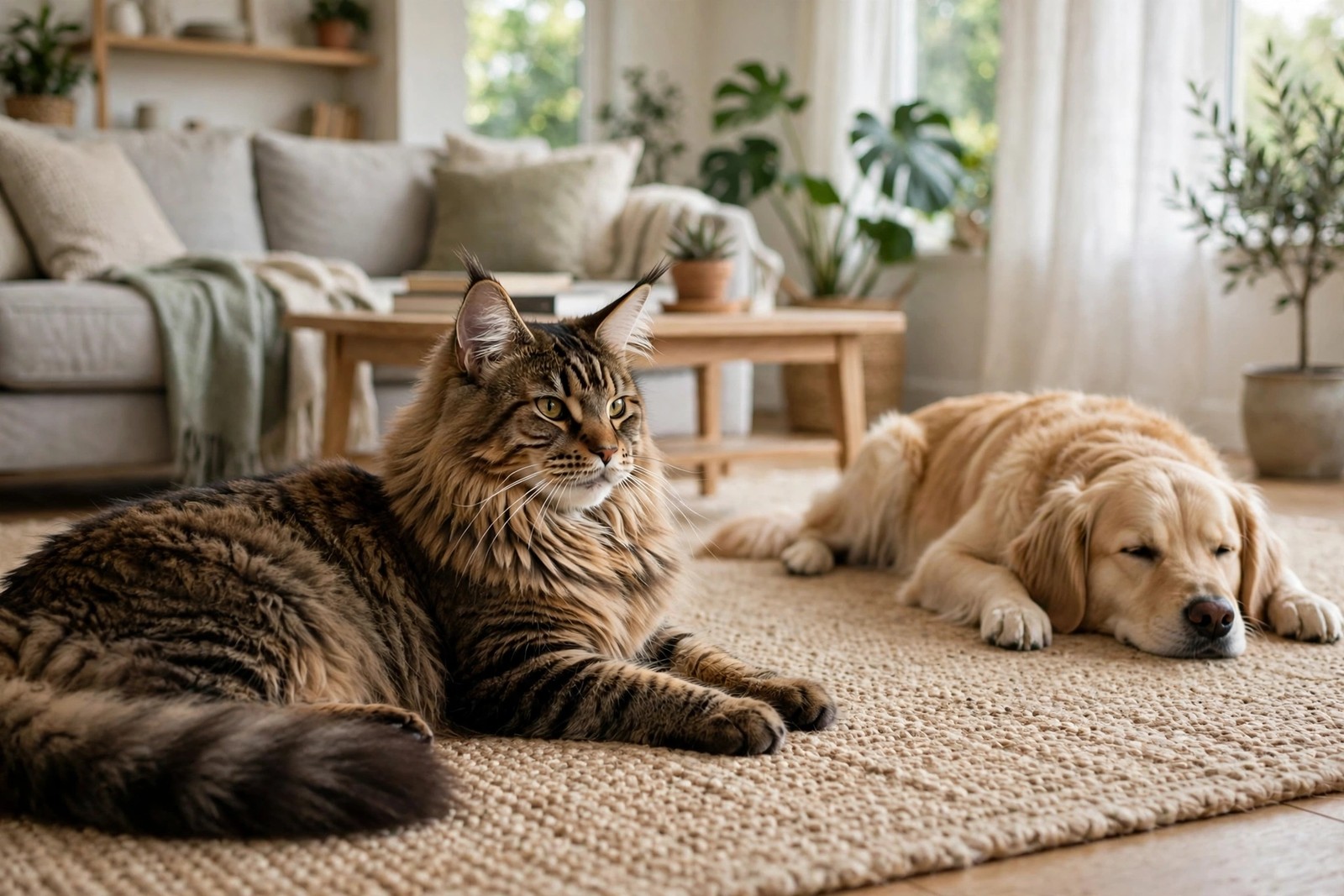
Of all the breed combinations owners ask about, Maine Coon and dog is one of the most hopeful, because the Maine Coon brings unusual assets to the negotiation. This is one of the largest domestic cat breeds, with a sturdy, muscular build and a temperament repeatedly described as dog-like: sociable without being clingy, playful well into adulthood, and inclined to follow household life around rather than observe it from hiding. Many chirp and trill at their people and even at the dog, play fetch, and choose to sleep near the action. A cat who stands its ground, blinks slowly, and saunters away invites far less chasing than a cat who bolts, and Maine Coons are temperamentally built to be the first kind.
The Dog's Half of the Bargain
The cat is only half the match. A dog with a history of chasing cats, squirrels, or anything that runs — especially a young, high-energy dog with a strong prey drive — can make any cat's life miserable or dangerous regardless of breed, while a dog who has lived calmly around cats, or who is steady, trainable, and capable of a relaxed down-stay, gives the Maine Coon the respectful audience it needs. Size cuts both ways: a Maine Coon can hold its own socially, but a large playful dog can still injure a cat accidentally in rough play, so compatibility is about the dog's self-control as much as the cat's confidence. Be honest about the dog you have, not the dog you hope training will produce by next month.
A Staged Introduction That Respects Both Animals
Start with separation and scent: keep the newcomer, cat or dog, behind a closed door, feed both animals on opposite sides of it so each learns the other's smell means dinner, and swap bedding between them. Next come visual introductions through a baby gate or a cracked, secured door, with the dog on a lead, rewarded for calm glances away from the cat and removed before excitement builds. Only then try shared space, dog still on a lead, with high shelves, a cat tree, and an always-open escape route for the cat, ending every session while things are still boring. Sessions of a few relaxed minutes, repeated daily, build the relationship far better than one long free-for-all, and food, litter trays, and resting spots should stay separated until the two are genuinely relaxed together.
Signs It Is Working — and Signs to Slow Down
Good signs are gloriously dull: the cat choosing to stay in the room, grooming or eating near the dog, slow blinks, and play that either animal can walk away from. Many Maine Coons end up actively fond of their dog, head-butting it, joining its walks around the garden, or sleeping against it. Warning signs are a dog who fixates with a hard, silent stare and cannot be called away, a cat who stops eating or hides for whole days, and any chase that ends in a corner. Those mean return to the previous stage for longer, or bring in a behaviour professional, not push through and hope.
A mixed household runs smoothly when every person follows the same stages and feeding arrangements, which is easier to promise than to remember across a busy week. KinsLe Care Teams keeps that shared plan visible by assigning the door-feeding sessions, the supervised time together, and each pet's separate meals and litter care to named people, stamped when done, so your Maine Coon's new friendship with the dog grows at the pace both animals chose.