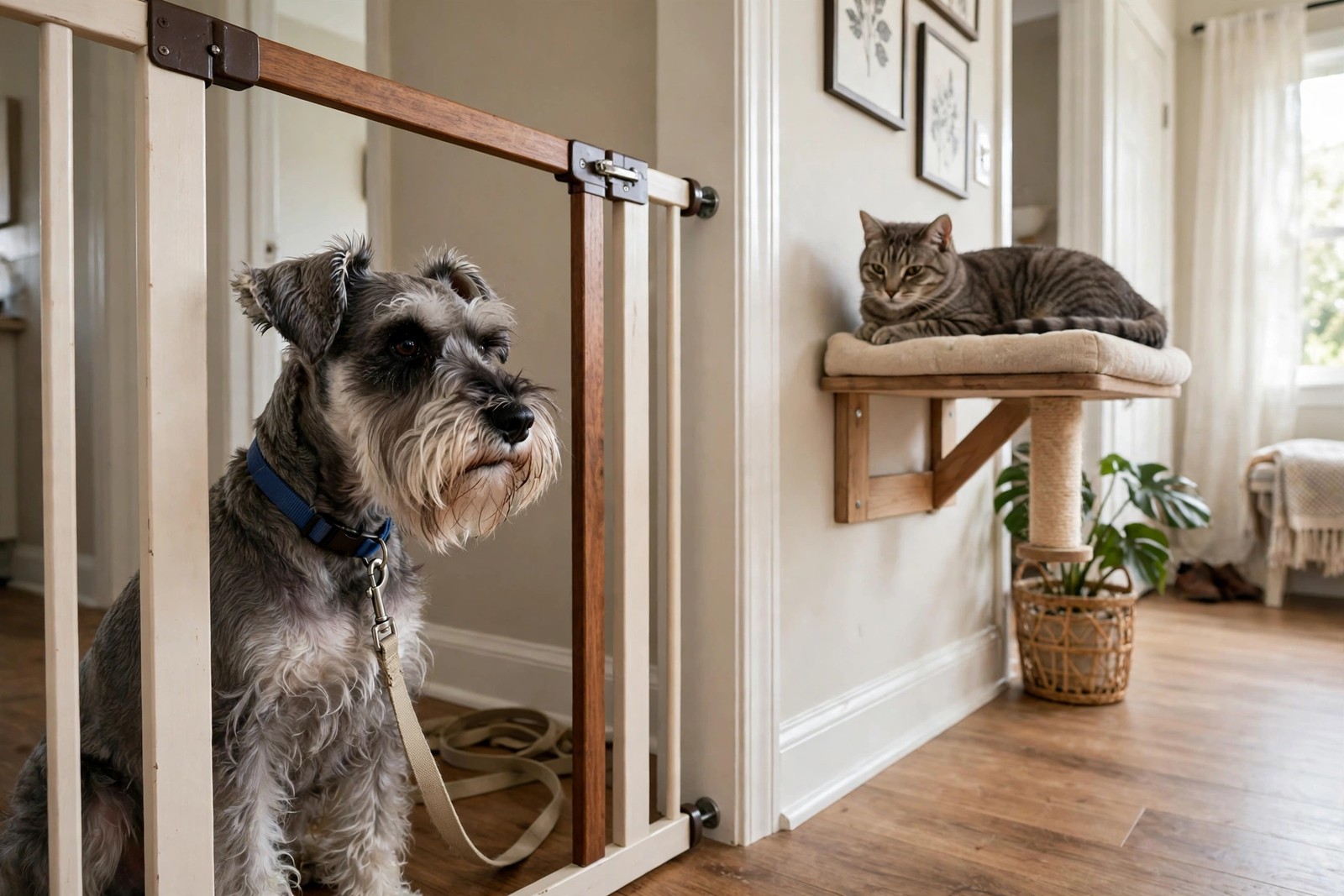
A Miniature Schnauzer can absolutely live well with a cat, and many do, curling up in companionable indifference once the novelty fades. The honest difference from a retriever is the starting instinct. Schnauzers descend from farm terriers bred to spot movement, give chase, and deal with vermin around barns, and that heritage survives in many individuals as a sharp, joyful urge to pursue anything that darts. A cat sitting still may earn barely a glance, while the same cat bolting down the hallway can flip a switch. Judge your own dog by that moment — the reaction to a moving cat — because it decides how slow and how managed your timeline needs to be.
Slower Stages, Stronger Management
Use the same broad sequence as any dog-and-cat introduction — scent first, then sight, then supervised time together — but hold each stage longer and add control a retriever household may never need. Scent swapping and feeding on opposite sides of a closed door can run for a week or more. Sight sessions belong behind a sturdy barrier, with the Schnauzer on a leash even then, rewarded for glancing at the cat and turning back to you. Early meetings in the same room stay leashed, short, and calm, and they end before excitement builds rather than after. A dog who whines, trembles, and cannot look away from the cat is not ready for more freedom; a dog who notices, sighs, and settles is showing you the stage is working.
Interrupt the Chase Before It Starts
Chase rehearsed is chase learned, so your job is to prevent the rehearsal. Watch for the early signs — body stiffening, ears pricking hard, weight shifting forward — and call the dog away or step on the leash line before the lunge, then redirect that energy onto something legal: a toy presented with real enthusiasm, a quick scatter of treats to hunt on the floor, a short game in another room. Never punish the dog for the instinct, and never let the cat become the training tool by scolding around her. Give the cat permanent cat-only zones the dog never enters, guarded by gates the cat can slip or jump and the dog cannot, with litter, food, water, and high resting places inside them. A cat who knows she can always leave is a cat who panics less, and a cat who panics less runs less — which removes the very trigger the terrier finds irresistible.
One Plan, Run the Same Way by Everyone
A managed introduction fails fastest when one person enforces the leash rule and another lets the dog greet the cat loose because it seemed fine. Agree the stages, the signals, and the redirection routine in advance, and write down what each session showed: how the dog responded to a moving cat, how long settling took, whether the cat used her zones calmly. Those written observations are the heart of the household response plan held in the Care Teams feature in KinsLe, where barrier duty, leash handling, and feeding in separate spaces are assigned by name instead of left to whoever is nearest. Given that structure, plenty of Schnauzers and cats reach a durable, relaxed coexistence — the dog learns the cat is household, not quarry, and the cat learns the dog can be predicted. For the dog who fixates despite weeks of careful stages, a certified behavior professional is the honest next step, and the notes you kept make that consultation far more useful. Inside KinsLe, the Care Teams schedule gives this slower introduction its staying power, because the household plan assigns every barrier session and cat-zone check to a named person each day.