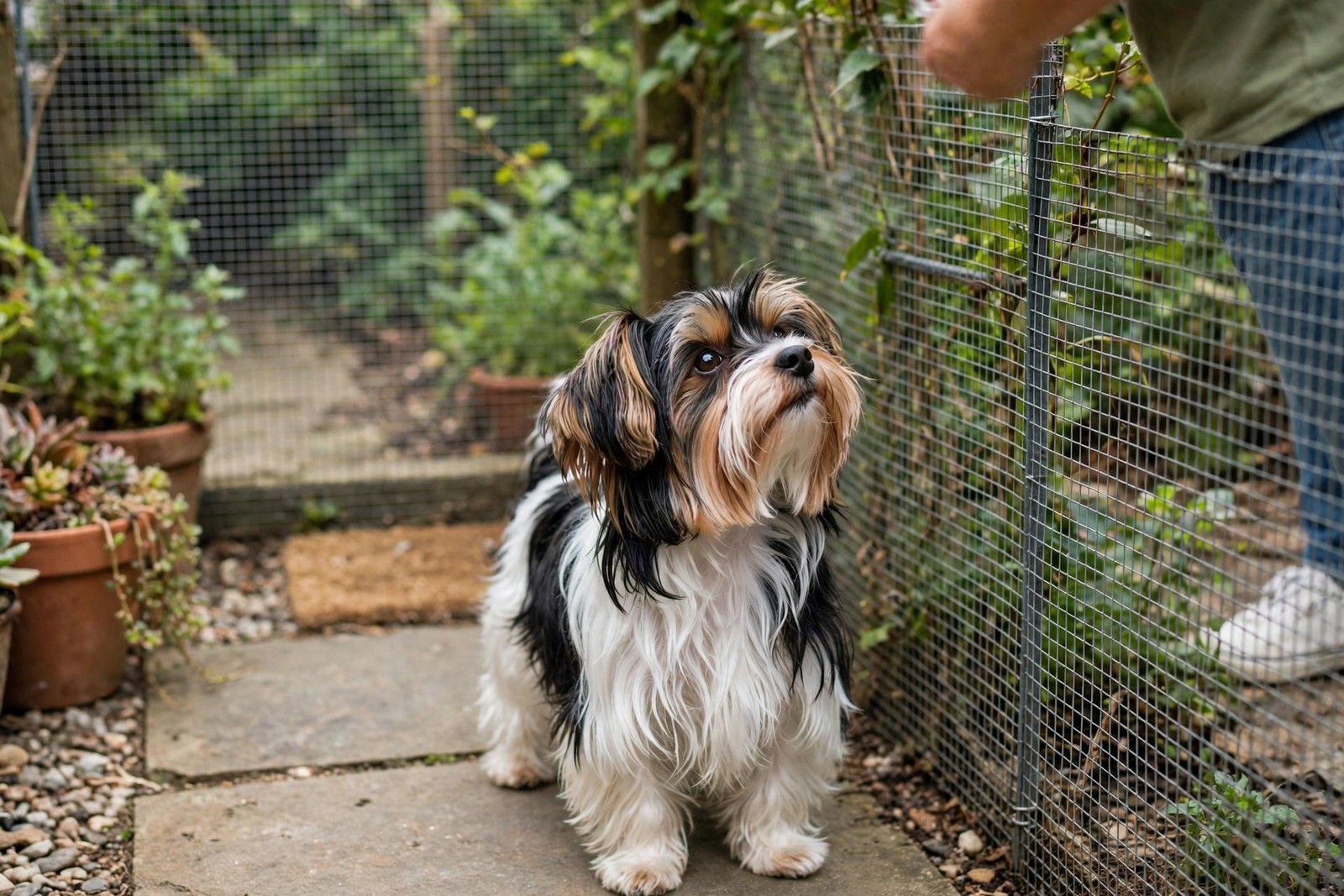
Small dog, different kind of risk
A Biewer Terrier is a toy companion with flowing tricolour hair and a devoted, stay-close temperament, so the classic escape story — a dog ranging off after adventure — is not really this breed's pattern. The secure fence matters for the opposite reason: almost every standard fence was built to contain much larger animals, and a Biewer can pour itself through spaces an adult would never notice. Add the threats that exist specifically at this size, from owls and hawks to a loose neighbourhood dog, and unfenced outdoor time needs far more supervision than most new toy-breed owners expect.
Gaps a Biewer can use without trying
Walk your boundary at Biewer eye level, ideally on your knees. The usual failures are the clearance beneath a gate, the diamond openings in chain-link, the spacing between deck or balcony rails, and the gap where a fence meets a house wall or a hedge thins out. Biewers are terriers underneath the silk, curious and surprisingly game, and a puppy will investigate every one of those openings on an ordinary sniff around. Digging is rarely the issue; squeezing is. Even a dog with no wish to leave can follow a butterfly through a rail gap and find itself somewhere it cannot retrace.
What secure looks like at toy scale
Fine mesh along the inside of an existing fence, a sweep fitted under gates, and panels closing the junctions at walls turn a normal yard into a Biewer-safe one. Check the line again after storms, gardening work, or any digging by other animals, because a single new hollow under the mesh reopens the whole question. Keep the outdoor area itself kind to a tiny dog: shade and shelter close to the door, no deep water feature the dog could fall into, and plants and garden chemicals checked for safety. Supervision still matters — a fenced Biewer should be accompanied outside where birds of prey hunt.
The leash still does most of the work
For most Biewer owners, the honest answer is that outdoor life is mostly leash life: harness walks, carried stretches in busy places, and fenced freedom as a supplement for play and toilet breaks rather than the main event. A harness suits this breed better than a collar for walking, spreading pressure away from a delicate neck. Recall training is still worth teaching — a cheerful, well-rewarded come is your backup for the day a front door, a visitor, and a determined little dog coincide — but a toy breed's safety plan should never actually depend on it outdoors.
Tiny dogs get lost quietly
A missing Biewer does not announce itself like a big dog: it can shelter under a porch, tangle in shrubs, or be picked up by a kind stranger who assumes it was abandoned nearby. Speed and local reach decide these reunions, and clear photos of that distinctive coat, kept current as the hair grows, help finders recognise the dog instantly. That is the gap KinsLe's Lost Pet Alert System is built for — one free alert to Circle of Love members nearby, letting whoever has found your little dog message you directly instead of guessing where it belongs.