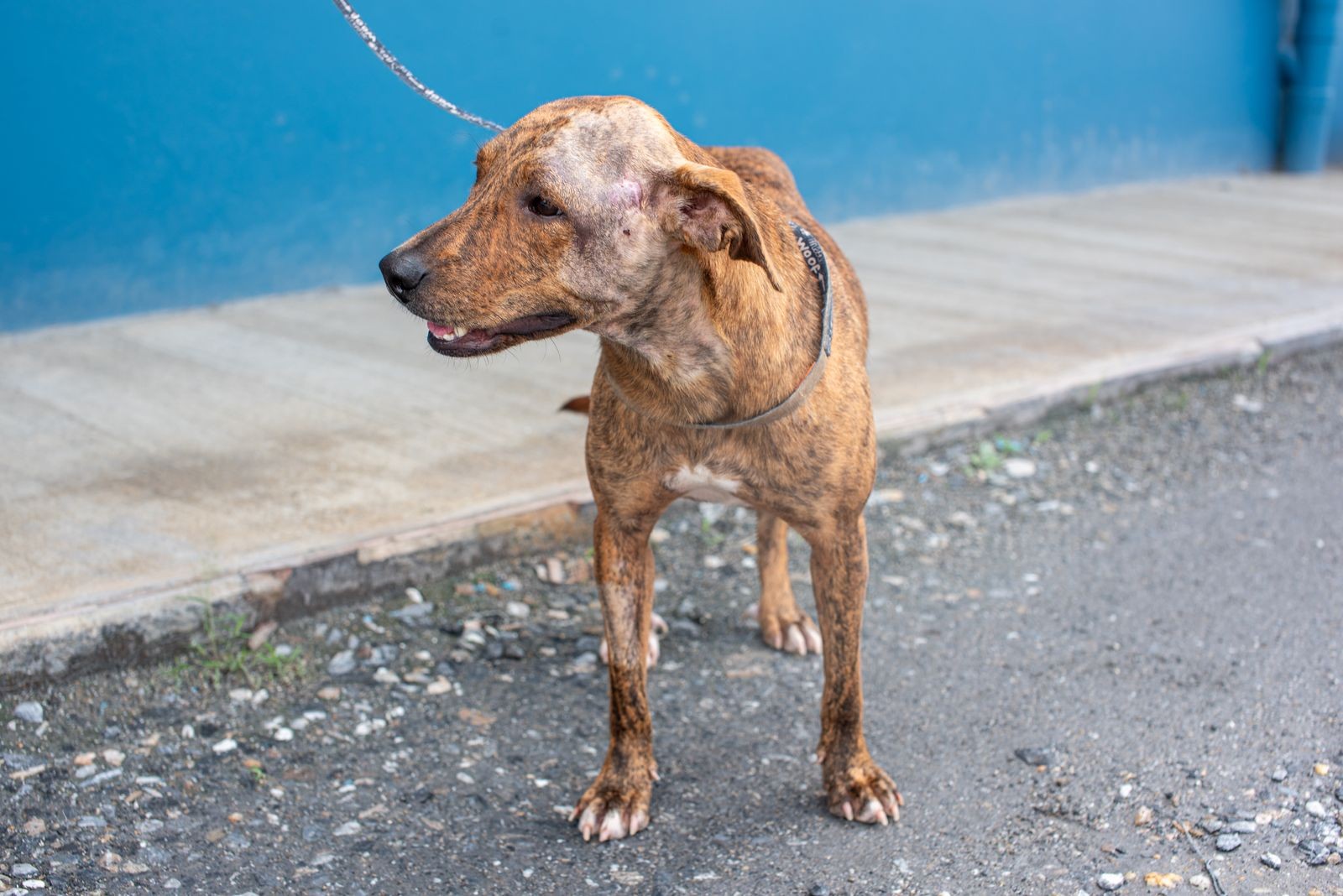
You build confidence in a fearful dog by making life predictable and letting them choose: predictable routines, choice-based games, sniffy decompression walks, and training that rewards brave little steps without ever pushing your dog past their comfort zone. The through-line is control. A dog who can approach, retreat, and say "not yet" — and have that answer respected — learns the world is negotiable rather than overwhelming, and that learning is what confidence is actually made of.
What fear looks like in everyday life
Fearful dogs are not always the ones cowering in corners. Signs include a tucked tail, ears pinned back, lip licking and yawning when not tired, a low crouched posture, avoiding eye contact, freezing, excessive shedding or drooling in new places, and the "whale eye" that shows the whites of the eyes. Some fearful dogs flee; some bark and lunge to create distance, which is often misread as confidence or aggression. Learn your own dog's early signals — the first lip lick or weight shift — because those quiet tells are your cue to make things easier before your dog has to shout.
Make the world predictable
Routines are scaffolding for a nervous mind. Feed, walk, play, and rest at roughly the same times, in the same patterns, so your dog can relax between events instead of bracing for surprises. At home, give them a permanent safe base — a bed or crate corner that is always available and never a place they are dragged from. Introduce new things one at a time, at a distance, and let familiarity do the work: the new vacuum sits in the corner for two days before it ever moves or makes a sound. Predictability does not mean a boring, sealed-off life; it means novelty arrives in doses your dog can digest.
Choice-based games and sniffy walks
Sniffing is the fearful dog's superpower. Decompression walks — long leash, quiet green space, dog chooses the route and sniffs every blade — lower arousal more reliably than any drill. At home, scatter treats in grass or a snuffle mat, offer cardboard boxes to shred and forage through, and play games where your dog controls the pace. Teach simple skills with rewards, and celebrate tiny offers: a paw toward the new object, a glance at the scary thing followed by a look back at you. If your dog wants to leave, leave. Every respected retreat builds trust that trying is safe, and trying is the raw material of bravery.
What to avoid
Flooding is the big one: dragging a dog into the farmers' market, holding them still for greetings, or forcing them to "face" the vacuum helps no one and often sensitizes rather than soothes. Avoid coddling rituals that add frantic energy — calm presence beats dramatic soothing — but never withhold comfort either; a steady hand and a quiet voice are fine. Punishment has no place here at all. Progress with fearful dogs is slow and uneven, with good weeks and sudden regressions after a single bad scare. That pattern is normal, not failure, and timelines are measured in months.
You do not have to do this alone
Living with a fearful dog can feel isolating — the walks at odd hours, the declined invitations, the explanations. KinsLe's Circle of Love is the community of pet lovers inside KinsLe who understand exactly that journey, because so many of them are walking it too. Every pet profile on KinsLe is free for your first pet, and Pet Lovers can join free as well; each new member strengthens the network, which also powers the free Lost Pet Alerts included in every profile. Shared experience, steady encouragement, and practical ideas from people who get it make the slow work feel doable. Through the Circle of Love on KinsLe, you can draw on owners who have lived through the odd-hours walks and setbacks, and borrow perspective that steadies the next small step.