
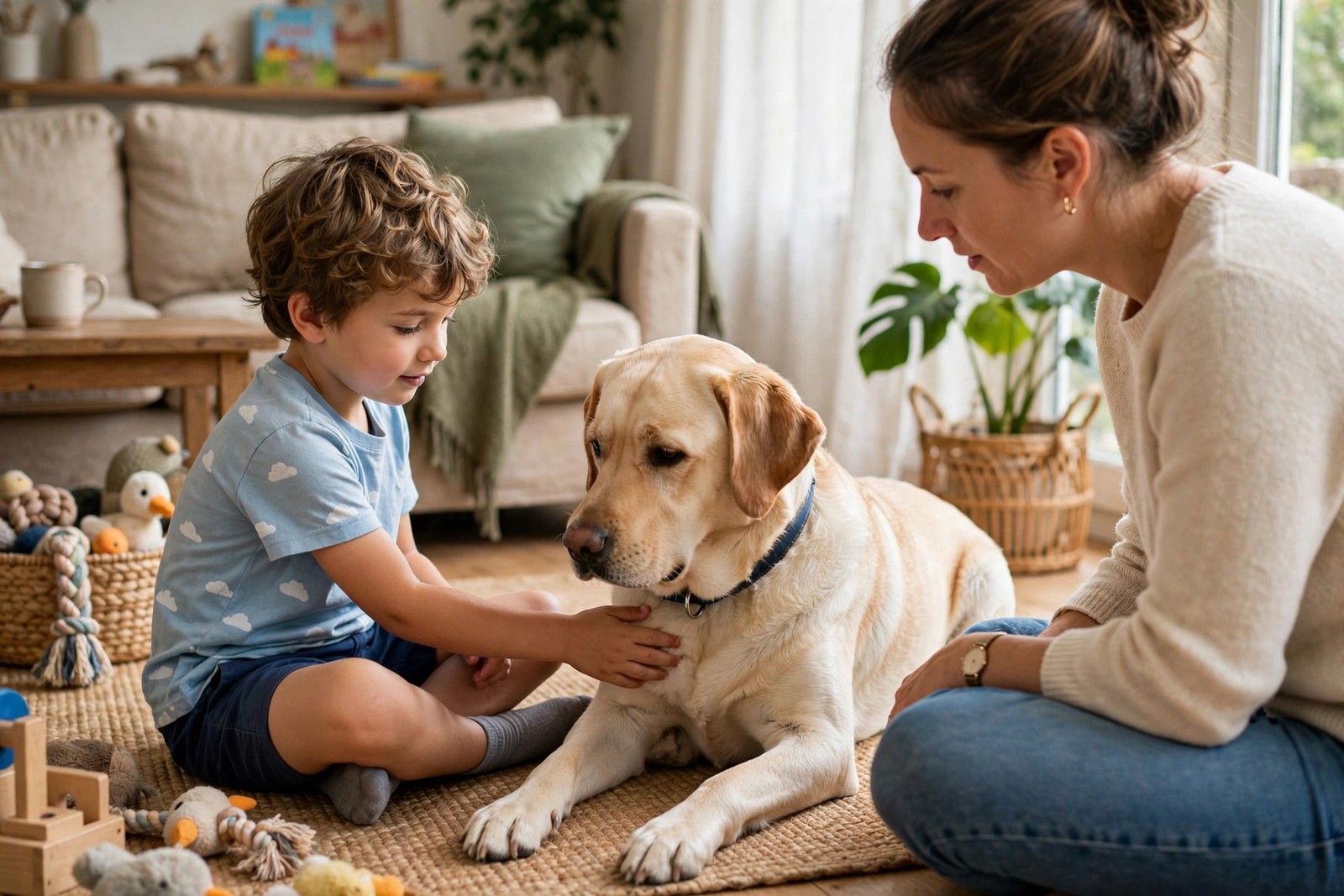
Dogs and young children get along safely when both sides are taught the rules: children learn calm, respectful handling, your dog learns that kids predict good things — and that he always has an escape route — and adults supervise every interaction until trust is earned over years, not weeks. Even the gentlest dog can be startled by a toddler's fall or a grabbed ear, so the goal isn't finding a "bombproof" dog; it's building a household where accidents never get the chance to happen.
Teach the children first
Kids under five can't reliably control impulses, so their rules must be simple and endlessly repeated. Approach slowly and let the dog come to you. Stroke the chest or shoulder, never reach over the head, and never hug, climb on, kiss, or grab the dog's face. Leave the dog completely alone while he's eating, chewing, or sleeping — most serious bites to children happen in exactly these moments, often from a dog the family trusted completely. Practice with a stuffed dog first: role-play makes the rules stick far better than lectures.
Teach and protect the dog, too
Your dog needs a child-free retreat — a crate with the door open, a gated corner, a bed behind a baby gate — that children are never allowed to invade. A dog who can always walk away rarely feels the need to escalate. Reward your dog generously for calm behavior around the kids: lying quietly while a toddler toddles past should pay in treats and praise. And watch his body language yourself: lip-licking, yawning, turning away, a suddenly still body, or "whale eye" all mean he needs space right now, and it's your job to give it before he asks louder.
Supervision means active, not nearby
There's a difference between being in the room and supervising. Active supervision means you're close enough to intervene, watching both parties, and ready to cheerfully separate them the moment either gets wound up, tired, or grabby. Rough, loud, fast play is where judgment evaporates on both sides — keep games structured: fetch with two balls, hide-and-seek where the child hides and the dog finds, or simple trick training where kids give cues and deliver treats under your eye.
Set up the house for success
- Baby gates that let the dog opt out of kid zones without being banished
- High-value chews and meals fed in the dog's retreat, never in play space
- Toys in two camps — dog toys and kid toys — with trades practiced calmly
- A house rule that a dog carrying something is left alone; adults do all retrieving
If your dog ever growls at a child, don't punish the growl — it's a warning system you want intact. Thank your luck, separate them, and look honestly at what pushed him there; repeated tension means bringing in a certified behavior professional and your veterinarian to rule out pain, which is behind more "sudden" grumpiness than most families realize.
Making the safety rules stick at home
Rules only protect kids if grandparents, babysitters, and older siblings all follow them. On the family side, KinsLe's Family Sharing lets you share his profile with the relatives you pick, so a grandparent or older sibling can open his profile rather than relying on a note on the fridge. That consistency is what turns safety habits into household culture. Through KinsLe Family Sharing, the relatives you have selected can view that profile for themselves, next to the retreat he escapes to and the chest-stroke handling he knows best.