
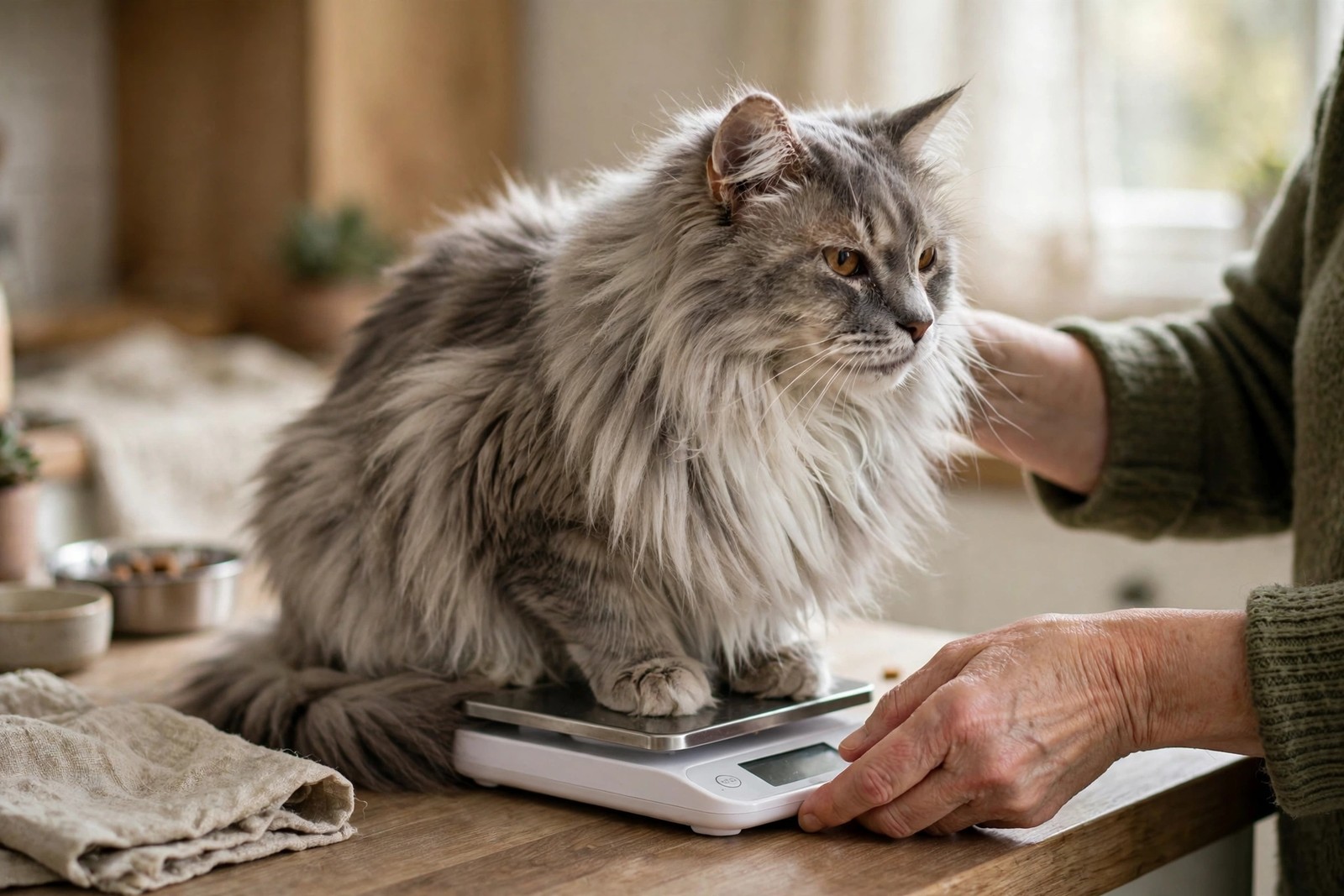
You help a senior cat maintain a healthy weight by weighing her monthly, measuring every meal instead of eyeballing it, feeding for muscle as well as fat control, and keeping her gently active every day. Older cats are tricky: they can lose valuable muscle while still looking round around the belly, so the scale alone does not tell the whole story.
Weigh, measure, and look at muscle
Weigh your cat once a month and write it down. A kitchen or baby scale works for most cats, or weigh yourself holding her, then without her. A change of even half a pound matters on a nine-pound cat. Alongside weight, run your hands along her ribs and spine weekly. Ribs should be felt with light pressure under a thin fat cover, and the spine and hip bones should not feel sharp or prominent — that can signal muscle loss even if weight is stable.
Eyeballing kibble is where portions quietly grow. Use a measuring cup or, even better, a small kitchen scale for accuracy, and count treats in the daily total. A few extra treats a day, given by different family members who each think they are the only one, is a very common reason senior weight creeps up.
Food choices for a steady senior weight
Most seniors do best on a complete, highly digestible food with quality protein to support muscle. Do not slash portions drastically on your own, and do not put a senior on a younger cat's weight-loss plan without vet input — older cats who eat too little, or stop eating, can become unwell quickly. Any diet change should be gradual over a week or more and vet-approved, especially if your cat has other health conditions.
If your cat needs to lose a little, small reductions, measured consistently, beat dramatic cuts. If she needs to gain or hold muscle, your vet may suggest more frequent, protein-rich meals. Either direction is individual, which is why a senior checkup before a big change is worthwhile.
Gentle movement counts
Play is exercise and appetite regulation in one. Two or three short sessions a day — five to ten minutes with a wand toy, a slow chase of a crinkle ball, or a food puzzle that makes her work a little — suits most seniors better than one frantic session. Let her “win” and end before she is tired. Cats with arthritis may prefer toys that stay low to the ground and play on carpet or a rug for grip. Stop and check with your vet if play suddenly becomes something she avoids.
When weight change is a vet call
Call your veterinarian promptly if your senior loses or gains weight quickly, stops eating for a day, drinks and urinates much more, vomits repeatedly, or seems weak in the back legs. Those changes can reflect health problems that diet alone should not be used to manage. Never start medication or supplements for weight based on internet advice — your vet knows your cat's full picture.
Making the whole household consistent
Weight plans fail when feeding is inconsistent. With KinsLe's Care Teams, family members can be assigned feeding duties and log each measured meal with a timestamp when it is completed. That gives you a true picture of intake — who fed, when, and whether a meal was finished — instead of guesswork and accidental double dinners. Care Teams on KinsLe give each measured breakfast and dinner a named feeder, so a senior weight plan rests on logged portions rather than household memory.