
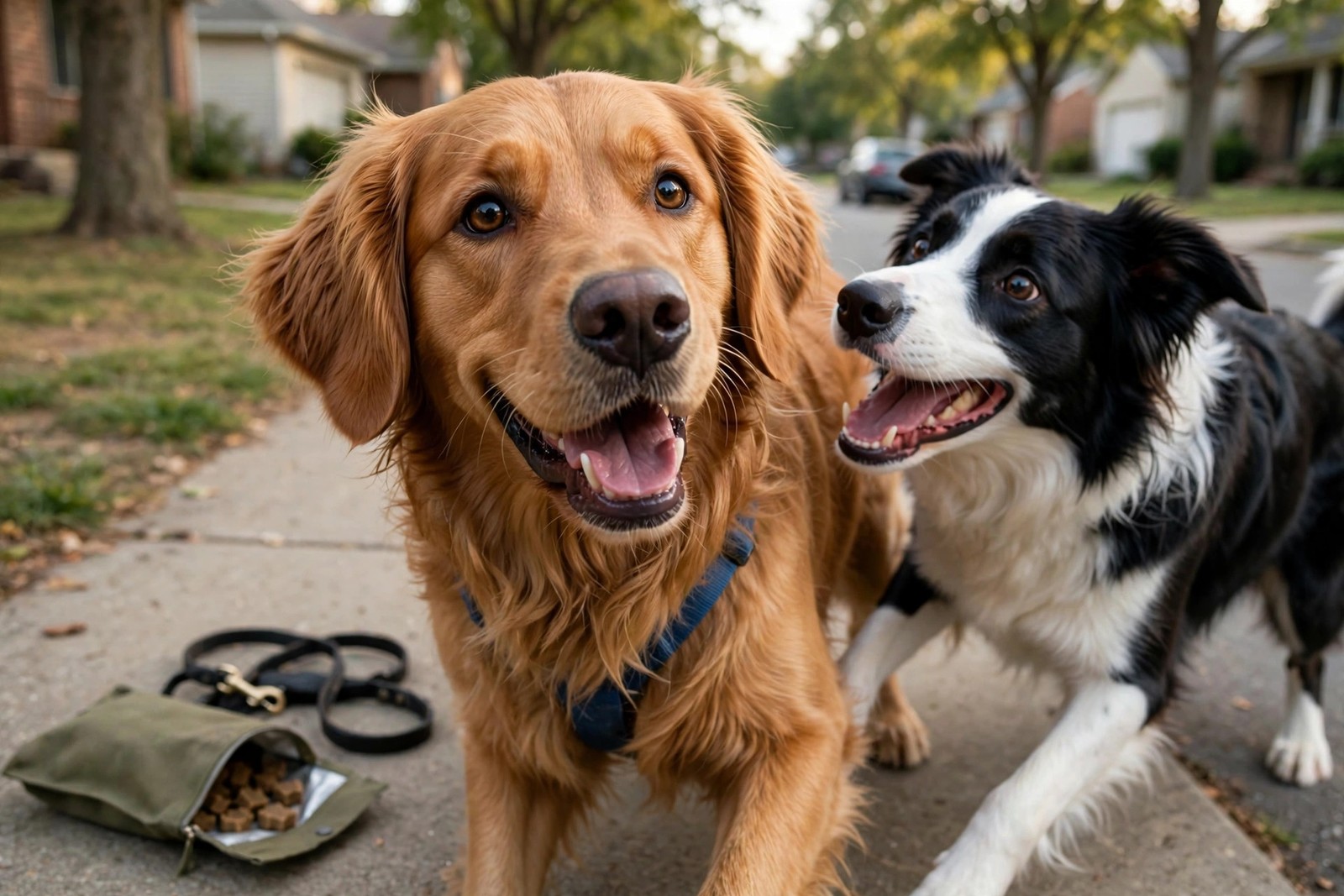
Healthy dog play can look surprisingly rough — growling, wrestling, mouths on necks, bodies tumbling — so noise and speed alone tell you very little. What separates play from a fight is the shape of the bodies and the fairness of the exchange. Read those two things and you can judge almost any pair of dogs within seconds.
What genuine play looks like
Play is loose, bouncy, and deliberately inefficient. Watch for the play bow — front end down, rear end up — offered before a pounce or mid-game to signal that everything following is pretend. Bodies curve and wiggle rather than moving in straight, tense lines, mouths hang open in a soft, almost grinning expression, and movements are exaggerated: big, silly bounds, floppy head tosses, and mock charges that veer off at the last moment. Fair play also swaps roles. The chaser becomes the chased, the dog on top in a wrestle rolls off and lets the other win for a while, and play sneezes and snorts punctuate the action. Above all, play pauses. Every so often both dogs stop, shake their whole bodies as if drying off, glance around, and then choose to restart. Those self-imposed breaks are the clearest sign that arousal is staying at a level both dogs can manage.
What a slide toward a fight looks like
Trouble stiffens everything. A dog who goes still, leans forward over his shoulders, closes his mouth, and fixes another dog with a hard, unblinking stare is giving a warning, not an invitation. Tails held high and moving in short, tight flicks, raised hackles along the shoulders and back, and a body that seems to grow taller and more rigid all point the same way. The exchange turns one-sided: one dog chases, corners, or pins while the other tucks his tail, ducks away, yelps, or snaps over his shoulder trying to escape, and nobody pauses or swaps roles. Vocalising changes character too — play growls rise and fall with the action, while a fight's sounds escalate steadily, sharpen, and do not stop when one dog tries to disengage. If one dog's intensity keeps climbing while the other's signals say leave me alone, step in before contact, not after.
The consent test, and how to interrupt safely
When you are unsure, use the consent test: calmly hold or lead the more intense dog away for a few seconds and watch the other one. A dog who was enjoying himself trots straight back in, bows, and re-engages. A dog who was not shakes off, moves away, hides behind you, or goes for water — believe him, and end the session kindly. If you need to interrupt rising tension, start with your voice and a cheerful recall or a sharp clap, and scatter treats on the ground away from both dogs. Never reach into a genuine fight for collars with your hands near mouths; use a loud noise, a barrier such as a board or chair, water, or leashes slipped around hindquarters by someone who knows the technique, and separate the dogs into different rooms to cool down fully before any reunion.
Know your own dogs' tells
Individual baselines matter: some herding breeds play with hard eye and nipping heels, some mouthy adolescents sound dramatic while playing beautifully, and a dog who was fine at twenty minutes may tip into over-arousal at thirty. Note which partners, settings, and session lengths keep your dog in loose, fair play, and which combinations have ended badly. Sharing those observations through KinsLe's Care Teams means a partner, dog walker, or family member supervising play works from the same tells and steps in at the same point you would.