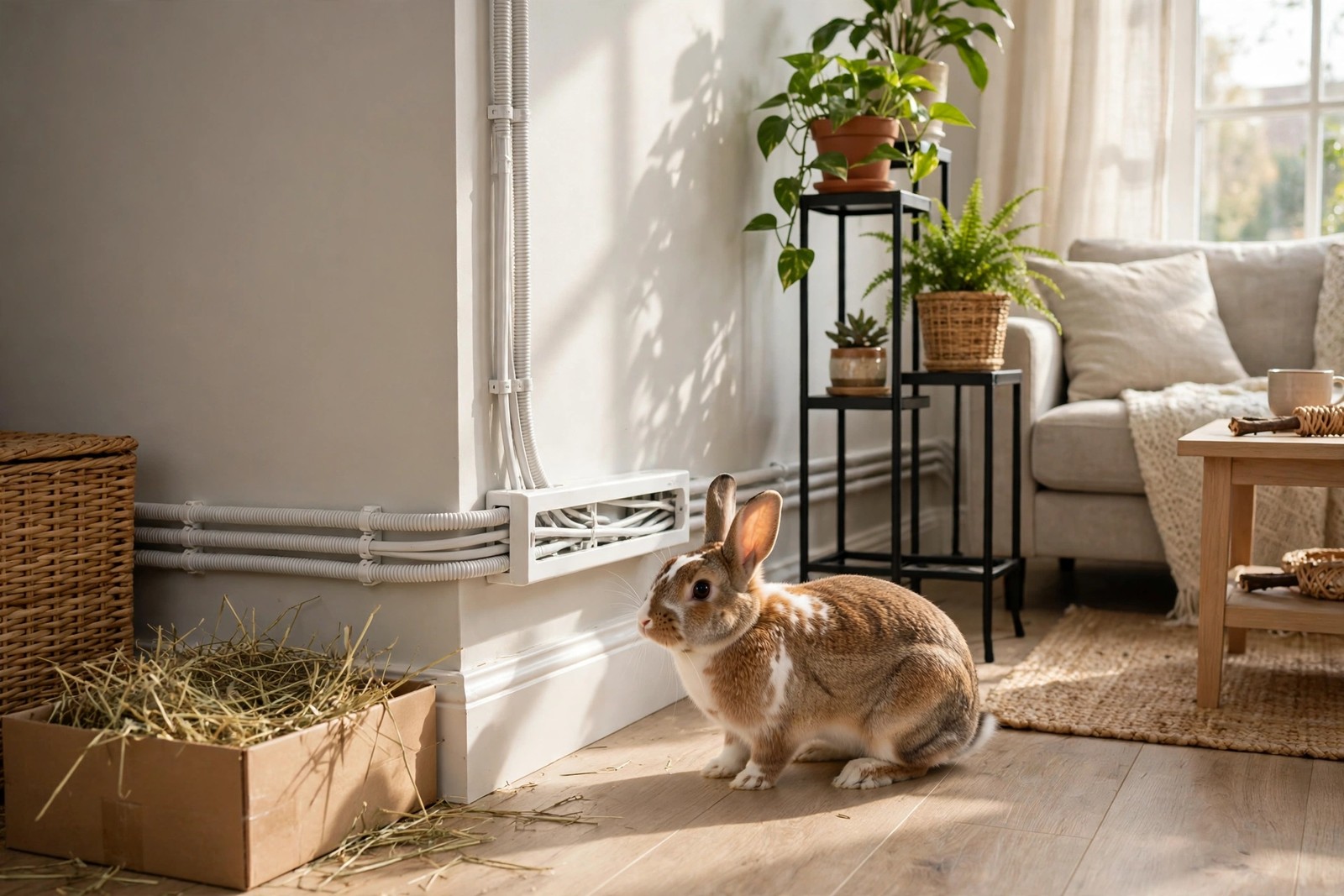
Bunny-proofing fails when it is done from standing height, because a rabbit experiences a living room as a landscape of cable runs, wood edges, and dark gaps at ankle level. Done at the rabbit's own level, methodically, the same room becomes a safe place to let a rabbit roam — with chewing redirected rather than merely forbidden, and with supervision as the standing rule that backs up every physical fix. Work through the room in layers: power, wood, plants, gaps, and finally the rabbit's own sanctioned alternatives.
Get Down to Rabbit Height First
Begin the audit on your knees, or lying on the floor, and look at what a rabbit actually meets: the underside of the sofa, the shadowed run behind the entertainment unit, the corner where two baseboards meet, the tempting loop of a lamp cord. Owners are routinely surprised by this view — forgotten cables, a gap behind a bookcase wide enough to admit a whole rabbit. Make the lap slowly and write down everything you find, because the list is the proofing job in full. Repeat it whenever furniture moves, since a shifted sofa opens new gaps.
Cables, Baseboards, and the Corners That Get Chewed
Cables come first because they are the one hazard that can injure in a second. Lift them off the floor entirely where you can — routed behind furniture, raised along walls — and where a cable must cross rabbit territory, armor it in hard conduit that teeth cannot work through; soft spiral wrap slows a rabbit down but does not settle the matter. Baseboards are the second classic target, especially corners, where a determined rabbit settles in for a long chew. Protect them with corner protectors fitted over the vulnerable stretches, or block access along the worst runs with furniture or panels, accepting that in some rooms rerouting the rabbit is easier than armoring every inch of woodwork. Furniture legs get the same treatment — wrapped, blocked, or watched — because a leg at rabbit height reads as a standing chew post. Log which runs are armored and which corners are guarded in the Family Sharing room check on KinsLe.
Plants, Furniture Legs, and the Gaps Behind Sofas
Houseplants come off the floor: lifted onto stands or shelves a rabbit cannot reach, or moved out of the roaming room entirely. Before any plant stays within reach, verify it is safe for rabbits — check each plant individually before access, because the safe list and the harmful list both contain common houseplants, and no plant earns floor space on a guess. If you cannot confirm a plant, it leaves the room; that is the whole rule. Then close the gaps: behind and under sofas, behind the television unit, the warm space behind appliances, blocked with panels or cushions fitted so a rabbit cannot squeeze through or become trapped halfway. A gap a rabbit can enter but not turn in is a hazard in itself, so block generously rather than narrowly.
Give Chewing Somewhere Better to Go
A proofed room with nothing legal to chew is a test a rabbit will eventually fail, because chewing is not a vice — it is how a rabbit maintains teeth that never stop growing and explores a world it cannot handle with paws. So provide the outlet deliberately: a sturdy box of hay and plain paper the rabbit may shred, dig in, and demolish, refreshed as it gets shredded down. Place it where the rabbit already likes to settle, not where the furniture looks best. Keep free-roam supervised as the standing rule regardless of how thorough the proofing was; supervision is what catches the new cable, the moved chair, the plant a guest set down. Proofing lowers the risk to a level supervision can actually hold, and the two together — never either alone — are what make a living room genuinely rabbit-safe.
Run the final lap together and record the finished setup in KinsLe's Family Sharing, leaving the next person a room they can trust at rabbit height.