
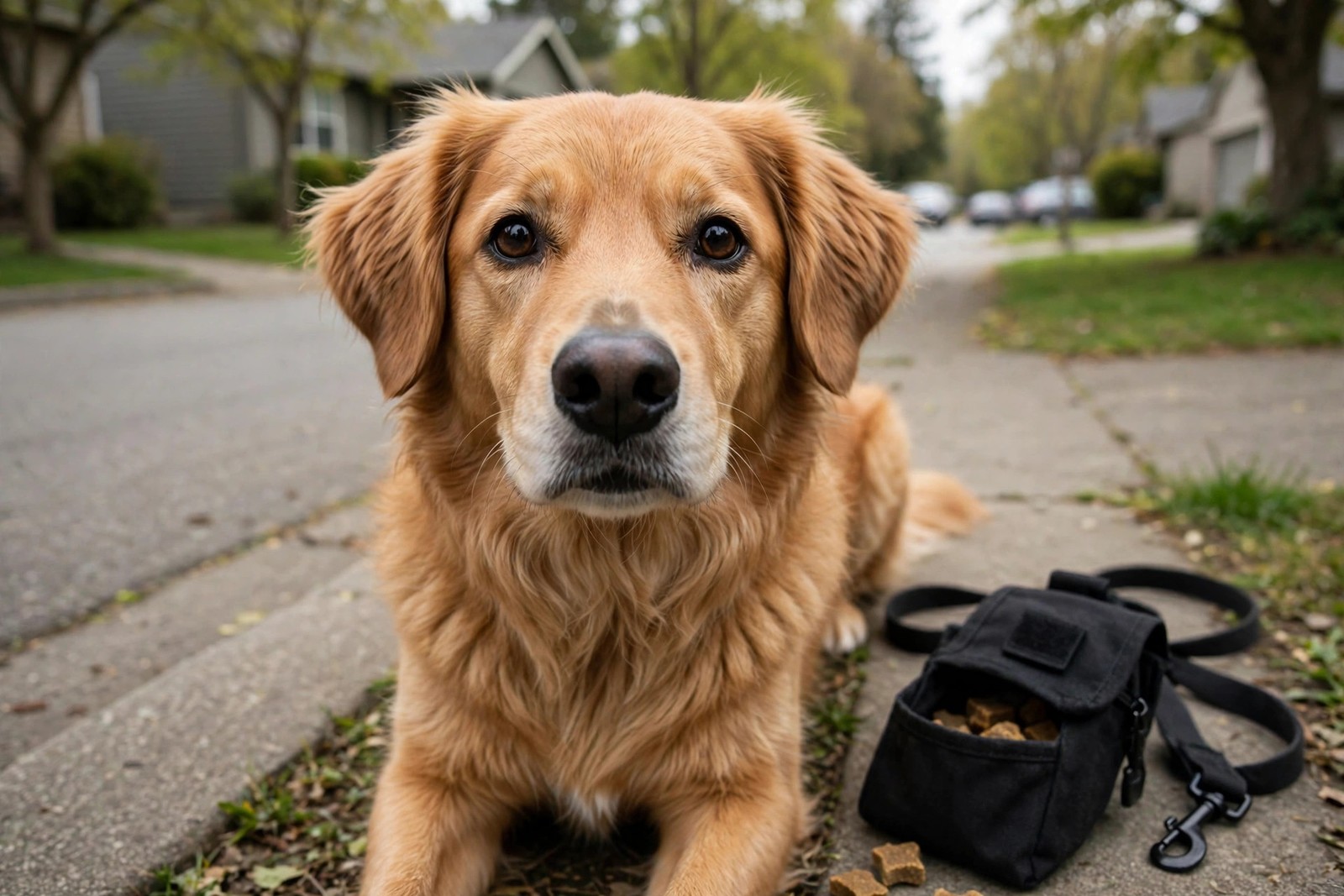
Feeling safe around strangers is not the same as enjoying them, and it does not require your dog to accept fuss from anyone. The realistic goal is a dog who can see unfamiliar people, understand that nothing is expected of her, and stay relaxed enough to walk past, wait nearby, or settle while visitors are in the house.
Find the Distance Where Learning Is Possible
Every worried dog has a threshold distance. Beyond it, she notices a stranger, ears up, but still takes treats, sniffs the ground, and responds to you. Inside it, she stiffens, stares, barks, lunges, hides behind you, or refuses food — and in that state she is surviving, not learning. Start all training beyond the threshold, even if that means watching people from across a park or through a window, and treat that distance as your working tool rather than a failure.
At that distance, mark and reward calm looking: stranger appears, your dog glances, you praise and deliver a genuinely good treat, then let her look away. You are building a simple association — people at a distance predict good things and no demands. Sessions of five or ten minutes, a few times a week, move the threshold inward far more reliably than one long, flooding outing to a busy street market.
Remove Forced Greetings From Her Life
The fastest way to frighten a worried dog is a stranger bending over her, reaching for her head, and maintaining eye contact while she is trapped on a short lead. Replace that script entirely. Strangers should ignore her: no looking, talking, reaching, or crouching toward her. If someone asks to say hello, answer for your dog with a clear statement that she is nervous and being ignored helps her most, and do not apologise for it. Owners often feel social pressure to allow petting, but your dog's sense of safety is worth more than a passer-by's disappointment.
If a calm stranger is helping with training, have them toss treats sideways onto the ground as they pass at distance, still without interacting. If your dog ever chooses to approach and sniff, the person stays still, lets her sniff for a couple of seconds, and she is then called away and rewarded — she learns approaches are brief, voluntary, and end well.
Build Real-World Routines
Choose walking routes and times that let you control distance: wide pavements, quiet streets, parks where you can arc away smoothly. Cross the road early rather than squeezing past a group. At home, give your dog a settled place away from the front door, brief visitors before they enter, and let her choose another room without being followed or coaxed out for introductions. Children need the clearest rules of all, because their height, noise, and sudden movements are the hardest for nervous dogs to read.
Watch body language honestly — a tucked tail, pinned ears, lip licking, yawning, freezing, or a hard stare all mean increase distance now. If your dog's fear is severe, generalising to everyday life despite careful work, or includes snapping or biting attempts, involve a qualified force-free trainer and raise it with your veterinarian rather than pushing more exposure.
In KinsLe, Care Teams can record your dog's comfortable distance this week, the visitor rules, and which routes worked, so each walker starts from the latest information instead of testing her limits from scratch.