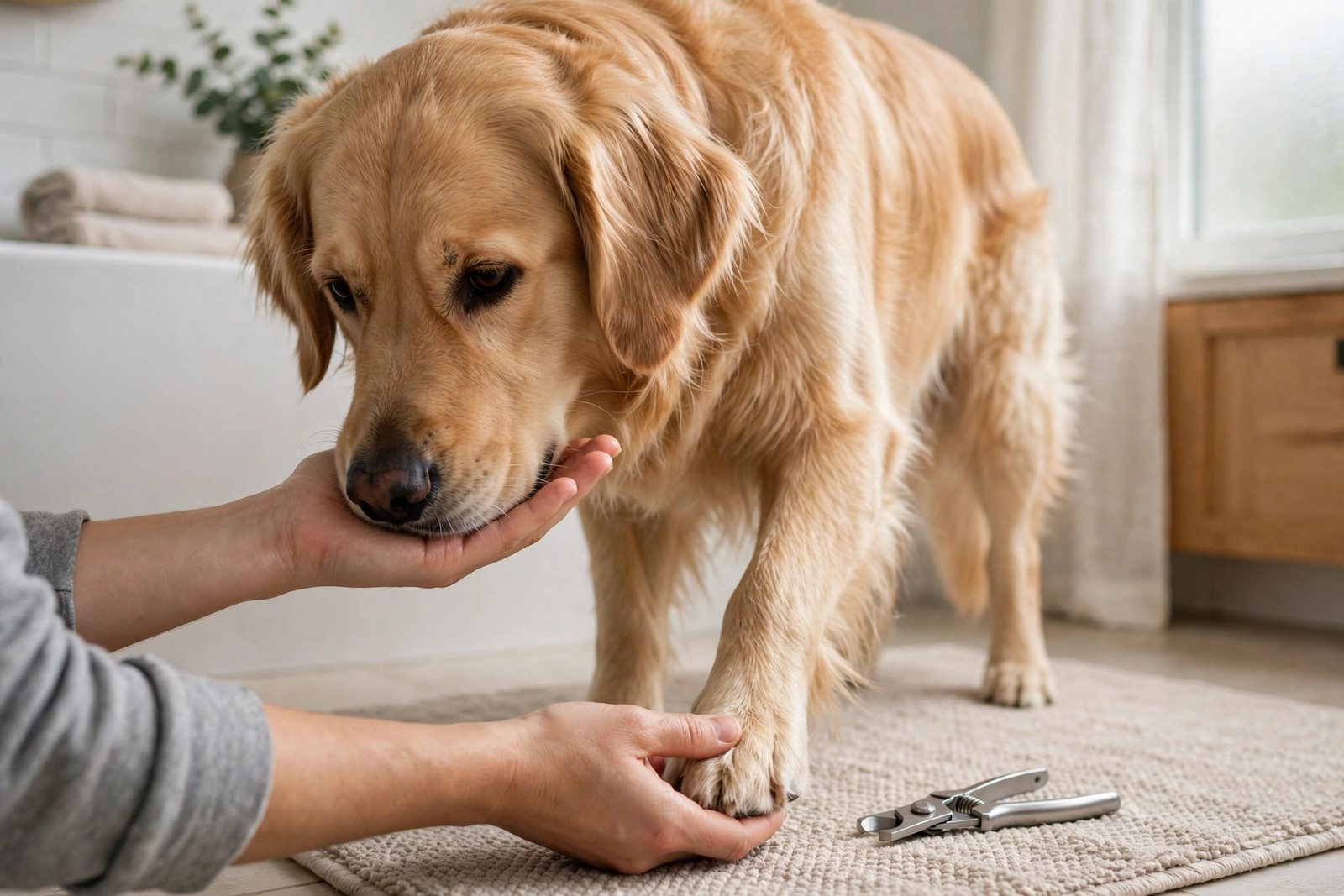
Cooperative care works because your dog holds a veto. Instead of pinning the paw and wrestling through four feet, you teach a consent signal first and then build the trim as a ladder of tiny, separately paid steps, starting with nothing more than a touch on the paw. Dogs who once hid at the sight of clippers often start offering their paws once they learn the choice pays and opting out is respected.
Teach the consent signal before the clippers appear
Choose a signal your dog can hold comfortably while standing: a chin rest on your palm, on a cushion on a low stool, or on your knee. Lure the chin down with a treat, mark the moment it lands, and feed in position so the chin stays planted. Practise until the chin lands the second you present your palm. The rule from then on never changes: chin down means you may work, and the moment the chin lifts, your hands come off and the session pauses or ends. That predictability is the whole mechanism, so never hold the head down or carry on through a lifted chin to finish one last nail.
Climb the ladder one rung at a time
Each rung is its own session goal, and you stay on a rung until your dog is visibly relaxed there. The sequence runs: touch the top of the paw and feed; hold the paw loosely for two seconds and feed; press one toe gently to extend the nail and feed; let your dog sniff the clippers on the floor and feed; click the clippers in the air nearby and feed; touch the clipper to one nail without cutting and feed; finally, clip the tip of one nail and throw a small celebration. Sessions of one to two minutes, once a day, beat one long session every few weeks, because the dog leaves each practice wanting more rather than flooded. Front paws are usually easier than hind paws, so expect the ladder to restart lower on the back feet.
Read the opt-outs honestly
A lifted chin is the clearest stop signal, but watch for the quieter ones too: the paw being withdrawn repeatedly, weight shifting away from you, lip licking, yawning, or a dog who takes the treat but turns her head while swallowing. Any of those means the current rung is too hard, so drop back one rung, pay generously there, and end. Ending on an easy win is progress, not failure; pushing through a worried dog teaches her the veto does not work, and the next session starts from suspicion.
Get the tools and the cut right
Use clippers sized for your dog, and keep the blades sharp, because dull blades squeeze before they cut, and that pressure is what many dogs actually object to. Clip small slices rather than one large cut. On pale nails the pink quick is visible, so stop short of it; on dark nails, clip in thin shavings and stop when the centre of the nail face turns from dry and flaky to smooth and darker, which signals the quick is near. Ask your vet or groomer to show you the angle on your own dog once, and keep a styptic product or plain cornflour within reach so a nicked quick is a brief pause rather than a panic. File or grind rough edges only after clipping itself is calm.
When the history is already bad
A dog who has been pinned for trims, or who has had the quick cut painfully, may need the ladder rebuilt over weeks, starting with treats for entering the grooming spot. That is normal and still faster than repeated battles. If your dog panics or tries to bite despite slow work, stop and ask your vet or a qualified behaviourist for help rather than adding restraint. KinsLe's Care Teams keeps the plan honest between sessions, because the person who ran today's one-to-two-minute practice marks it complete with a timestamp and the next person can see exactly which rung the dog reached.