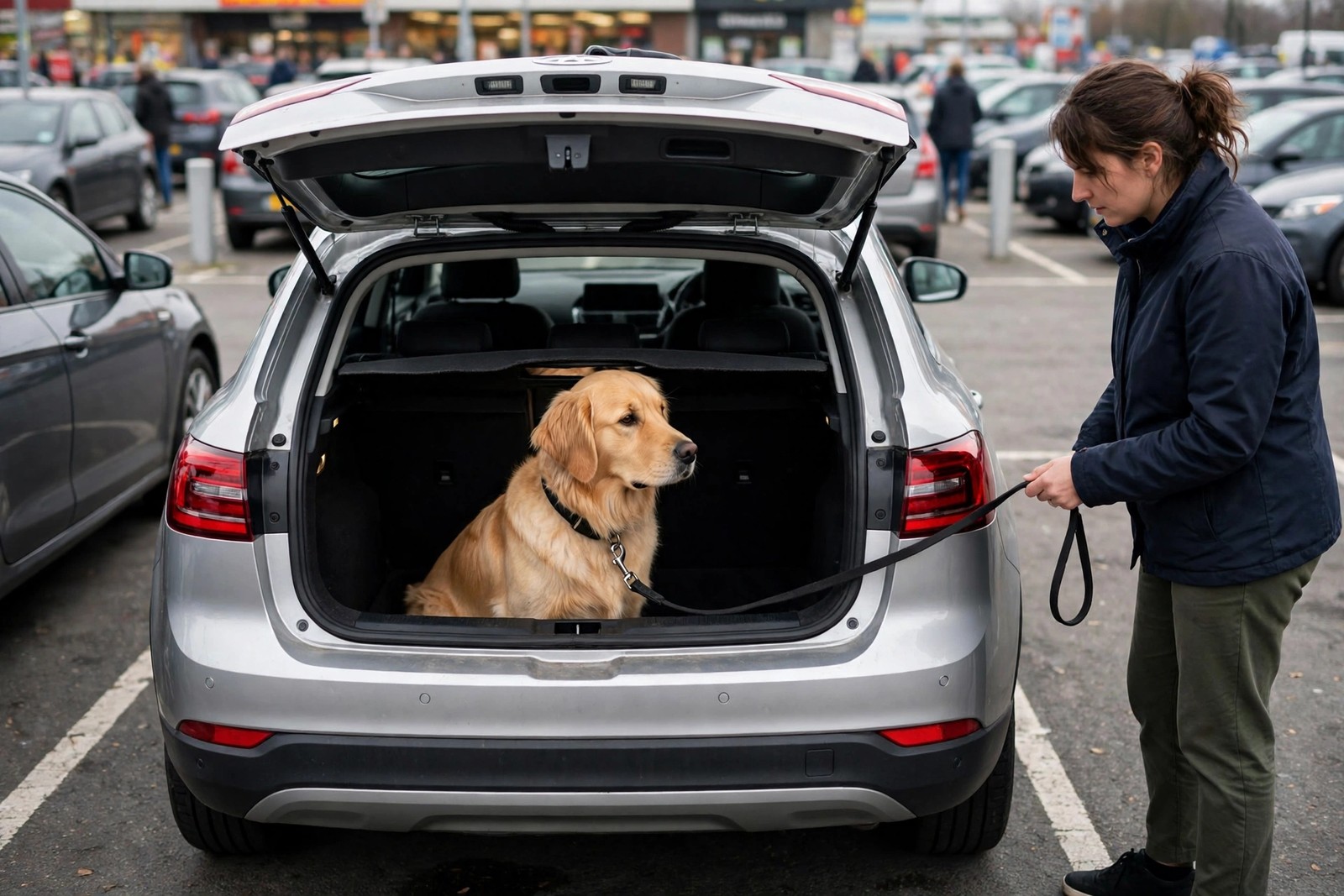
A dog who launches out of a trunk into a busy parking lot is not being reckless — it has simply never been taught that the trunk opening is a door with rules. The wait you need is a trained sequence, not a hope: leash secured first, trunk opened a crack, the dog holding its wait while the world becomes visible, and an exit that happens only on your release word. Build that sequence where failure is cheap, then run it identically in the real lot, and the leap into traffic never gets the chance to happen.
Proof the Wait Before the Busy Lot
Start at home, in the driveway or garage, with the engine off and nothing exciting outside. Teach and reward a plain wait inside the car first: dog settled in the trunk area or back seat, a brief pause, release word, reward. Every practice wait happens with you standing right there — a dog is never left alone in a parked car in warm weather, because a closed car heats dangerously fast. Then add the trunk itself — open it fully in this safe setting, reward the dog for staying put behind the opening, release, repeat.
Graduate to quiet parking lots at off hours: a near-empty lot, a few cars, real asphalt smells and distant movement. Run the full sequence there until it looks boring. Boring is the standard — a dog who holds the wait with mild interest, gets released, and steps out calmly has the habit installed before traffic ever tests it.
The Sequence in a Busy Parking Lot
Park, engine off, and begin before anything opens. The leash goes on and is held — clipped to the dog and in your hand or stepped on securely — while the dog is still inside, never reached for after the trunk is open and the dog is already moving. This order is the whole safety case: the dog must be physically connected to you before it can see the exit.
Open the trunk just a crack, a few inches, enough for air and a sliver of view but not enough for a dog to squeeze through. Say the wait cue once, let the dog look, breathe, and settle behind that crack, and reward the holding — calmly, with food delivered to the dog inside. Widen the opening in stages only while the wait holds. Then give the release word, and the dog exits to you, already leashed and held, before the trunk ever stands fully wide with the dog loose beside it. Close up, reward again, and walk away together.
If the dog breaks the wait, close the trunk, reset, and make the next attempt easier — a break is information about difficulty, never a reason to scold.
The Back-Seat Door Alternative
Some dogs — jumpers, trunk-haters, dogs in cars without a suitable trunk space — do better exiting through a back-seat door, and the routine transfers cleanly. Leash on and held first, with the dog settled on the back seat. Open the door a crack against your body so you are the barrier filling the gap, wait cue, reward the hold, then release word and the dog steps out into your control through an opening you widen only as it exits. The narrower, body-blocked doorway gives a determined dog far less launch room than a rising trunk lid, and many families find it the calmer default.
Choose one setup as the family's standard, because two routines with different words teach one fuzzy habit instead of a solid one.
The Same Sequence From Every Driver
Write the household plan down in order: the wait cue, the release word, who rewards and when, and the rule that nobody opens anything before the leash is on and held. Every family member who drives the dog practices the quiet-lot version before running the busy-lot one, so the dog hears identical cues and timing from every pair of hands. Practiced the same way by everyone, the routine holds up on the busiest days, and KinsLe supports that consistency because Care Teams records who trained, which step held, and what needs work.