
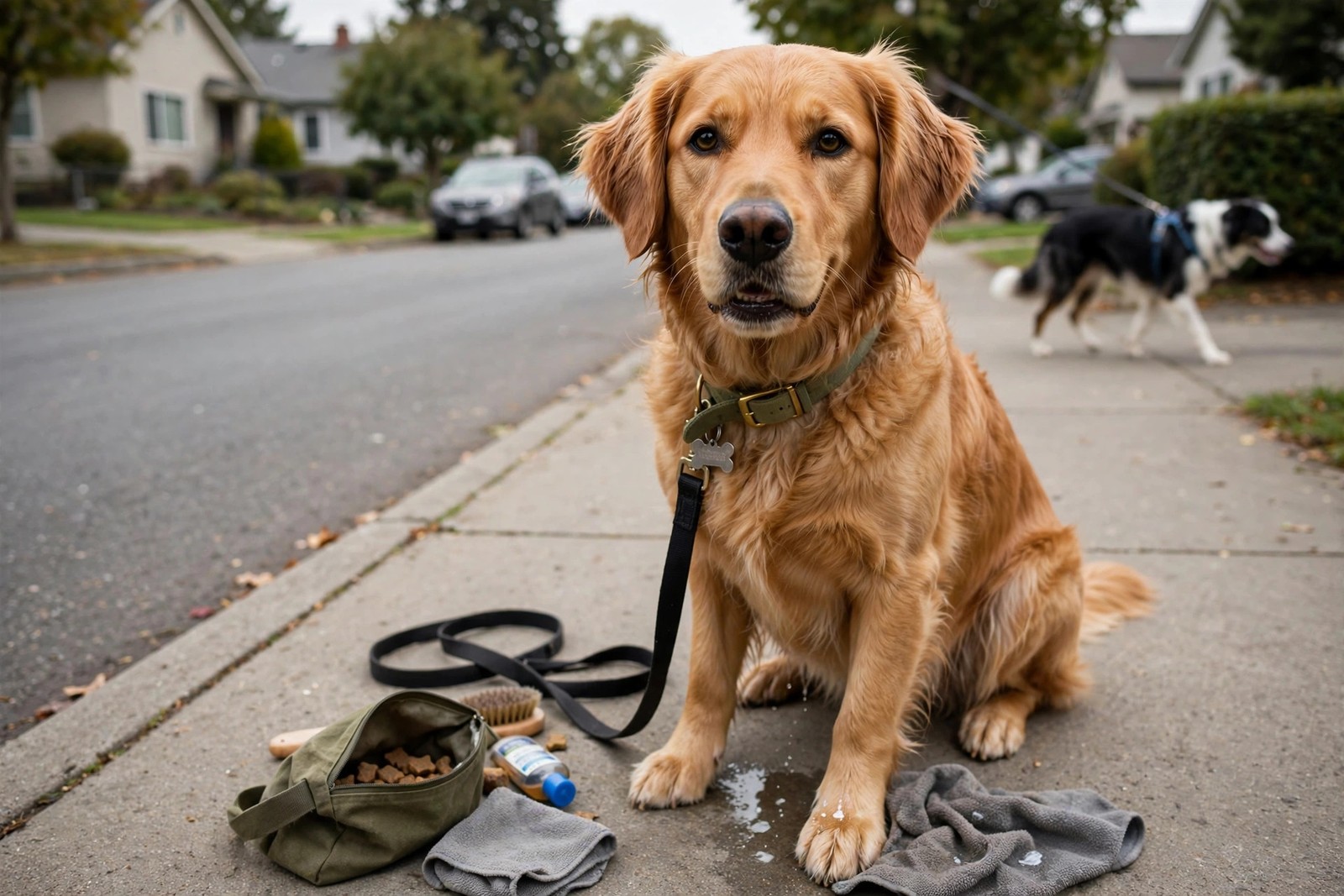
Calm passing is a distance skill before it is an obedience skill. If your dog is barking, lunging, or frozen and staring, you are simply too close for learning to happen, no matter how good your treats are. Start where your dog can notice another dog, then still turn back to you for food — for many reactive or over-friendly dogs that is across a wide street, behind parked cars, or on the far side of a park for the first week or two.
Find Your Dog's Working Distance
Watch for the early signs that your dog is going over threshold: a closed mouth, a hard stare lasting more than a couple of seconds, ears pushed forward, a high and stiff tail, and weight shifting onto the front feet. Those signs mean you should add distance, not push on and hope. At a workable distance your dog's body stays loose, the mouth stays soft, and a treat is still interesting. Note that distance honestly — twenty metres on a quiet morning may grow to forty on a busy evening when your dog is already tired or excited.
Games That Build a Calm Pass
The look-at-that pattern is the foundation. Let your dog glance at the other dog, say yes the moment the glance happens, and feed beside your leg as your dog turns back to you. Repeat five or six times from the same spot, then move on. As that becomes easy, use the one-two-three pattern game while walking: count your steps aloud in a steady rhythm and feed on three, so your dog learns that passing time has a predictable, rewarding beat. Practise U-turns on quiet streets until they are cheerful and automatic — a happy "this way" and a turn away from trouble is a skill, not a surrender, and it gives you an exit before a stare becomes a lunge.
Closing the Distance Gradually
Shrink the gap in small steps over days, not minutes. Cross to the same side of the street only after several relaxed passes at the previous distance, and pass in a gentle arc rather than head-on, because a direct approach reads as confrontational to most dogs. Reward heavily for the hardest moment — the seconds when the dogs draw level — and keep walking rather than stopping to chat, since standing face to face builds pressure. If your dog blows up, do not scold; calmly increase distance, let them shake off and sniff, and make the next repetition easier. One bad pass is information about distance, not a reason to drill.
Routes, Timing, and Honest Progress
Choose wide pavements, quiet hours, and routes with escape options while you train, and skip the narrow path where two dogs must squeeze past at touching distance. Short, successful outings of fifteen calm minutes teach more than one long walk with three explosions. Progress usually looks like this: your dog notices sooner, recovers faster, and needs less distance week by week. If there is no improvement after several consistent weeks, or your dog has bitten or nearly bitten, a qualified reward-based trainer or your veterinarian is the right next step. Keeping a brief note of distance, route, and recovery time in KinsLe Care Teams lets everyone who walks your dog see exactly what worked last time and repeat it.