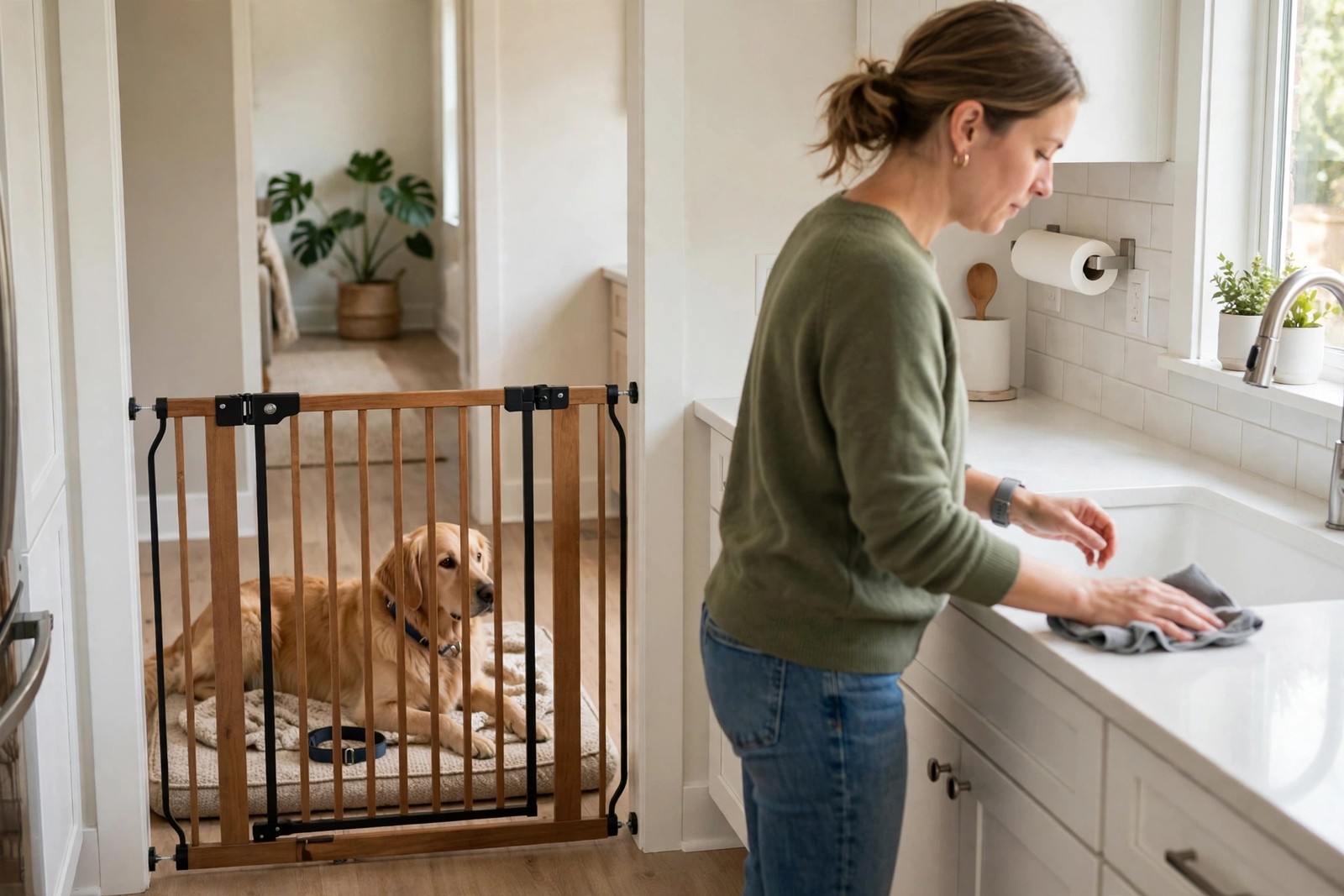
Make rehearsal impossible between lessons: clear every counter completely, store food in closed cupboards, use lidded bins behind doors, wipe surfaces so crumbs and smells stop paying, and gate the kitchen during cooking and eating. A dog who has stolen food for years is not working from a vague hope. He has a long, well-paid history, and each new theft teaches him that checking counters, waiting for a turned back and trying again eventually works.
Remove the payoff completely, not mostly
Management fails at the word mostly. Bread left to cool, butter near the edge, a child's plate carried low, recycling that smells of meat and a bin that opens with a nose nudge are all still lessons. Move tempting food into cupboards, the oven, the microwave or a closed pantry while it cools. Put bins in a cupboard or choose a bin he cannot open, and tie or store food waste so a tipped bin does not become a second prize.
Wipe counters after preparation, sweep crumbs from the floor and check the sink for soaking pans. A counter can look empty to you and still smell like a promise to a dog who has learned the geography of your kitchen in detail, including which corner held chicken yesterday.
Control access during the risky moments
Cooking, unloading shopping, serving children and clearing plates are the moments when attention splits and a practiced thief moves. Use a baby gate, a closed door or a lead anchored away from the work area so your dog can see family life without rehearsing a lunge. Set up before food comes out, not after he is already circling.
Give him a defined station outside that boundary: a mat where he can settle and receive food in a puzzle feeder, a long-lasting chew that is safe for him, or a stuffed feeder prepared in advance. Pay the station generously at first. He should learn that the mat during cooking is where food happens for dogs, while the kitchen side of the gate is simply unavailable.
Align the whole household
One person who leaves pizza on the coffee table undoes a week of careful clearing. Agree in writing where food may be left, which is nowhere within reach, who gates the kitchen before cooking, and who does the final counter and floor check at night. Visitors and children need the same rule in plain language: no feeding from plates, no plates on the sofa arm, and no calling the dog into the kitchen to clean up spills.
If he does steal, stay calm, move him away safely, clear the scene and record what was left, where it was and who was present. That record is not blame; it shows which gap in the system paid him, whether it was cooling food, an open bin or an ungated doorway during a party.
Train separately from real meals
Do not test leave-it skills with tonight's dinner while you are distracted. Practise settle on the mat and leave-it with low-value items in short, deliberate sessions when you can reward success, then raise difficulty gradually. Keep real meals under full management until the station habit is strong, because a failed test beside real food is another rehearsal, not a neutral mistake.
Expect management to continue long after training improves. Years of theft build a durable habit, and an older habit can reappear during holidays, house moves and busy gatherings when routines loosen. The goal is a household system that stays boring even on a chaotic day.
Through KinsLe's Care Teams, you can assign the nightly counter clear, the gate check before cooking and short mat-practice sessions to different people, and the timestamp on each finished task shows that the system actually ran that day.