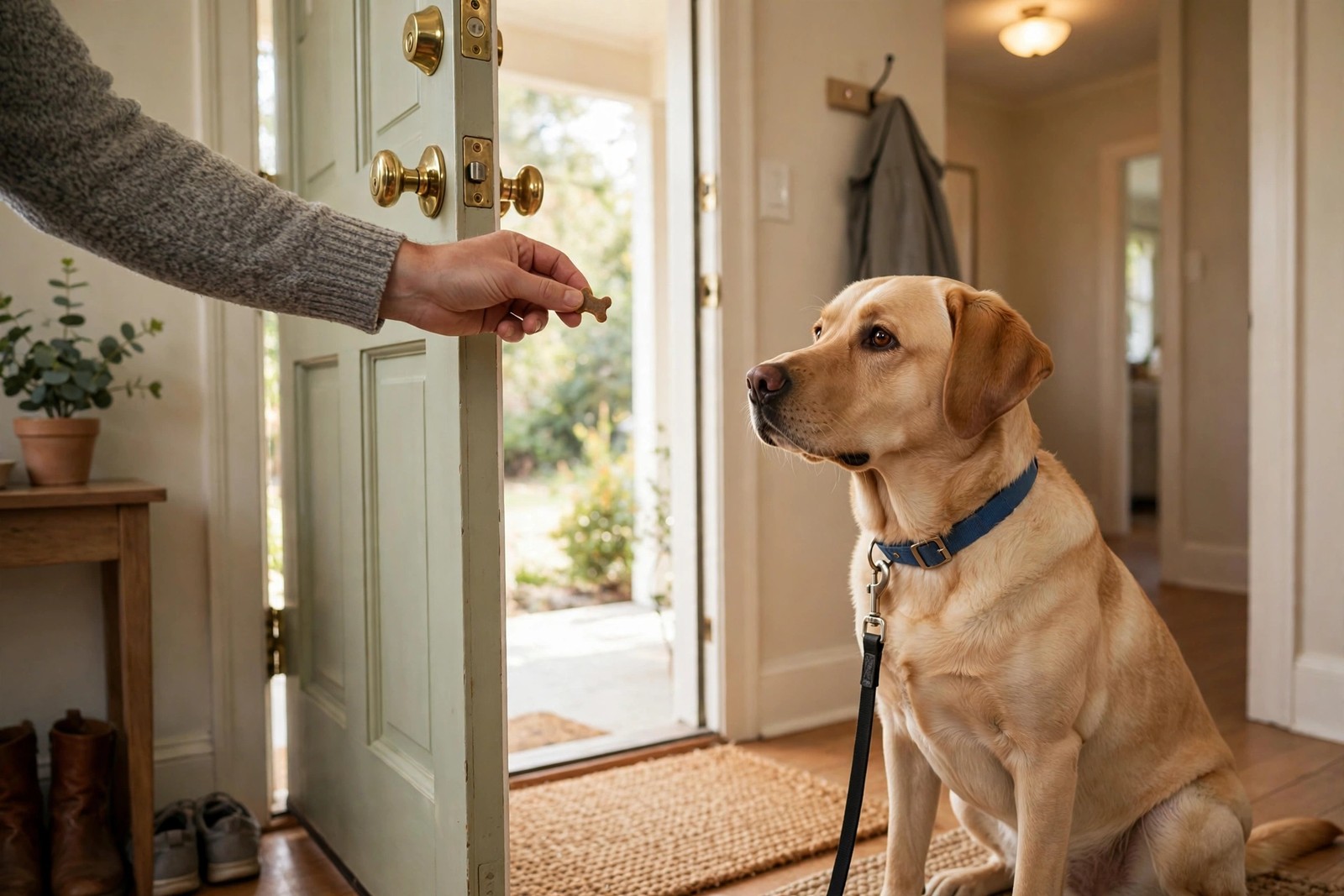
Barging through doorways is rarely disobedience; it is a habit that has always worked. The door opens, exciting things lie beyond it, and the dog who pushes first arrives first. The kind fix does not involve blocking the dog with your body, scolding at thresholds, or wrestling for position. It involves handing the job to the door itself, so the environment teaches a clear, emotionless rule: movement toward the door closes it, and stillness opens it.
The Core Game at One Quiet Door
Start at a boring inside door, with the dog on a lead and rewards in your pocket. Stand at the door, wait for the dog to be roughly settled, and turn the handle. Open the door a crack — two or three centimetres. If the dog surges forward, let the door close gently; do not slam it, yank the lead, or say anything much. If the dog pauses, holds back, or looks at you, praise warmly, reward, close the door, and repeat. Within a handful of repetitions, dogs begin to hesitate on purpose to see what happens, and that hesitation is the behaviour you are building: pay it every time.
When the pause is reliable at a crack, open the door wider in stages — a hand's width, half open, fully open — rewarding the wait at each stage and closing the door calmly whenever enthusiasm wins. Only when the dog waits at the fully open door do you add the release: a single clear word, such as okay or free, after which the dog may walk through and receive praise on the other side. The release word matters, because it separates waiting, which has no fixed end from the dog's point of view, from permission, which always arrives if the dog waits.
Progression: Inside Doors, Front Door, Garden Gate Last
Work through your home in order of excitement. Inside doors come first because nothing thrilling lies beyond them and you can rack up successful repetitions quickly. The front door comes next, practised at quiet times of day before it is attempted when a delivery arrives or a walk is due; use the lead every time during this stage, because one successful dash into the road can cost you weeks and could cost far more. The garden gate, the car door and doors at other people's houses each count as a new lesson in the dog's mind, not a test of the old one, so start each new door back at the crack stage and build up faster than the first time.
A mat or a practised sit beside the door helps some dogs by giving the wait a location. Use it as a support if your dog finds free-standing waits hard, not as a requirement layered on top of a dog who is already succeeding without one.
Safety and Household Rules While It Settles
Until the behaviour holds at the front door under real excitement, management carries the safety load: lead on before the door opens, every time, and a baby gate or closed hallway door as a back-up for a dog who could reach a road. Children do not hold the lead for door practice and do not open doors the dog is waiting at during the training period, because timing — the instant closing, the instant reward — is the whole mechanism, and it needs one consistent handler per repetition.
Expect the rule to need refreshing at adolescence and after house moves, and expect visitors to be your weak point: a guest who flings the door open and greets the dog mid-barge has paid the old behaviour handsomely. Brief guests cheerfully before they arrive, or keep the dog behind a gate for greetings until the wait is robust. Consistency across every person and every door is what turns a training exercise into a habit the dog offers unprompted. Agreeing the release word and the current stage for each door, and noting them in KinsLe Care Teams, keeps the whole household teaching the identical lesson instead of three similar ones.