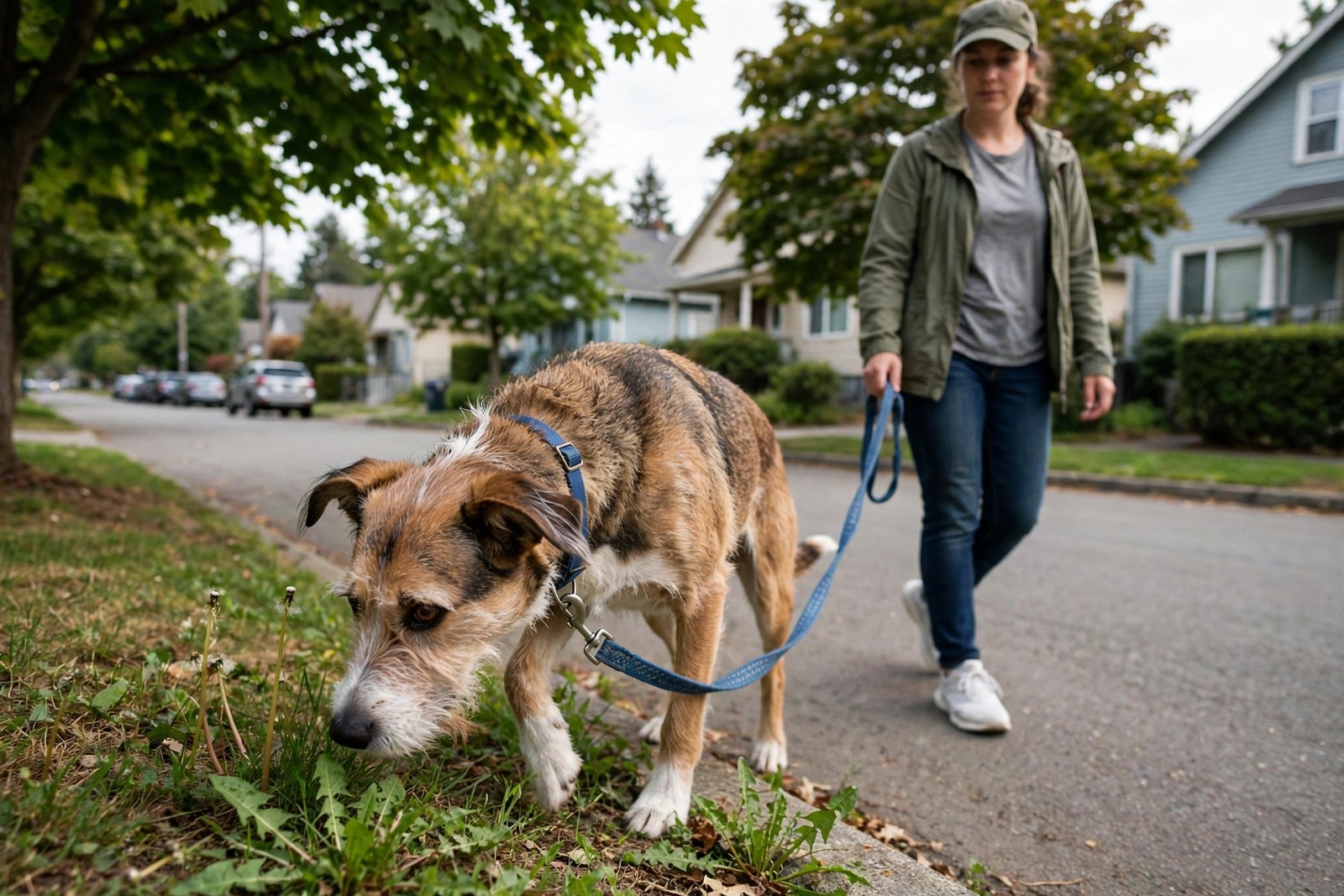
A newly adopted dog is learning your streets, your front-door routine and you, all at the same time. Resist the tour of the whole neighborhood in the first days. One short, quiet route, walked the same way each time, gives him a patch of the world he can predict, and predictability is what turns a vigilant walk into a relaxed one. Let him sniff as much as he wants on that first route: scent is how he maps the area, and a walk that looks slow to you is busy work for him.
The First Route: Short, Quiet and Repeated
Choose a loop or an out-and-back that takes roughly fifteen to twenty minutes at his pace, on streets with wide pavements and few surprises. Walk it at quieter times of day at first, avoiding school-run crowds, busy junctions and the park entrance where off-lead dogs gather. Keep the lead loose, reward him whenever he glances back at you or chooses to walk beside you, and cross the road early — before he reacts — when you see a dog, a jogger, a scooter or anything else that makes him stare, stiffen or pull. Turning for home while he is still coping teaches him that walks end well; pushing on until he is overwhelmed teaches him that walks are where overwhelming things happen. Keep the start identical every time too: same harness, same cue at the door, a moment of calm before you open it, so the walk begins predictably rather than in a scramble.
Expand One Street at a Time
Once he walks the first route with a loose lead, soft body and regular check-ins, add one new street, then return to familiar ground for the rest of the walk. That pattern — a short stretch of new inside a route he trusts — lets you widen his world without stacking new challenges. Learn the local map as he does: which garden fence has a dog who charges it, which corner is a blind bend, where the off-lead area begins, and which streets are quietest in the evening. Keep greetings with neighbours brief at this stage, rewarding him for disengaging, so other people do not become the main excitement of his new route. Vary the time of day only after the route itself is easy, because dusk changes sights and sounds even on familiar streets. If a new street proves too much — he pulls hard for home, stops scanning and enjoying smells, or reacts to things he would normally ignore — drop back to the previous route for a few walks and try the extension again later. Setbacks handled that way usually cost days, not the whole routine.
Different Walkers, Same Walk
An adopted dog settles faster when every person who holds the lead walks him the same way: same route until it expands, same cue words, same rule about crossing early for space, same reward for check-ins. Write the current route, the known worry spots and the turn-back signals down where everyone can see them, and note after each walk anything new he coped with or struggled with, because that log is how you decide when to add the next street. A dog walked by three people with three different routines learns three neighborhoods at once and relaxes in none of them. KinsLe's Care Teams lets you assign each walk to a named person with the current route and worry spots attached, and every completed walk is marked complete with a timestamp, so his neighborhood education stays consistent whoever clips the lead on.