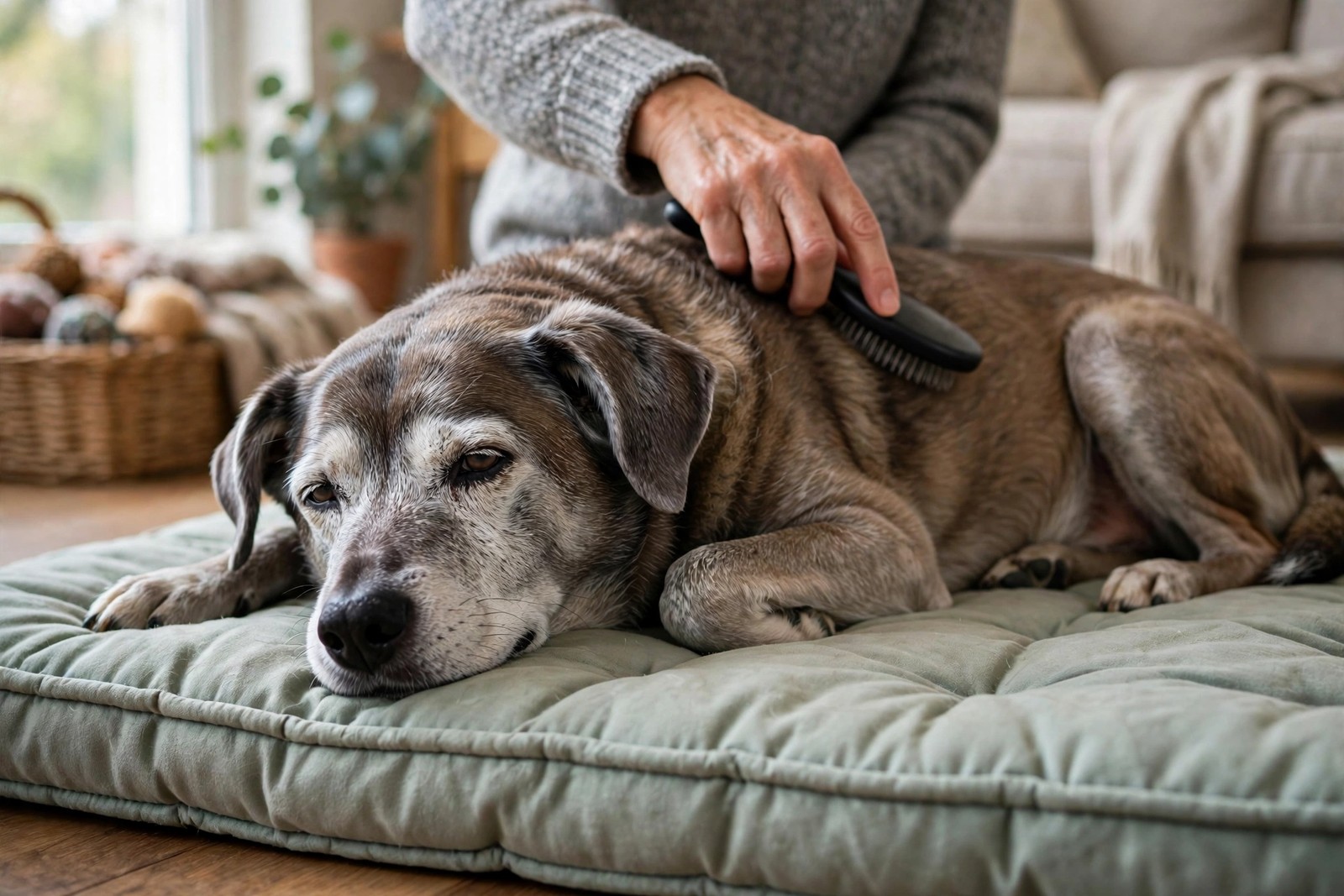
A senior dog that finds standing hard is not being difficult about grooming; she is rationing effort across joints and muscles that tire quickly and ache afterwards. Reshaping the groom around lying down, short instalments and genuine rest days keeps her tidy without asking her body to pay for a haircut. The measure of a session is how she moves the following morning, and the plan bends to that measure every time.
Set Up a Lying-Down Grooming Station
The owner grooms her where she already rests, on thick padding over a non-slip base at floor level, or on a low, stable platform she can step onto without jumping. A thick mat or folded bedding cushions bony elbows, hips and hocks, and the non-slip base matters once she shifts her weight, since a sliding mat under an unsteady dog ends the session and her trust together. The owner works on whichever side faces up: brushing, checking skin, trimming accessible hygiene hair and cleaning what can be reached, then lets her rise, move and resettle on her other side in her own time, or leaves the second side for the next instalment entirely. All tools, treats and a drink of water sit within the owner's reach before starting, so she is never left waiting mid-groom while somebody fetches scissors from another room.
Split the Groom Across Days
The owner breaks one traditional groom into instalments of a few minutes each, spread across several days: nails and paw hair on one day, a brush-through and skin check on another, ears and hygiene trim on a third. Each instalment ends while she is still comfortable, ideally before she asks for it to end, and a treat or a short sniff in the garden closes the session on her terms. The owner keeps a simple note of what was done and how she moved the next morning, since memory blurs across a week of small sessions and the note turns guesswork about session length into a plan based on her actual recovery. When a brief stand is unavoidable, for a rear trim or a quick rinse, the owner supports her weight properly, an arm or a broad hand beneath her ribcage or in front of her hips, keeps the stand to a brief useful span, and lowers her back to the mat between tasks rather than working through a list while she trembles. On a bad day for her, when rising itself looks hard and she seems flatter than usual, non-essential jobs are skipped without guilt; a missed brush harms nothing, while a forced session can cost her the next day.
Read the Following Day and Route Pain to the Vet
The owner watches her the morning after each instalment: how she rises, whether she hesitates at a step she managed yesterday, and whether she is stiffer than her usual baseline. Next-day stiffness is information, and the plan adjusts to it directly, with shorter instalments, longer gaps, or a job moved to a surface she finds easier. Grooming time is also inspection time, and new lumps, skin changes, sore spots or a sudden drop in mobility noticed under your hands are worth raising with the vet, since grooming is often where such changes surface first. Pain itself is never a grooming problem to work around silently; a dog that cries out, guards a leg or shows new reluctance to be handled in one place needs the vet, not a gentler brush. To keep the instalments from bunching up again, list each small job as its own duty in Care Teams, and KinsLe will show which helper finished which piece and when.