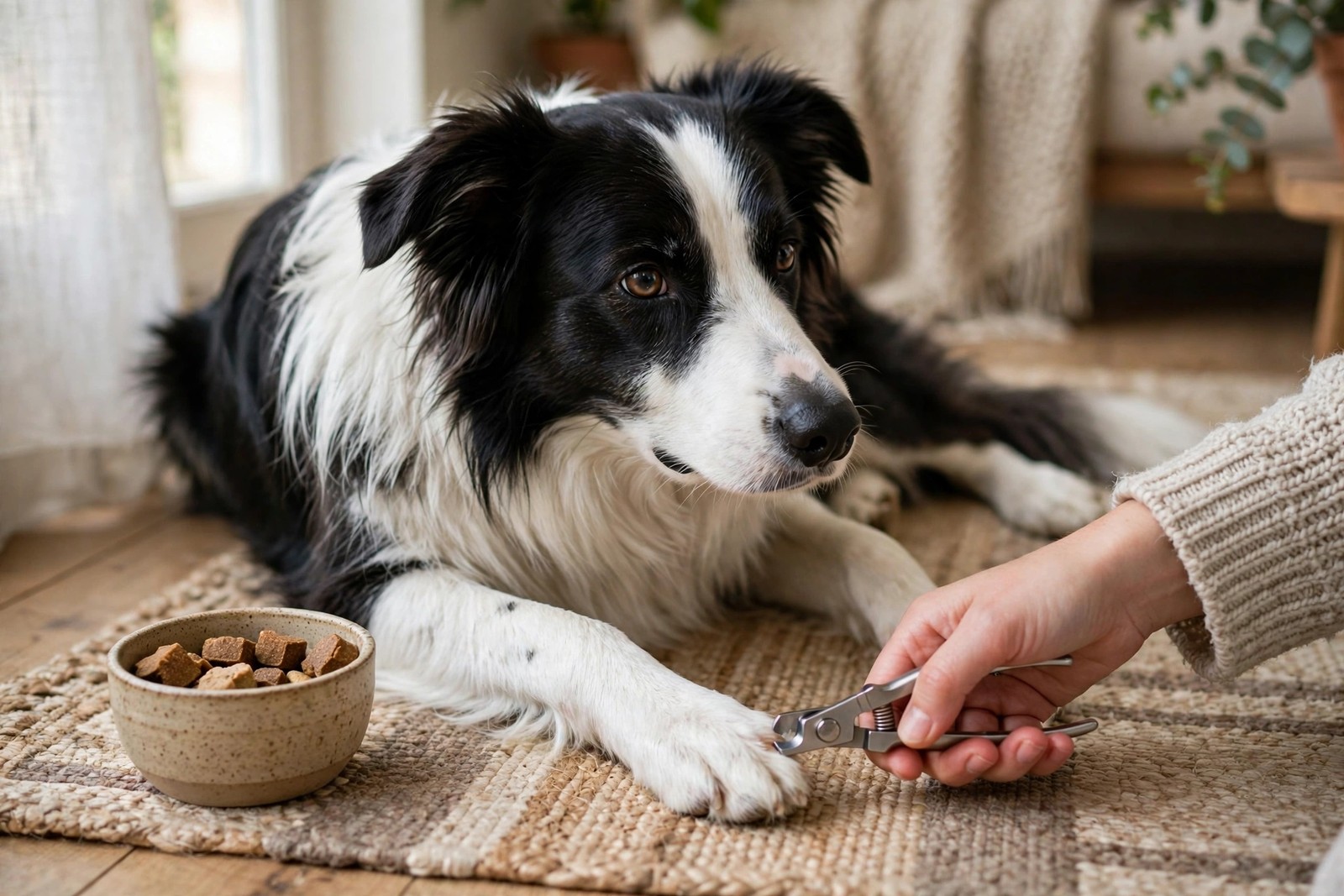
For most dogs, nails need trimming every two to four weeks. There is no benefit in waiting longer: nails grow continuously, and once they pass the right length they begin to change how the foot lands. Use the two-to-four-week window as your starting schedule, then adjust to your own dog using the clicking test below.
The clicking test and the weekly check
Stand your dog on a hard floor and listen as they walk. Nails that click or tap against the surface are too long today, whatever the calendar says. On a correctly trimmed dog standing still, the nails should just clear the floor. Build a five-second check into a weekly routine — lift each paw while your dog is relaxed, look at the length, and pay special attention to the dewclaws on the inner legs. Dewclaws touch nothing as the dog walks, so they never wear down naturally, and left alone they curl, sometimes growing into the pad itself. Front nails usually grow faster and wear less evenly than rear nails, so check all four feet rather than assuming symmetry.
Dogs walked daily on pavements wear their nails down and may stretch comfortably toward four weeks. Dogs exercised on grass, sand, or carpet get almost no natural wear and often need the two-week end of the range, as do puppies, small breeds, and older dogs whose gait has softened.
Why little and often beats rare and drastic
Inside each nail runs the quick, a living core of blood vessel and nerve. It grows out with the nail, which is why long-neglected nails cannot simply be cut back to ideal length in one session — the quick is in the way. Trimming a thin slice every week or two lets the quick gradually recede, so over a couple of months genuinely short, comfortable nails become possible. Take off small slivers at a time, stopping when the center of the freshly cut nail turns grey or pinkish, which signals you are nearing the quick. On dark nails, where the quick cannot be seen, that color change in the nail's cross-section is your most reliable guide.
If you do catch the quick, stay calm, press a little styptic powder or plain cornflour onto the tip, and give the dog a break and a reward. It looks dramatic, heals quickly, and happens to professionals too.
Making trims a non-event
Pair trimming with good things from the start: one paw, a treat, done, building to all four feet over several sessions for nervous dogs. A rotary file suits many dogs better than clippers because it removes length gradually and cannot take a painful chunk. Dogs who panic despite patient handling are better served by your veterinarian or a groomer doing the job — overgrown nails that alter posture, split, or curl into pads are a health issue, not a cosmetic one, and a vet should also see any nail that is brittle, discolored, or lifting from the bed.
Putting the weekly paw check and the fortnightly trim into KinsLe's Care Teams, with the task assigned and its completion timestamped, means the job is shared fairly and never left until the clicking starts.