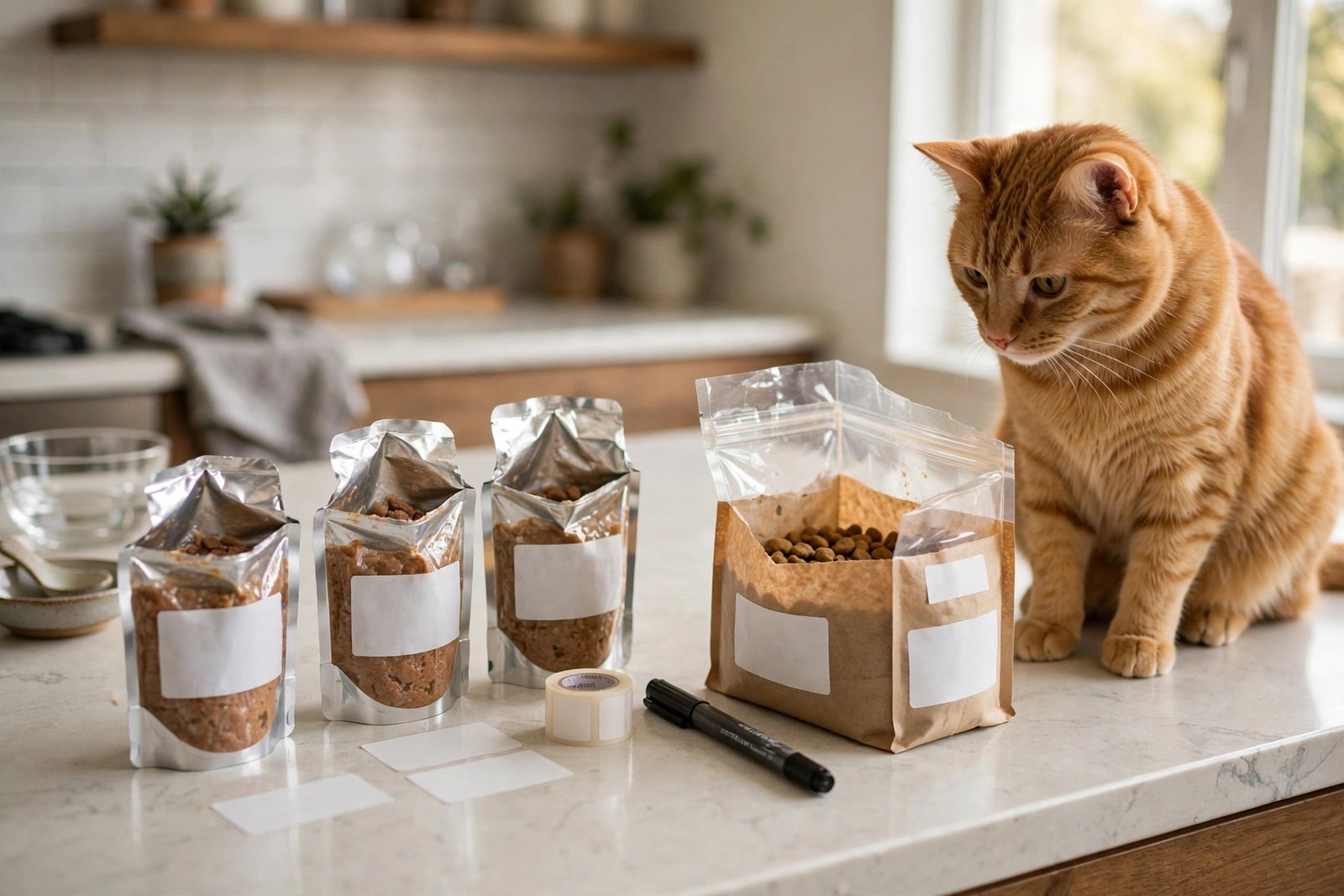
Stale food reaches a cat through ambiguity, not neglect. A pouch opened at some point, a bag whose opening day nobody remembers, a sitter making a reasonable guess at midnight: the food looks fine, so it gets served. A labeling system removes the guess entirely. It takes seconds per item and rests on one habit and one rule.
Marking the Day You Open It
Every opened pouch and every opened bag gets marked the day it is opened, with the date written on the item itself, in your own hand, in the same spot each time. On a pouch, write across the top or the back in a marker that survives the refrigerator; on a bag, write on the bag itself near the opening, not on a sticky note that migrates and not in a phone note the sitter will never see. The date travels with the food or it does not count.
Make the writing legible to a stranger: a clear day and month in plain figures, written large. If more than one cat or more than one food is in play, add the food's name beside the date, since two similar pouches opened on different days are the classic mix-up. Mark at the moment of opening, as part of opening, the way you reseal as part of serving.
Part-Used Pouches and Opened Dry Food
A part-used pouch goes into the refrigerator as soon as the meal is served, folded or clipped so the opening is closed, with its opening date already on it from the rule above. It is then used within the maker's printed guidance, which is the authority for that food; the guidance on the packaging, not a household habit, decides how long an opened pouch stays in use. When in doubt, the sitter rule settles it.
Dry food stays in its own bag rather than being poured into a bin or jar, because the bag carries the food's identity and its best-before information, and the bag is what you dated. Fold the top down and seal it with a clip after each serving, store the bag somewhere cool and dry, and keep the newest bag behind the one in use so the older bag is always used first, by position rather than by memory. Any container decanted from the bag carries the same opening date as the bag it came from.
The Sitter Rule
Hand the sitter one rule, stated plainly and with no exceptions listed, because exceptions are where stale food gets through. If it is not labeled and dated, it is not fed. Fresh food is opened instead, and the unlabeled item is set aside for you to judge when you return. Say the rule out loud when you hand over, point at the dates on the items in the cupboard so the sitter sees the system working, and make clear that opening a fresh pouch is always the right call, never a waste the sitter needs to apologize for. A sitter who trusts the rule feeds confidently; a sitter left to sniff and guess feeds anxiously and sometimes wrongly.
Writing the Convention Into the Packet
A labeling habit that lives only in your head resets every time a new sitter starts. Write the convention down where the cat's feeding instructions live: the date written on the item itself on opening day, part-used pouches refrigerated and used within the maker's guidance, dry food kept sealed in its own dated bag, and the sitter rule in its exact words. That written convention sits in the Pet Passport on KinsLe, the cat's records packet, alongside the feeding routine it protects, so the neighbor, the professional sitter, and the family member all inherit the same system rather than three versions of it. Update it once if your storage changes, and every future handover carries the current practice.
Any sitter opening the packet meets that convention on the first page, spelled out in the Pet Passport record on KinsLe, ready before the first meal is due.