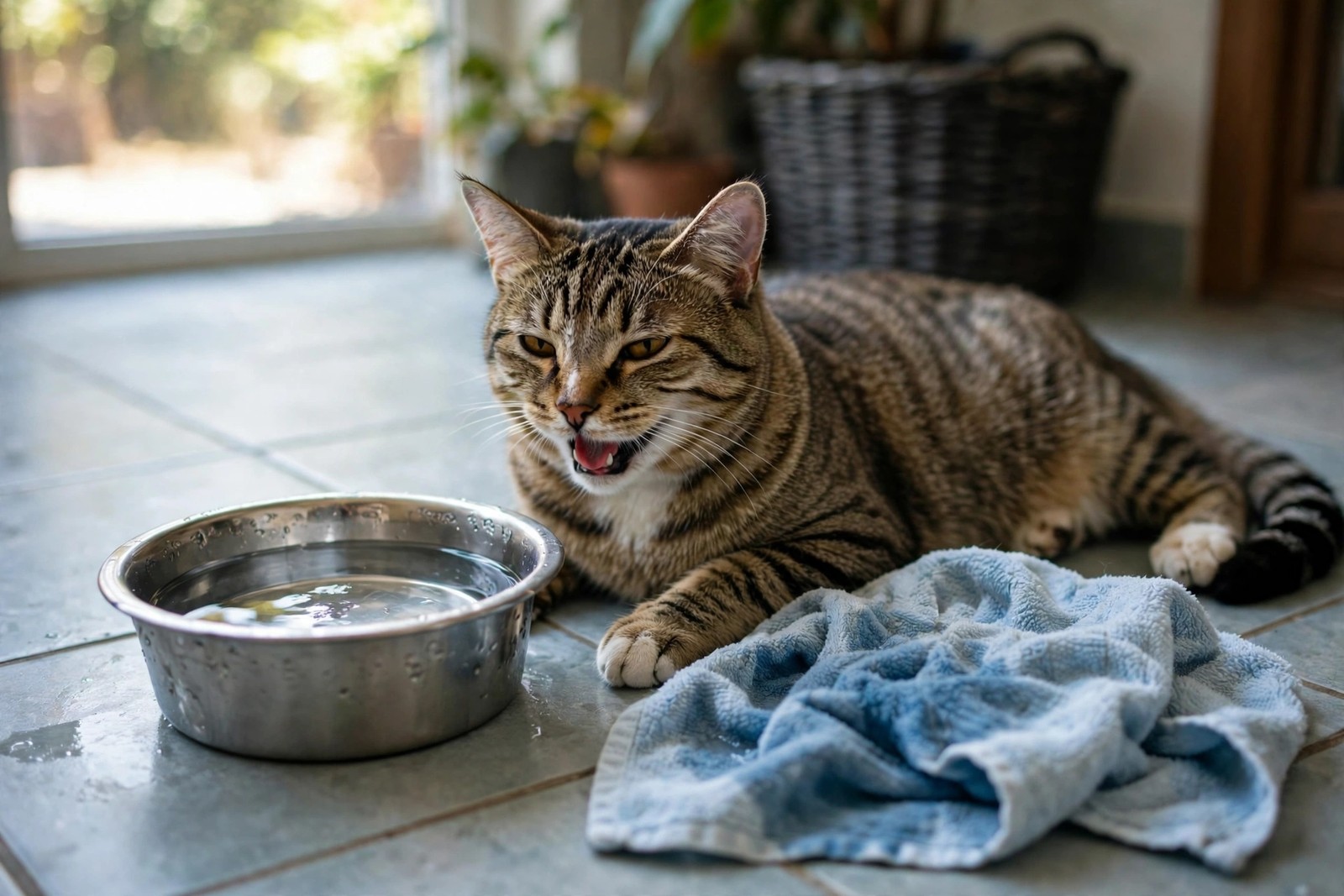
Cats evolved for warm climates and cope with ordinary summer days by sleeping through the heat, grooming more, and drinking a little extra. A heatwave overwhelms those quiet strategies faster than most owners expect, especially in stuffy rooms, sun-trap conservatories, and parked cars, where a cat's body temperature can climb past the point the body can correct. Heat stress is dangerous precisely because cats rarely dramatize it.
The Signs, in Roughly the Order They Appear
Panting is the headline sign because healthy cats almost never do it outside brief moments of stress: open-mouth breathing in a resting cat during hot weather is a red flag, not a curiosity. Alongside it, look for drooling, a restless cat who keeps changing position and cannot settle, ears and paws that feel hot to the touch, and a heartbeat you can see working through the chest. As heat stress deepens, the pattern flips: restlessness gives way to lethargy, the cat stops responding normally, vomiting may appear, and movements can turn unsteady. Dark red gums and glassy, unfocused eyes belong to the serious end of the sequence. Flat-faced breeds, older cats, kittens, and cats carrying extra weight typically reach trouble sooner, and a cat already unwell has less reserve, but no cat should be assumed immune during extreme heat.
First Steps That Help, and What Never to Do
Move the cat calmly to shade outdoors or to the coolest room in the home, away from sunlit windows. Begin gentle cooling with cool, not cold, water: wet the paws, ears, and belly, where heat escapes most readily, or lay a damp towel over the body and refresh it as it warms. Offer fresh water nearby and let the cat drink voluntarily; a fan or open window that keeps air moving across the cat supports every other step. Two prohibitions matter as much as the steps themselves. Never use ice or ice-cold water, because the shock can drive blood away from the skin and trap heat deeper, and never force water into the mouth of a cat who is weak or barely responsive, because it can enter the airway. Cooling is a bridge to veterinary care for a cat who is struggling, not a home cure that replaces it, so keep cooling while someone else calls ahead.
When It Is an Emergency
Some presentations skip the home steps entirely. If breathing looks labored, with visible effort, noise, or an open mouth that does not settle within minutes of cooling, or the cat collapses, cannot stand, or stops responding, treat it as an emergency and go straight to a veterinarian, continuing gentle cooling on the way if you can do it safely. If the cat needs that emergency trip, hand the clinic the timeline from the Pet Passport record on KinsLe: the signs you saw and the cooling already done help the veterinarian pick up exactly where your care left off.
Setting Up the Home Before the Next Heatwave
Prevention is mostly environmental. Keep at least one room as cool as the home allows, with curtains closed against direct sun, water bowls in several places rather than one, and a cool tile or shaded floor area the cat can choose freely. Never leave a cat in a parked car or a closed conservatory in hot weather, even briefly, and check that a cat has not slipped into a greenhouse, shed, or vehicle before closing doors during a heat spell. During the hottest hours, postpone active play, keep handling low-key, and check the cat more often than habit suggests, particularly an older cat or one with a flat face.
Heat stress rewards owners who act on the early, quiet signs rather than waiting for unmistakable distress, because a cat cooled during the panting stage usually recovers far more smoothly than one reached at collapse. Afterward, write the signs, timing, and cooling steps into the Pet Passport record on KinsLe so a future heat episode starts from evidence rather than memory.