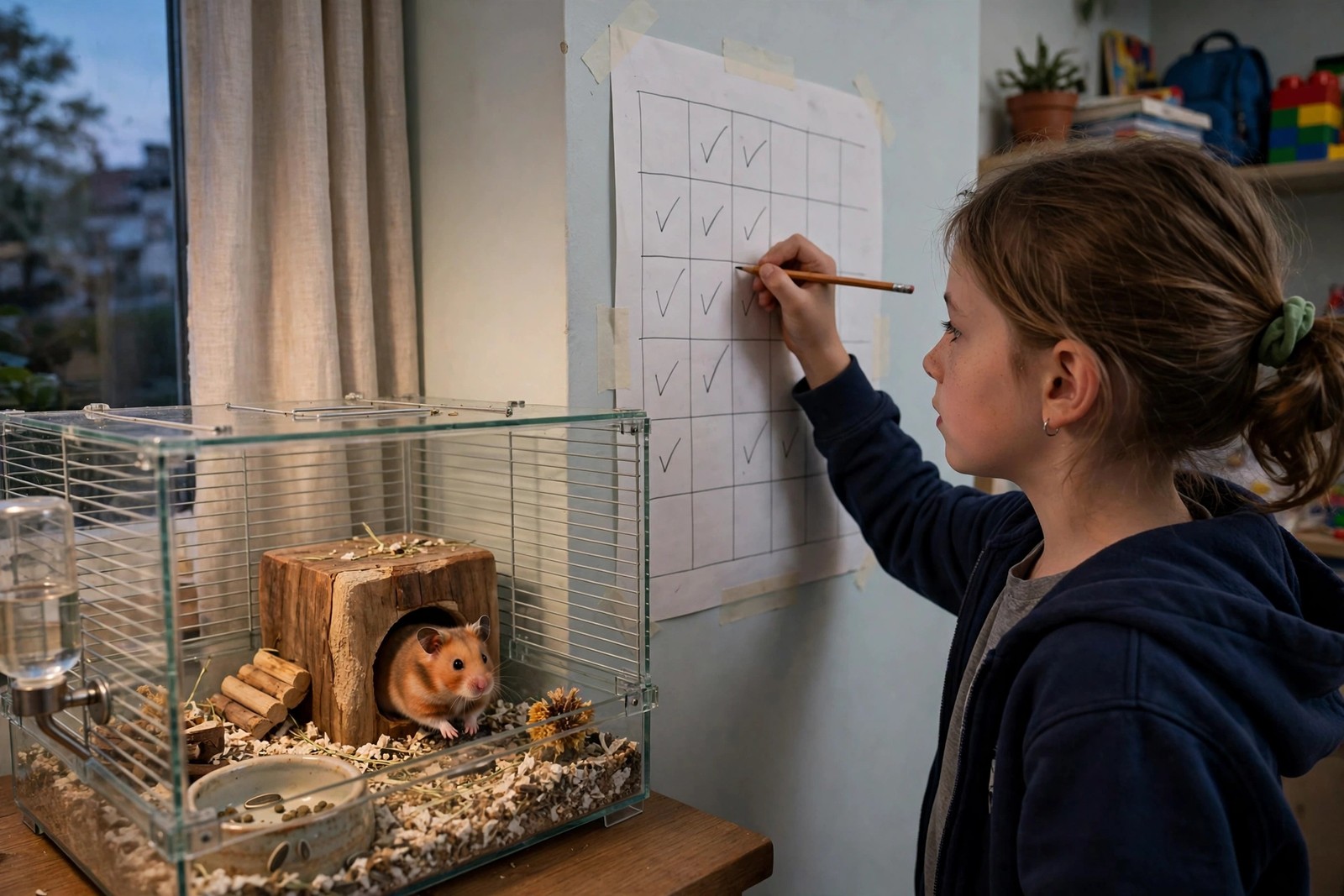
Shared care fails in a predictable place: each child assumes another child did it. The hamster gets handled three times in an evening and not at all for two days, the water bottle goes unchecked because everyone remembers someone checking it, and nobody can say whether he has been quieter this week because nobody wrote last week down. One visible log, built for small hands and short attention, fixes the whole pattern.
The Grid: A Row a Day, a Column a Job
Keep the format brutally simple — a notebook page or chart on the wall beside the cage, ruled into the same columns every day. Date. Cleaning: spot-clean done, full clean done, or neither needed, with initials. Handling: who held him, roughly how long, and how it went in a word or two — confident, wriggly, sleepy. Food and water: topped up or changed, initials again. Activity: one short line, and this column matters more than it looks. Children write what they observed that evening — on his wheel for ages, rebuilt his nest in the other corner, left his seeds untouched, out earlier than usual. Symbols and stickers work for younger children; the rule that makes it a record rather than a decoration is initials on every job, so 'done' always has a name attached and gaps are visible the same day, not at the weekend.
Fitting the Rota Around a Nocturnal Animal
Hamsters sleep through the day and work at night, so the rota has to respect the animal's clock or the log will record a week of disturbed, grumpy handling. Handling turns belong in the early evening when he wakes naturally — never a wake-him-up turn at lunchtime because it is someone's day. Cleaning splits into two rhythms children can learn: the daily spot-clean of the toilet corner and any wet bedding, and the bigger weekly clean, which is an adult-supervised job and a good one to rotate as a named responsibility. Food and water checks sit with the evening handling turn so the cage is visited once, calmly, rather than opened six times by six turns. Writing the rota as turns — Monday evening is yours — rather than as jobs floating free is what stops the popular tasks being done twice and the boring ones never.
Reading the Activity Column as an Early Warning
Over weeks, those one-line activity notes become the household's memory of normal: when he usually surfaces, how much wheel noise a normal night makes, how his hoarding and nest-building shift with the seasons. Against that baseline, changes stand out in a way no single evening reveals — three consecutive notes of 'didn't see him' or 'left his food' is information, and it is the moment an adult steps in and, if the quietness continues or he looks unwell, gets him checked by a vet rather than letting the log accumulate a fourth line. Show the children this is why the column exists; being the person whose note spotted something is a powerful reason to keep writing honest ones, including 'nothing different', which is a perfectly good entry.
The Adult's Weekly Five Minutes
Once a week an adult reads down the columns — not to grade the children, but to audit the system. Are full cleans actually weekly? Did handling spread fairly, or did one child do nearly all of it while another only ever feeds? Is the activity column being written, or decaying into identical ticks? Fix the rota, not just the omission: swap turns that clash with clubs and homework, and re-teach any job being done sketchily. Paper beside the cage works, but it stays in one room and one house; KinsLe's Care Teams carries the same grid digitally — each cleaning, handling, and food duty assigned to a named child, marked complete with a timestamp when done, so a parent can see the week's care at a glance and the hamster's routine survives sleepovers, split households, and busy weeks.