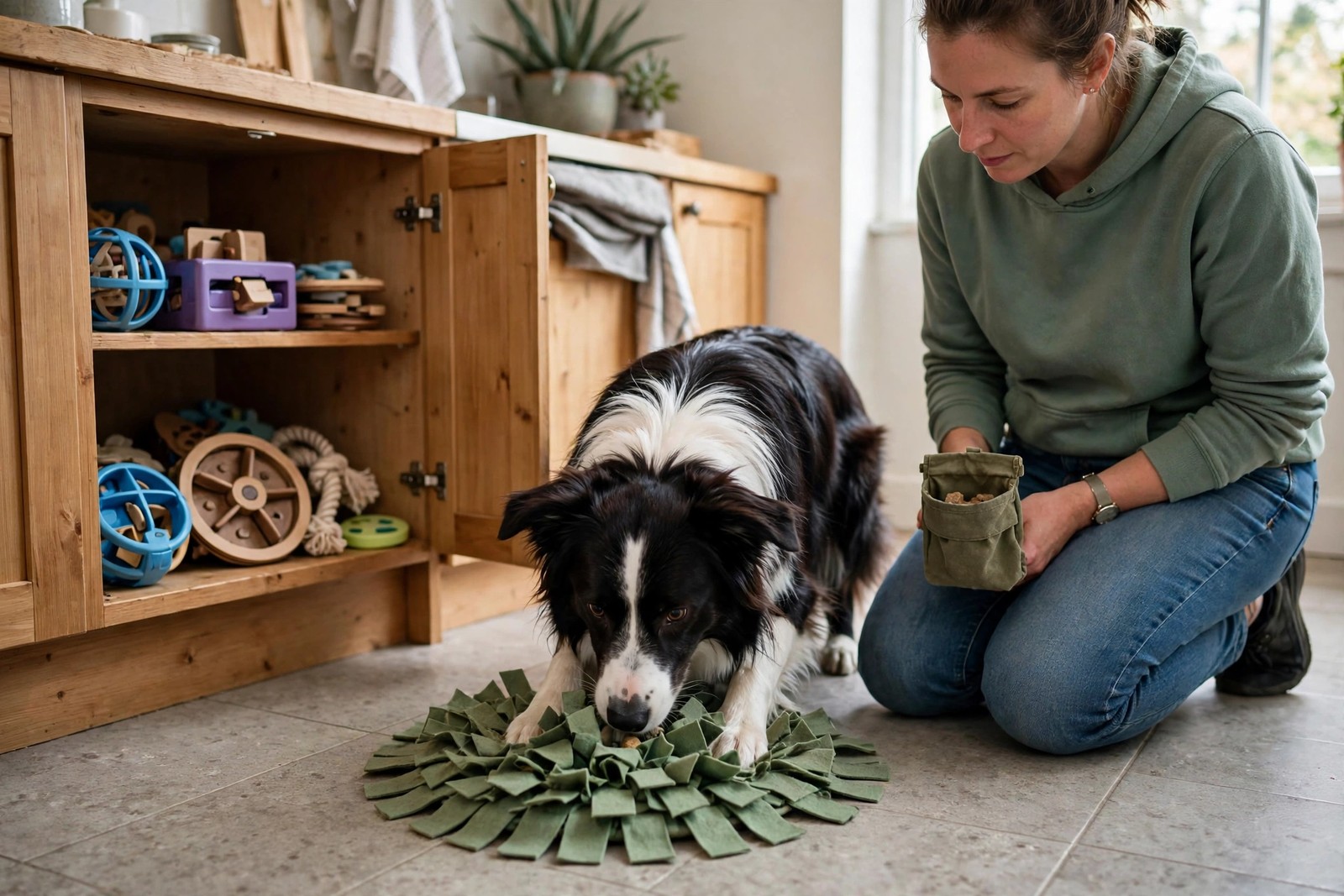
A dog who empties every puzzle in minutes is rarely too clever for puzzles. More often, the same three toys appear in the same order, filled the same way, so the dog has memorised a routine instead of solving a problem. Rotation works on two axes: which toy or game is offered, and how hard that toy is set on the day. Change both, and even a modest cupboard of toys stays interesting for months.
Build a Library With Real Variety
Aim for eight to twelve items across different kinds of work, because each kind asks a different question. Licking mats and frozen stuffed food toys reward slow, settled licking. Sliding and lifting puzzles reward paw and nose problem-solving. Snuffle mats, rolled towels and cardboard box searches reward sniffing and shredding. Scatter feeding in grass and muffin-tin games covered with balls reward patient searching. A dog who has mastered sliding lids may still work happily for twenty minutes over a frozen fill, because the skill is different.
Store the library out of sight in a closed cupboard. A toy that lives on the floor all day becomes furniture; a toy that appears after several days away, carrying food smells, becomes an event.
Run the Rotation Week
Offer one puzzle or sniffing game per main meal slot, and never more than two puzzle toys at once. A simple pattern works well: a sniffing game on Monday, a frozen food toy on Tuesday, a sliding puzzle on Wednesday, a scatter hunt on Thursday, a towel roll on Friday, a lick mat on Saturday and a box search on Sunday, then start the week again with different fills. On that weekly cycle each item rests six days between appearances, inside the four-to-seven-day range. Keep a brief note of what was offered and how long it lasted. If a game drops below two minutes twice in a row, rest it for three to four weeks instead of escalating it daily, and bring it back later at a fresh difficulty.
Raise difficulty inside the toy in small, fair steps. For a stuffed food toy, move from loose kibble to a dampened fill, then to a fill frozen for a few hours. For a towel roll, add one extra fold, then tuck the roll inside a box. For scatter hunts, spread the same amount of food over a wider patch of grass. Change one step at a time, and drop back a step if your dog walks away, whines, or starts biting at the toy, since those are signs the jump was too big.
Protect the Ration and the Toy
Measure puzzle food out of the daily ration rather than adding it on top, so enthusiasm does not quietly become weight gain. Wash food toys and lick mats after each use, check rubber and plastic for tooth damage, and throw away any piece a dog could bite off and swallow. Supervise new puzzles until you know whether your dog solves them or tries to dismantle them, and take the toy away calmly once the food is gone so chewing the empty toy never becomes part of the game.
End each session while your dog is still engaged, not after interest has died, and let the dog choose between two rested options once or twice a week; the choice itself is enriching, and the rejected option tells you what to rest longer. In KinsLe, Care Teams keeps that system shared: the person feeding can see which game is due, mark the prep done with a timestamp, and leave the solve time for the next person to beat.