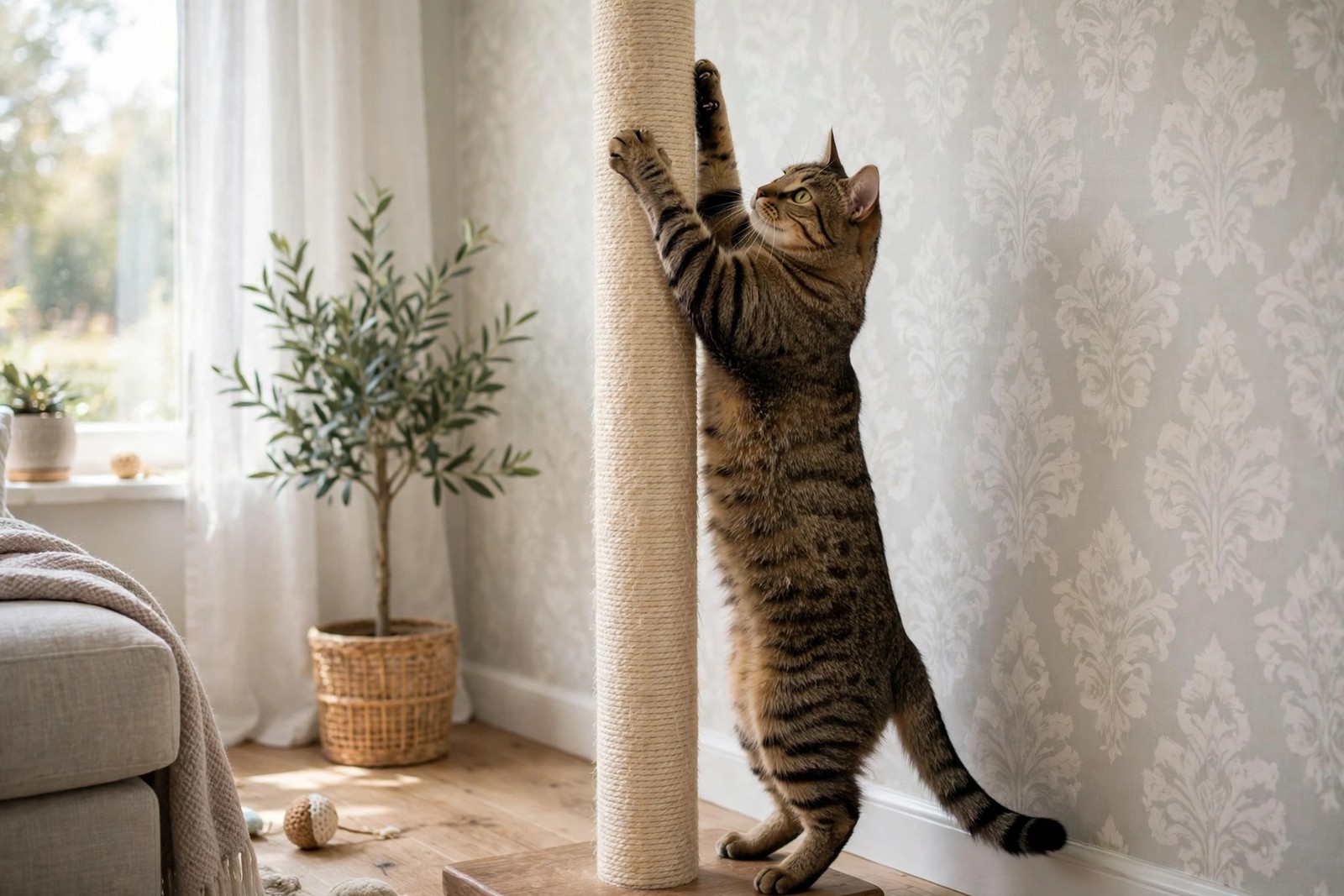
Wallpaper loses to a cat for a simple reason: it is vertical, grippy, and located exactly where she wants to scratch. Scratching is not vandalism. It strips the worn outer sheath from her claws, stretches her shoulders and back, and deposits scent from glands between her toes, which is why she returns to the same successful spot. Punishing her teaches her only to scratch there when you are out, so the workable plan is to make a better offer in the same place and make the paper itself less appealing.
Put the Post Where the Damage Is
Place a scratching post flush against the very corner or wall section she already uses, not in a tidy corner of another room where you would prefer it. The post must be tall enough for her to stretch at full length with her front paws high, and heavy or wide enough at the base that it does not wobble when she leans her weight into it, because a post that tips once is a post she may never trust again. Sisal-wrapped posts suit most wallpaper scratchers since the fibres give the same resistance as paper over plaster. If she ignores the new post, check two things before buying another: whether it wobbles, and whether she actually prefers a horizontal surface, in which case a flat scratcher laid at the base of the same wall is the honest answer.
Make the Wallpaper the Worse Option
While the post earns her loyalty, protect the paper. A smooth, clear panel fixed over her favourite section removes the grip her claws need, and she will usually test it twice and give up. Double-sided deterrent tape works on the same principle, since most cats dislike a sticky surface under their paws; replace it as it collects dust and loses its feel. Keep these covers up for several weeks after she has switched to the post, because removing them the first good day invites a relapse, and re-covering a re-damaged wall helps nobody. Trim her claws regularly during the retraining weeks too, a few at a time with proper cat nail scissors, so any stray scratching does less harm while the new habit forms.
Redirect Every Time, Reward Every Success
When you catch her raising her paws to the paper, interrupt calmly, lift or lure her the short distance to the post, and scratch the post with your own fingers to draw her in. The moment her claws go into the post instead, reward her with praise, a small treat, or a short play session, whichever she values most. Rubbing a little catnip into a new post, or dangling a wand toy against it, helps early sessions along. Expect the switch to take two to four weeks of total consistency, and expect her to test the old spot occasionally; a calm redirect, not a telling-off, is what closes the question. If a cat who never scratched walls suddenly starts and also seems restless or unwell, a vet check is worthwhile, since new behaviour in an adult cat sometimes has a physical cause. KinsLe's Family Sharing keeps the post's location, the cover plan, and the redirect-don't-punish rule visible to everyone in the home, so your cat gets one clear message about the wallpaper from every person she lives with.