
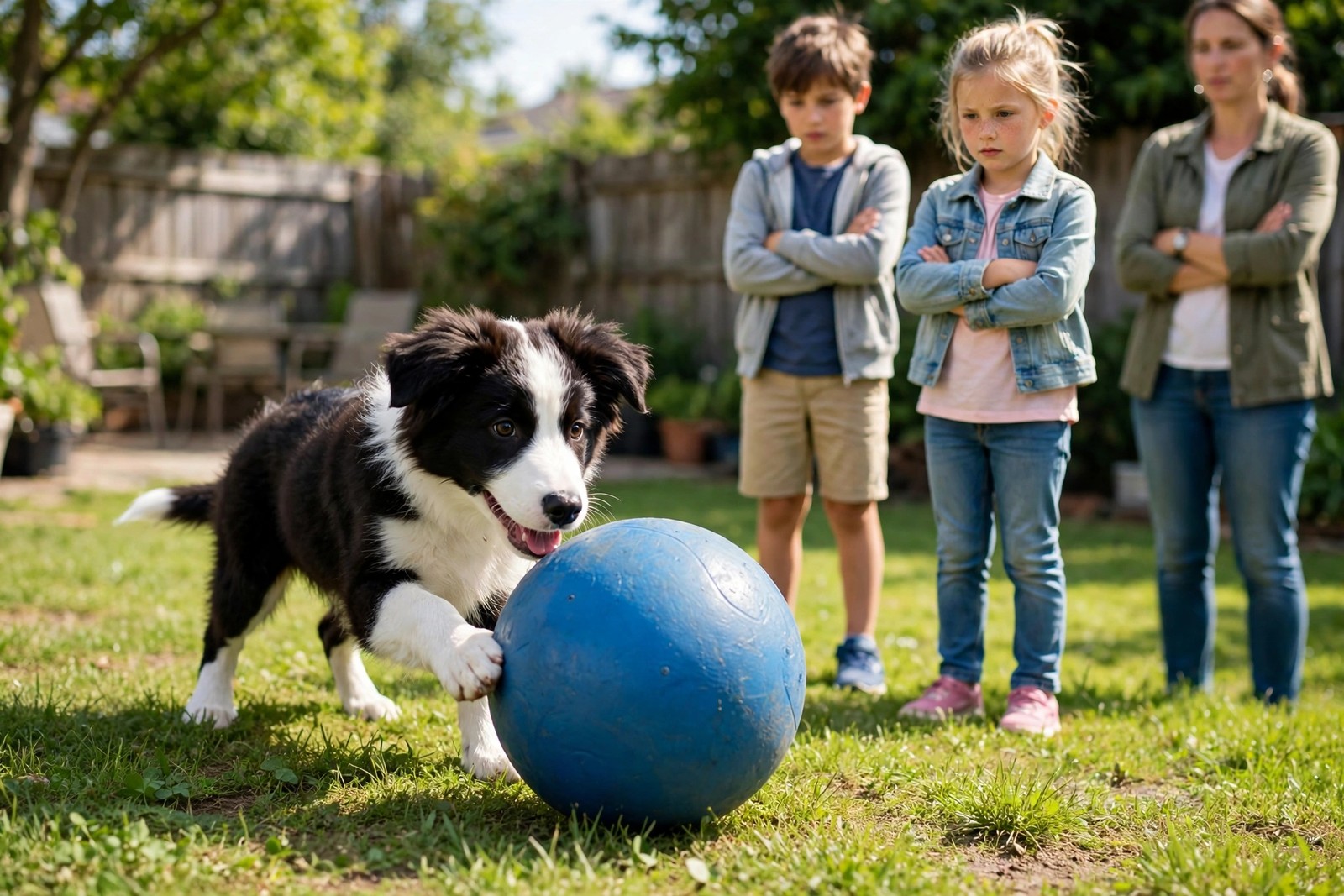
A herding-breed puppy who rounds up your children, barks at their heels, and grabs at ankles is doing precisely what generations of selection built them to do. Movement triggers the sequence — eye, stalk, chase, nip — and nothing on earth moves more like livestock than a small child running, flapping, and squealing at puppy height. You cannot train the instinct out, and you should not try to punish it out. You manage the triggers, you interrupt the rehearsal every single time, and you give the drive a better job.
The Freeze Rule for Children
The chase only pays while the "sheep" keep running. Teach your children one simple response and practise it as a game when the puppy is calm: the moment the puppy starts circling, chasing, or nipping, stop, stand still, fold your arms, look at the ceiling, and go quiet — statues are boring. Running away, kicking out, pushing the puppy, and high-pitched squealing all pour fuel on the sequence; a puppy whose nip produces a squeal and a sprint has just been paid in full. Young children cannot always remember this mid-excitement, which is exactly why the next rule is non-negotiable.
Adults Supervise, Redirect, and Enforce Rest
Puppy-and-children time is supervised time, with an adult close enough to step in — not watching from another room. Your job is to redirect before the nip, not after: read the early signs (the fixed stare, the crouch, the circling to get behind the children) and interrupt with a cheerful call, then throw a toy, start a tug game, or roll a large herding ball your puppy can push and chase instead. A long toy or flirt-style pole toy keeps arousal on an object and your children's heels out of the equation. If redirection fails twice, the session ends calmly: puppy behind a gate with a chew, children elsewhere. Tired and over-aroused puppies herd and nip far more, so enforced naps in a crate or pen are part of the training plan, not a break from it.
Starve the Rehearsal
Every completed chase-and-nip makes the next one faster. That means no games where children run from the puppy, no encouraging the puppy to "round everyone up" for laughs, and no rough wrestling that ends in grabbing clothes. Use gates and leads indoors during busy, exciting periods — after school, birthday energy, visitors arriving — so the puppy literally cannot practise on moving children. Structured, calm interactions are what you want repeated: children sitting to hand-feed treats, gentle stroking while the puppy chews a toy, short training games where the puppy sits and downs for the kids under your eye.
Some herding drive aimed at a big ball, a training class, and eventually, for keen families, organised herding or dog sports gives the instinct a real outlet and often settles the household behaviour noticeably. If nipping is hard-mouthed, increasing, or paired with growling over toys or food, bring in a qualified force-free trainer early rather than waiting for the puppy to grow out of something they are currently practising daily.
Sharing supervision in planned turns keeps the rules identical for every play session, and KinsLe Care Teams lets you assign who is on puppy watch, who is running the redirect game, and when nap breaks happen, each task confirmed with a timestamp.