The two scenes look like two different dogs, but they are one dog in two different geometries. At the park, your dog can approach, greet, play, or drift away, and social encounters resolve themselves in seconds. At the fence, your dog gets the full sensory announcement of another dog, sight, sound, and scent, at the one place that is most your dog's own, with a barrier that makes resolving the encounter impossible. Blocked social urges at a territory boundary are the exact ingredients of barrier frustration.
How the Fence Builds the Frenzy
Fence barking is a duet, not a solo. Your dog barks, the neighbor's dog answers and charges the boundary from the other side, each dog's arousal confirms the other's, and the pair escalate together in a way neither would sustain alone at the park. The fence also strips out the tools dogs use to calm encounters: a loose dog can curve its approach, look away, sniff the ground, or simply leave, while a fenced dog can only face the trigger head-on at full intensity, often running the boundary to keep the other dog in view.
Rehearsal locks it in. If this performance happens every time the neighbor's dog is let out, the first footstep in the next yard becomes a starting pistol, and your dog is at full pitch before the other dog even reaches the fence. The behavior is not a verdict on your dog's sociability, as the park proves daily; it is a habit welded to one location and one barrier.
Why the Park Picture Is So Different
At the park there is no territory stake, because the ground belongs to nobody, and no barrier, because meetings complete. Your dog can read whole bodies instead of partial views through slats, can use distance freely, and can choose indifference, which many dogs choose when they are allowed to. Choice is the sedative the fence removes. That contrast is genuinely useful information: it tells you the problem is the fence setup, not a dog who needs socializing, and it tells you the training target is the boundary, not dogs in general.
Screening, Supervision, and a Recall Worth Leaving For
Cut the visual fuel first. Screening along the shared fence, with planting, a second offset fence line, or opaque fence covering, so the dogs can no longer sight each other through slats, lowers the starting temperature of every encounter; sound and scent remain, but the staring match that ignites the run is gone. While training is young, supervise garden time rather than leaving your dog out alone to rehearse, and bring your dog in calmly at the first boundary run rather than after the full performance. Agreeing let-out times with your neighbor, so the dogs are not routinely out together, is a perfectly respectable interim measure while you train, not a surrender.
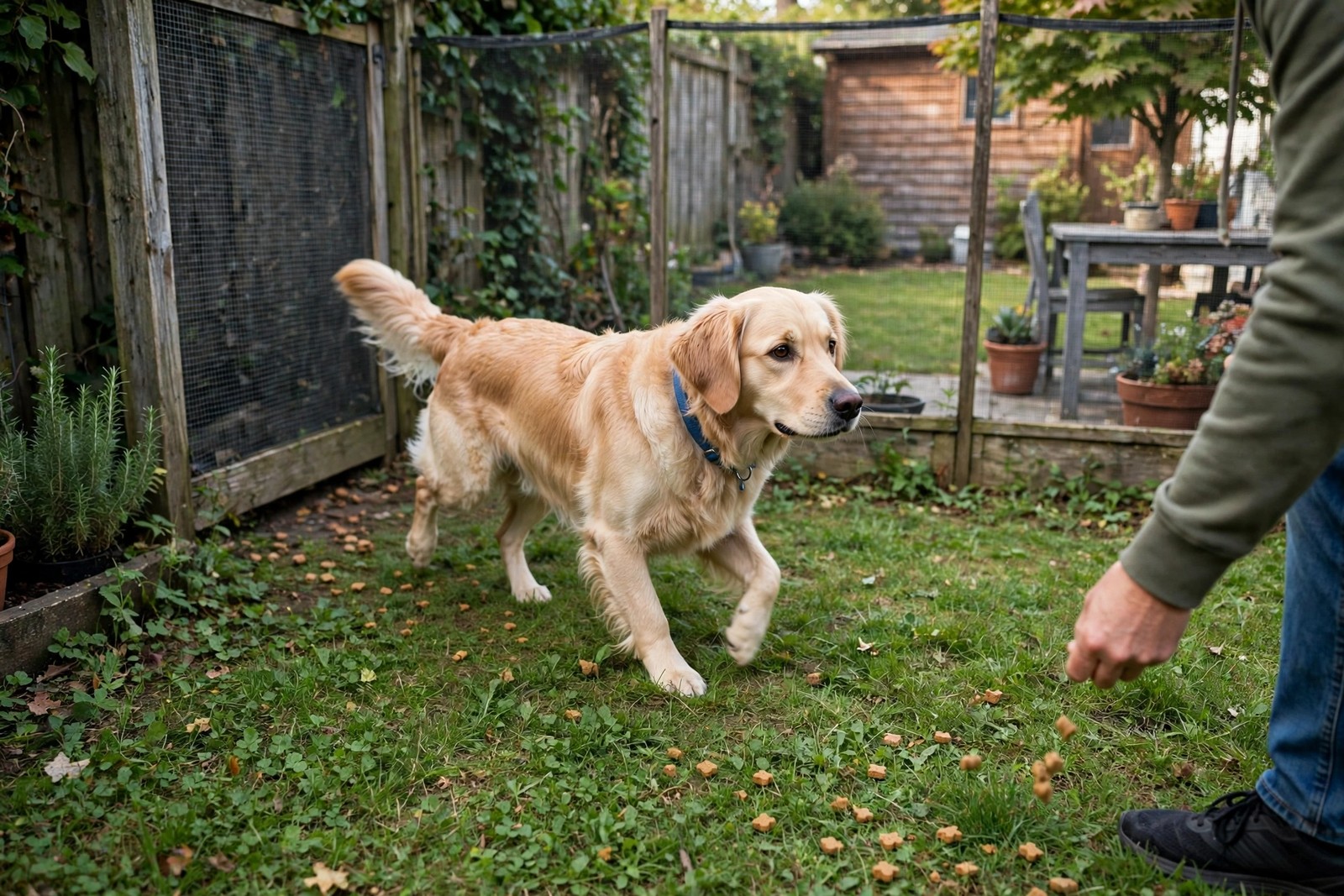
Train the recall away from the fence as its own skill: call your dog mid-interest at increasing levels of distraction and pay with genuine jackpots, scattered food to hunt in the grass away from the boundary, or a favorite game that only happens for fence recalls. If relations with your neighbor allow it, parallel walks together on neutral ground, both dogs moving in the same direction at a comfortable distance, often defuse a fence feud remarkably well, because the dogs finally get to complete a normal, boring social picture of each other. Take care at peak frenzy not to grab a collar or step between two fence-running dogs, because arousal that high can redirect onto the nearest hand; recall, scatter food indoors, or wait for a lull instead. With KinsLe Care Teams, you can assign supervised garden slots and short fence-recall practices across the household, each marked complete with a timestamp, so your dog is never left out alone to rehearse by one person while another trains.