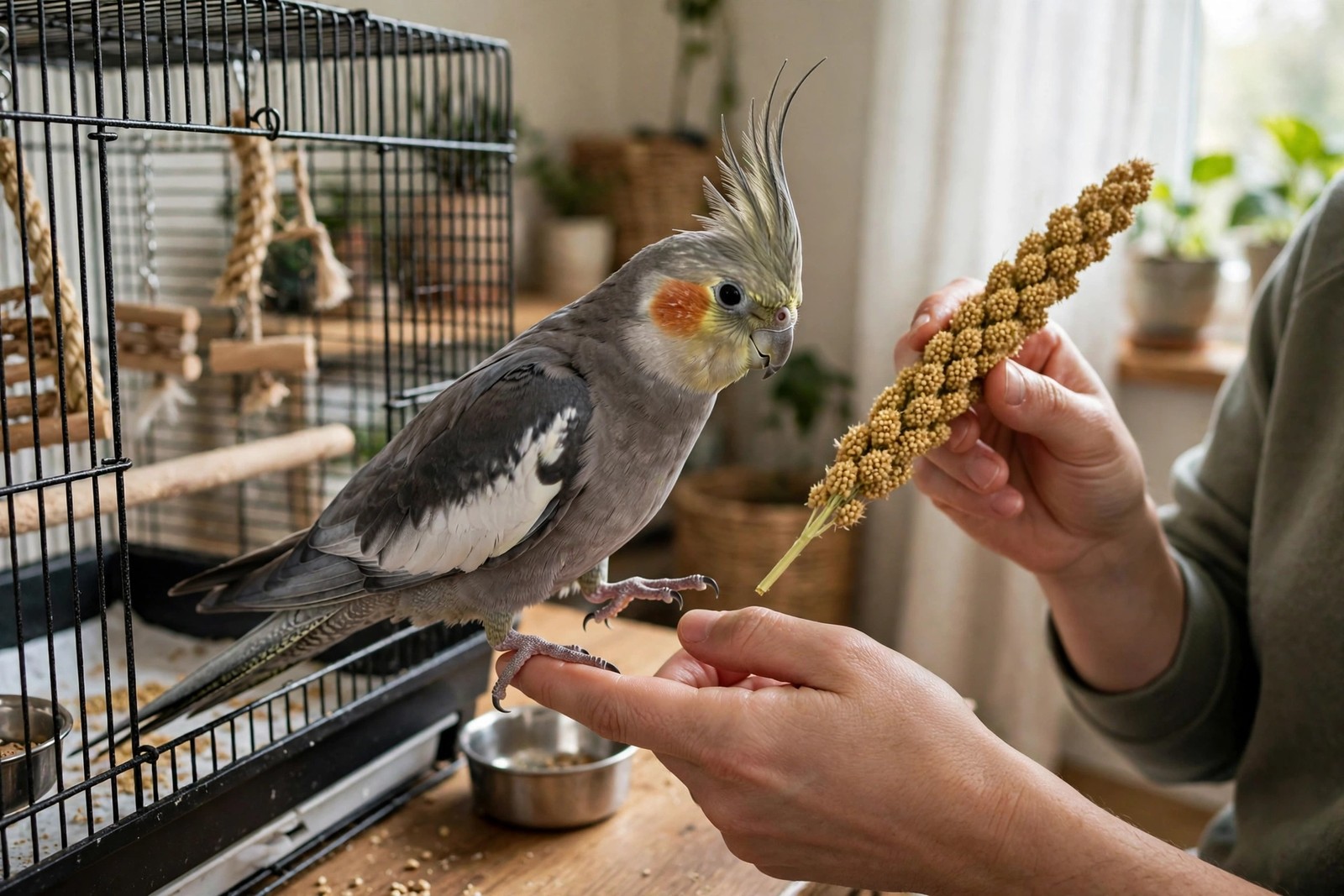
Cockatiels are gentle, flock-oriented birds that tame readily when the human behaves like a trustworthy flock member: visible, predictable, unhurried, and never swooping in from above. Most taming failures come from rushing — grabbing to "get the bird used to it" — which teaches exactly the fear the owner was trying to skip. Plan on days of simply being around the cage before hands feature at all, and weeks before you have a bird who actively seeks you out.
Settle In and Become Familiar
Give a new cockatiel a few days in a quiet corner of a lived-in room — visible to household life but not in the thick of it — with food, water, and a consistent day and night rhythm. Sit nearby reading or working, talk and whistle softly, and let the bird study you. Cockatiels are excellent whistlers and often answer a simple repeated tune before they accept anything else from you; a bird who whistles back, eats, preens, or grinds its beak in your presence is relaxing. Change food and water with slow movements, narrating what you are doing, and avoid staring fixedly, which reads as predator attention.
Hand-Feeding and the Low Approach
Once the bird is calm with you nearby, offer a spray of millet or a favourite seed through the bars, then at the open door, and finally from inside your palm's neighbourhood, letting the bird close the final distance itself. Two rules govern every approach. First, come from below or the side, at or under the bird's eye level: a hand descending from above is a hawk shadow, and cockatiels react accordingly. Second, move slowly and let the bird watch the hand coming — no sudden appearances beside the perch.
Step-Up, and Reading Stop Signals
With the bird comfortable taking food near your hand, present a finger or perch horizontally just in front of its feet and apply the lightest upward pressure against the lower belly while saying "step up." Reward the first clumsy step immediately with millet and praise, and set the bird back down before it wants off, so stepping up never becomes a trap. Cockatiels announce their limits clearly: a hiss, an open-beaked lunge, a crest pinned flat, or backing away all mean stop, withdraw calmly, and retry in a later session. A crest standing tall and curious, by contrast, usually signals interest. Respecting the hiss is not spoiling the bird; it is how the bird learns you listen, which is the entire basis of tameness. Keep sessions to a few minutes, several times a day, and never chase the bird around the cage to start one.
A cockatiel who was parent-raised and unsocialised will simply need longer at each stage than a hand-raised youngster, and an older bird may always prefer shoulder-sitting and whistling duets to being held — work with the bird you have. Sudden tameness changes in an established bird, with appetite loss or drooping posture, warrant an avian veterinarian rather than more training.
Identical cues and limits from every person stop a cockatiel getting mixed lessons, and KinsLe Care Teams lets you assign each day's sitting, hand-feeding, and step-up practice to named family members, each session timestamped so progress is easy to track.